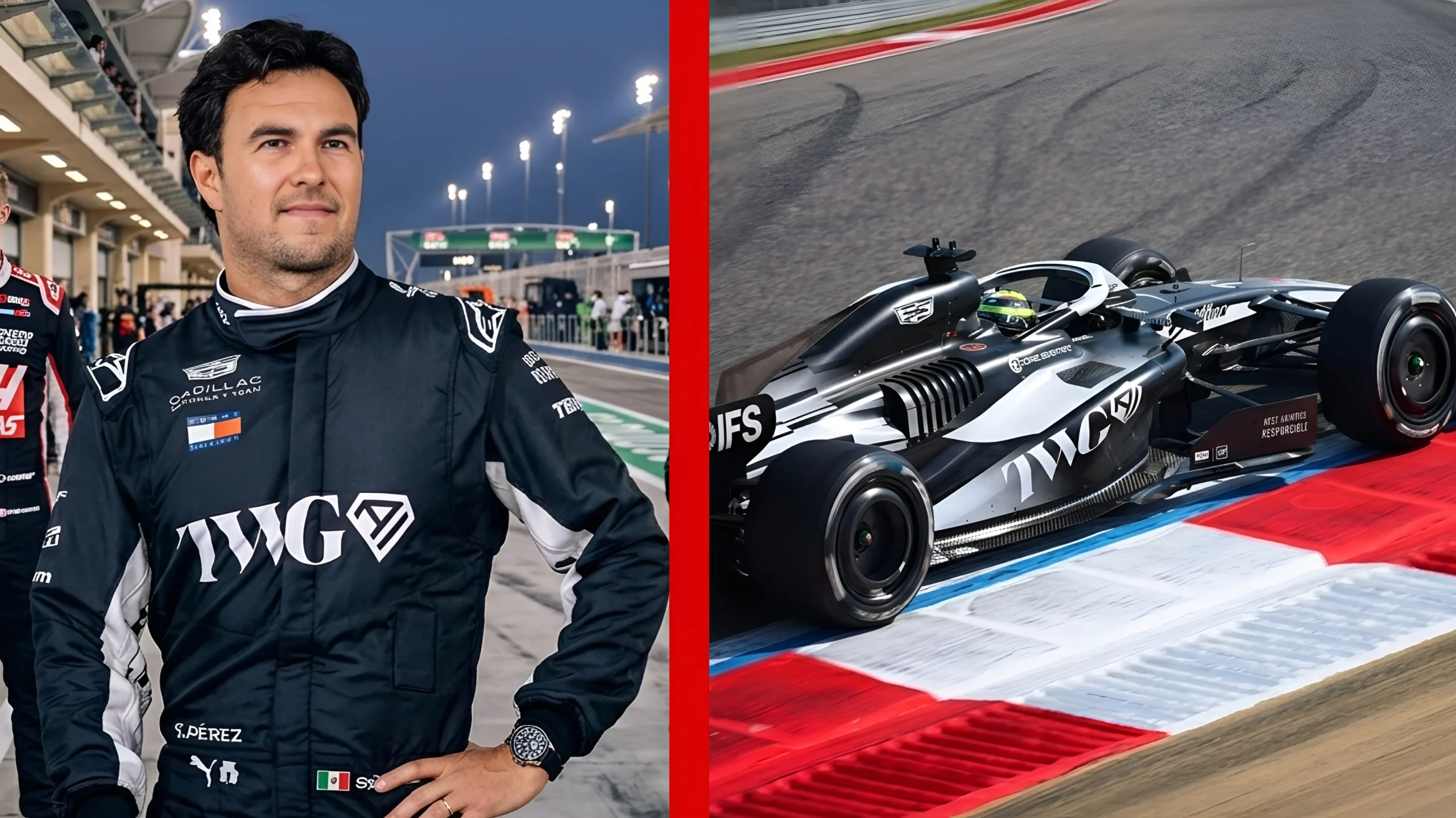
Veteran Leadership: Sergio Perez will lead Cadillac Racing’s technical debut of its high-downforce aerodynamic package at the demanding Suzuka Circuit this weekend.
Published by: AutodromeF1 Editorial Team
Sergio Perez Issues Measured Warning as Cadillac Prepares High-Downforce Aerodynamic Debut at Suzuka for Japanese Grand Prix
London. 26 March – As the 2026 Formula 1 season progresses into its third round, Cadillac Racing confronts one of its most exacting tests yet. Veteran driver Sergio Perez has delivered a candid and strategically grounded assessment, underscoring the inherent risks associated with debuting the team’s new high-downforce aerodynamic package at the legendary Suzuka International Racing Course. The Japanese Grand Prix, long regarded as a definitive benchmark for chassis balance and aerodynamic fidelity, demands precision that few circuits can rival. For a fledgling outfit still acclimatising to the complexities of the 2026 regulatory framework, this weekend represents far more than a routine race—it is a crucible of engineering validation and operational resilience.
Perez’s caution is neither alarmist nor defeatist; rather, it reflects the accumulated wisdom of a driver who has contested more than 250 Grand Prix starts and understands the unforgiving nature of high-speed, directionally demanding layouts. Suzuka’s 5.807-kilometre configuration, with its rapid elevation changes, sweeping esses, and the notorious 130R corner, places extraordinary emphasis on aerodynamic stability across a broad speed range. The introduction of Cadillac’s high-downforce specification—optimised for enhanced mechanical grip and downforce generation in medium- and low-speed sectors—carries the potential for unforeseen imbalances when transposed onto a track that rewards neutral handling and minimal drag in its high-velocity sections.
Circuit Demands and Aerodynamic Transition Risks
The technical transition to higher downforce levels is never trivial, but at Suzuka it assumes heightened significance. The circuit’s Sector 1 features the technically intricate first sector with its combination of slow- and medium-speed corners, where increased downforce should, in theory, yield lap-time gains through superior traction. Yet the subsequent high-speed flows in Sectors 2 and 3—characterised by the Esses, Spoon Curve, and the daunting 130R—expose any aerodynamic inefficiency instantly. A package that generates excessive drag or induces instability under load could compromise corner exit speeds, tyre management, and, crucially, driver confidence.
Perez’s warning aligns precisely with this dynamic. The Mexican driver, who has previously secured podium finishes at Suzuka during his tenure with Red Bull Racing, possesses intimate knowledge of the circuit’s nuances. His perspective is informed by direct experience: the same layout that once rewarded aggressive setup choices under previous regulations now serves as a severe audit for Cadillac’s nascent 2026 machine. Early indications from pre-season testing and the opening rounds suggest the team’s baseline performance is competitive in certain windows, yet the leap to a high-downforce configuration introduces variables that only on-track data can resolve. Setup iterations during free practice will therefore be critical; any misalignment between wind-tunnel predictions, simulation models, and real-world behaviour could result in compromised qualifying and race pace.
Recent Momentum: A Foundation for Measured Optimism
Cadillac’s progress, though incremental, has been tangible. At the Chinese Grand Prix, the team achieved its maiden two-car finish in the championship, with Valtteri Bottas crossing the line in 13th position and Perez in 15th. The result was hard-earned, coming despite early-race contact between the two drivers that could easily have ended in retirement for one or both. This double-points-scoring effort—albeit modest—enabled Cadillac to consolidate 10th place in the Constructors’ Championship, capitalising on Aston Martin’s double retirement. In the context of a new entrant operating under the most radical technical overhaul in decades, such consistency represents a meaningful step forward.
The Chinese weekend also doubled as a Sprint event, adding further layers of operational complexity. Both drivers navigated the compressed schedule with professionalism, extracting maximum value from limited running. Perez’s ability to recover from the opening-lap incident and bring the car home underscored the growing maturity within the squad. Bottas, meanwhile, continued to provide the kind of precise feedback that accelerates development for an organisation still building its institutional knowledge base.
Reliability Lessons and the Shadow of Early Setbacks
Perez’s circumspection is also rooted in recent reliability history. Fuel-pump failures in both Melbourne and China highlighted vulnerabilities in the power-unit integration and ancillary systems—issues not uncommon for a manufacturer entering the grid with an all-new powertrain and chassis philosophy. While the Chinese Grand Prix saw improved durability, the spectre of mechanical attrition remains a strategic consideration. At a circuit as physically and thermally demanding as Suzuka, where engine and hybrid deployment are pushed to their limits through sustained high-load corners, reliability will be as decisive as outright pace.
The 2026 regulations, with their emphasis on sustainable fuels, active aerodynamics, and revised chassis architecture, have introduced unprecedented complexity. Teams must balance performance, cost-cap constraints, and long-term durability within a compressed development timeline. Cadillac’s approach—prioritising clean running and systematic data acquisition—demonstrates organisational discipline. Yet the margin for error is slim; a single component failure could erase the hard-won gains of recent weekends.
Team Principal Graeme Lowdon on Progress and Culture
Team Principal Graeme Lowdon has struck a note of pragmatic encouragement. In remarks reflecting the squad’s trajectory, Lowdon observed: “From Australia to China, we made significant steps forward in only a short amount of time. We are progressing quickly and every session we are learning more about ourselves as a team… I am convinced we have a very special group of people here and I’m looking forward to building on the strong foundation we established at the beginning of the season as we move to Suzuka this weekend.”
Lowdon’s leadership, forged through previous roles in Formula 1’s independent teams, brings a steady hand to an organisation navigating the dual challenges of technical innovation and cultural integration. His emphasis on rapid iteration and collective learning is particularly pertinent ahead of Suzuka. The team’s ability to translate simulator work and wind-tunnel data into on-track performance will define the weekend’s success.
Perez’s Perspective: Experience as a Strategic Asset
Perez himself articulated a balanced outlook in the team’s official pre-event release: “The team has been pushing hard over the first two races of the season, and we have already made clear progress. The Sprint weekend in China was another new challenge, but we handled it well and came away stronger. I’m excited to continue pushing at Suzuka, a real drivers’ circuit and one where I’ve had podiums before. While the higher downforce configuration will make it a more difficult weekend for us, we’ll approach it in the same way — focus on having trouble-free sessions, progress each time we hit the track and get to the end of the race.”
His words reveal a clear strategic playbook: minimise variables, accumulate data, and safeguard race completion. By leveraging his extensive Suzuka pedigree—including multiple podium visits—Perez is positioned to guide the engineering team through the inevitable setup compromises that accompany a new aerodynamic philosophy.
Technical Context: High-Downforce in the 2026 Paradigm
The high-downforce package itself merits deeper examination. Under 2026 rules, aerodynamic freedom has been recalibrated to promote closer racing while maintaining safety and performance parity. Cadillac’s design philosophy appears to prioritise a wide operating window, yet Suzuka’s unique blend of corner radii and speeds will test the limits of that window. Engineers will monitor front-rear balance, tyre temperatures, and suspension compliance with forensic attention. Any deviation could manifest as understeer in high-speed direction changes or oversteer on corner exit—both of which erode lap time and increase accident risk.
Strategic Outlook for the Japanese Grand Prix and Beyond
For Cadillac, the Japanese Grand Prix is unlikely to yield a breakthrough points haul relative to the frontrunners. Instead, the weekend should be viewed through the lens of long-term development. A clean run through all sessions, coupled with incremental gains in aerodynamic understanding, would constitute genuine success. Should the team avoid the reliability pitfalls that have dogged earlier rounds and demonstrate improved single-lap pace, the result—regardless of final classification—will reinforce internal confidence.
In the broader Constructors’ Championship context, maintaining 10th position while closing the gap to ninth remains a realistic mid-term objective. The presence of experienced personnel such as Lowdon, combined with the driving calibre of Perez and Bottas, provides a solid platform for sustained improvement. As the season unfolds, the lessons extracted from Suzuka will inform subsequent upgrades and inform the team’s approach to circuits of similar character later in the year.
Ultimately, Perez’s warning serves as a professional calibration rather than a concession. It acknowledges the scale of the challenge while reaffirming the team’s commitment to methodical progress. In an era defined by regulatory upheaval and technical ambition, Cadillac’s measured approach at Suzuka may prove more valuable than headline-grabbing heroics. The Japanese Grand Prix will not define the season, but it will illuminate the path ahead—one lap, one data point, and one carefully optimised setup at a time.


