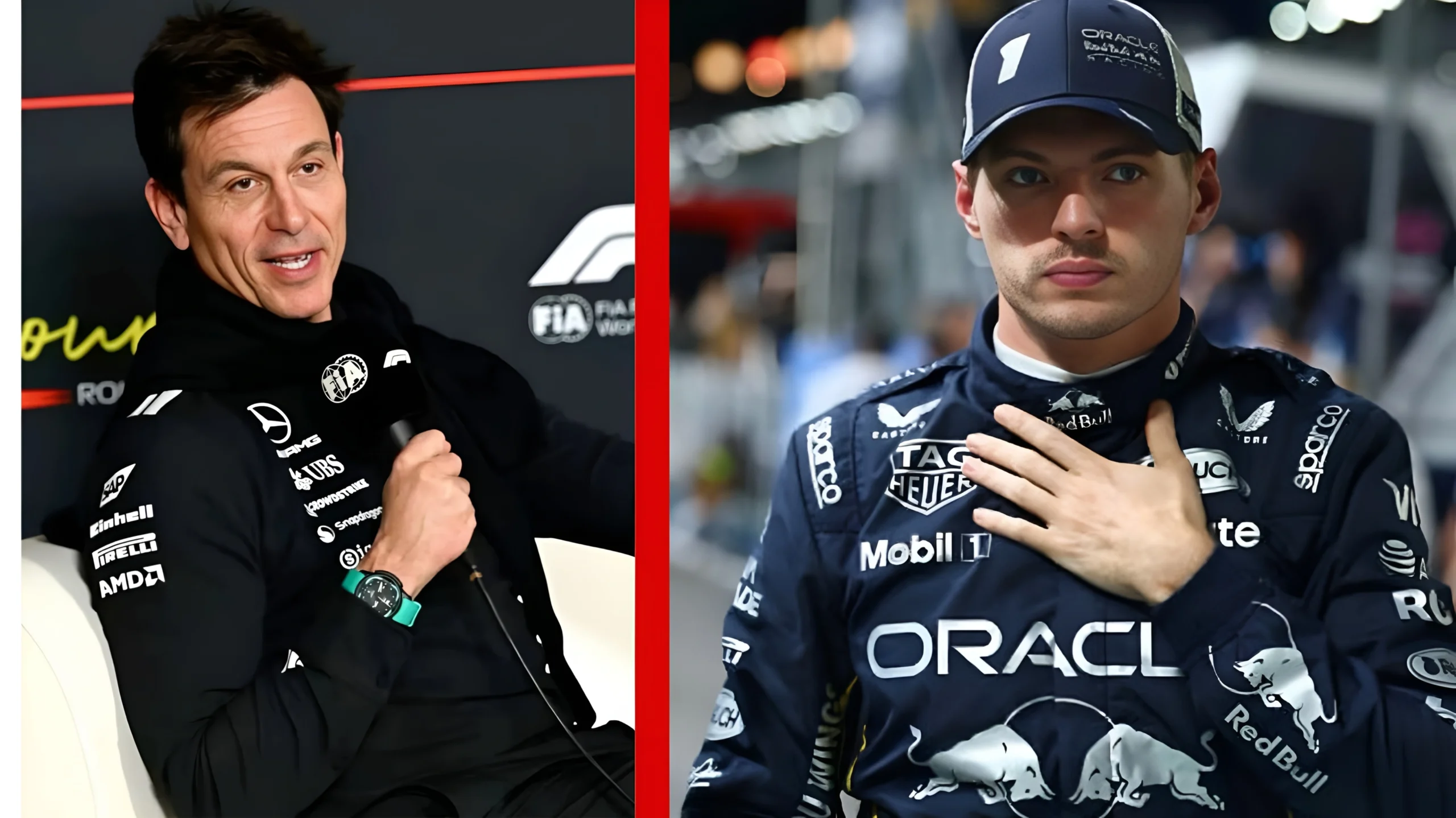
Mercedes Team Principal Toto Wolff has officially dismissed speculation linking Red Bull’s Max Verstappen to a 2026 Silver Arrows seat.
Published by: AutodromeF1 Editorial Team
Mercedes-AMG Petronas Motorsport: Toto Wolff Delivers Emphatic Rebuke to Max Verstappen Speculation, Cementing Long-Term Faith in Russell and Antonelli Duo
London, 25 March – In a forthright declaration that cuts through the persistent haze of Formula 1’s rumour mill, Mercedes team principal Toto Wolff has unequivocally dismissed any notion of recruiting Max Verstappen as “stupid,” reaffirming an unshakeable commitment to the team’s current driver pairing of George Russell and Kimi Antonelli. This latest intervention arrives at a pivotal juncture, as the Silver Arrows navigate the dawn of the 2026 regulatory era with a squad that sits atop the Drivers’ Championship standings in commanding 1-2 formation. Far from mere deflection, Wolff’s remarks reflect a calculated strategic posture—one rooted in empirical performance metrics, contractual certainty, and a forward-looking philosophy that prizes continuity over disruption.
Speaking with characteristic precision during a media engagement tied to the team’s ongoing campaign, Wolff articulated his position with clarity and respect. “We have two drivers with whom we have long-term contracts, spanning several years,” he stated. “I couldn’t be happier with either of them. They are both delivering top-level performances, so there is absolutely no reason to consider a change of driver pairing, or even to think about other drivers. I say this with the utmost respect for Max.” The Austrian executive went further, confirming that no discussions whatsoever had taken place with Verstappen’s representatives, thereby extinguishing any lingering ambiguity about potential overtures.
This stance marks a deliberate evolution from Wolff’s earlier, more open expressions of admiration for the four-time world champion. In 2024, amid the seismic shift prompted by Lewis Hamilton’s departure to Ferrari, Wolff had acknowledged Verstappen’s exceptional talents in public forums. Yet the landscape has transformed dramatically since then. The confirmation of Russell and Antonelli as the 2026 line-up, announced in late October 2025, represented not only a closure to that chapter of uncertainty but also a vote of confidence in Mercedes’ internal talent pipeline. With Russell securing a contract extension through 2026—complete with a 2027 option—and Antonelli on a reported two-year agreement, the team’s driver roster is now insulated against external volatility well into the medium term.
The context of these developments merits careful examination. Hamilton’s exit to Maranello after a decade of unparalleled success with Mercedes had initially fuelled intense speculation about a Verstappen-shaped succession plan. The Dutchman’s dominance at Red Bull Racing, coupled with Wolff’s longstanding regard for his racecraft, made such conjecture inevitable. Yet Antonelli’s meteoric promotion from the Mercedes junior programme—coupled with Russell’s consistent maturation into a championship-calibre leader—altered the calculus. By mid-2025, the team’s focus had crystallised around nurturing this youthful, high-potential tandem rather than pursuing a high-profile external acquisition.
Current form underscores the wisdom of that choice. As the 2026 season unfolds under the radical new technical regulations—encompassing revised power units, active aerodynamics, and a heightened emphasis on sustainable fuels—Russell and Antonelli have emerged as the benchmark. Their 1-2 positioning in the Drivers’ Championship is no statistical anomaly; it reflects seamless adaptation to the W17 chassis, exemplary tyre management, and a symbiotic working relationship that has minimised intra-team friction. Wolff’s endorsement of their “top performances” is not hyperbole but a data-driven assessment, evidenced by consistent podium finishes, strategic acumen in variable race conditions, and a collective points haul that positions Mercedes as a genuine constructors’ title contender.
Contrast this with the broader driver-market dynamics. Verstappen remains contractually bound to Red Bull Racing through 2028, a commitment that renders any immediate relocation logistically improbable absent extraordinary circumstances. While past seasons have witnessed clauses and negotiations reshaping the grid, Wolff’s explicit rejection of dialogue signals a deeper institutional preference for stability. “There is no reason at all to even think about a line-up change,” he emphasised, a sentiment that extends beyond tactical pragmatism to encompass the intangible elements of team culture. Mercedes has historically thrived when driver pairings exhibit mutual respect and shared ambition; the current duo embodies precisely that equilibrium.
This approach diverges markedly from the reactive tendencies observed elsewhere on the grid. In an era where driver contracts increasingly resemble chess moves in a high-stakes endgame, Wolff’s insistence on honouring existing agreements projects an image of principled leadership. It also mitigates the risk of destabilising a squad that has already weathered the post-Hamilton transition with remarkable composure. Antonelli, still in the nascent phase of his Formula 1 career, benefits immensely from the continuity; pairing him with Russell—a driver who has honed his craft under pressure—facilitates accelerated development without the shadow of a superstar incumbent looming overhead.
From a technical standpoint, the 2026 regulations represent a paradigm shift that rewards adaptability over pedigree. The introduction of smaller, more efficient power units and chassis designs prioritises teams capable of rapid iteration. Mercedes’ early-season supremacy suggests that its engineering cadre has decoded these complexities more effectively than rivals, a feat attributable in no small measure to the stable driver feedback loop provided by Russell and Antonelli. Introducing a third variable in the form of Verstappen—however talented—could disrupt the delicate equilibrium of data correlation, simulator alignment, and on-track synergy that underpins current success.
Moreover, Wolff’s remarks carry a subtle rebuke to the rumour ecosystem itself. Formula 1’s siloed information flows have long amplified conjecture, particularly around marquee talents like Verstappen. By labelling the speculation “stupid” while extending “the greatest respect to Max,” the team principal navigates a rhetorical tightrope: he honours the Dutchman’s stature without indulging the narrative. This measured tone contrasts sharply with the breathless reporting that has characterised much of the coverage, where unverified whispers often eclipse substantive analysis. In reality, the absence of any contact with Verstappen’s camp underscores a deliberate demarcation between admiration and action.
Looking ahead, the implications of this stance ripple across the sport. For Red Bull, it reinforces the security of their flagship asset, allowing them to focus on resolving early-season challenges with the RB22 amid the regulatory upheaval. For other constructors—Ferrari, McLaren, Aston Martin—the door remains theoretically ajar for future manoeuvres, yet Mercedes’ clarity may temper the frenzy. Within the Silver Arrows organisation, the message is unequivocal: investment in the incumbent drivers will continue unabated, from bespoke simulator programmes to personalised engineering support. Russell’s extension, in particular, signals a long-term vision that aligns with the team’s ethos of cultivating homegrown talent while integrating prodigious newcomers like Antonelli.
Critics may counter that forgoing a driver of Verstappen’s calibre represents a missed opportunity, especially given Mercedes’ historical prowess in elevating multiple champions. Yet such arguments overlook the empirical realities of the present. The 2026 campaign is proving that Russell possesses the race-winning maturity once associated with Hamilton, while Antonelli’s raw speed and learning curve evoke the promise of a future title contender. Their harmonious coexistence—free from the hierarchical tensions that have occasionally afflicted multi-champion line-ups—affords Mercedes a competitive edge that no single superstar could replicate in isolation.
In broader philosophical terms, Wolff’s decision embodies a humanistic approach to leadership in elite sport. It values loyalty, proven collaboration, and incremental excellence over the allure of disruption. As Formula 1 grapples with evolving commercial pressures, sustainability mandates, and an increasingly global audience, teams that prioritise internal cohesion may well emerge as the true victors. Mercedes, under Wolff’s stewardship, appears poised to exemplify this model.
As the season progresses and the regulatory dust settles, one truth crystallises: the Silver Arrows’ trajectory is defined not by external acquisition but by internal conviction. Toto Wolff has drawn a firm line in the sand, not out of complacency, but from a position of strategic strength. The rumour mill may churn elsewhere; at Brackley, the focus remains resolutely on Russell, Antonelli, and the pursuit of silverware in 2026 and beyond.
This resolute posture invites reflection on the very nature of success in motorsport. In a domain where fleeting alliances and opportunistic shifts often dominate headlines, Mercedes’ unwavering fidelity to its chosen drivers offers a counter-narrative—one of patience, precision, and principled governance. Whether this approach yields further championships remains to be seen, but in an era of perpetual flux, such stability may prove the ultimate competitive advantage.


