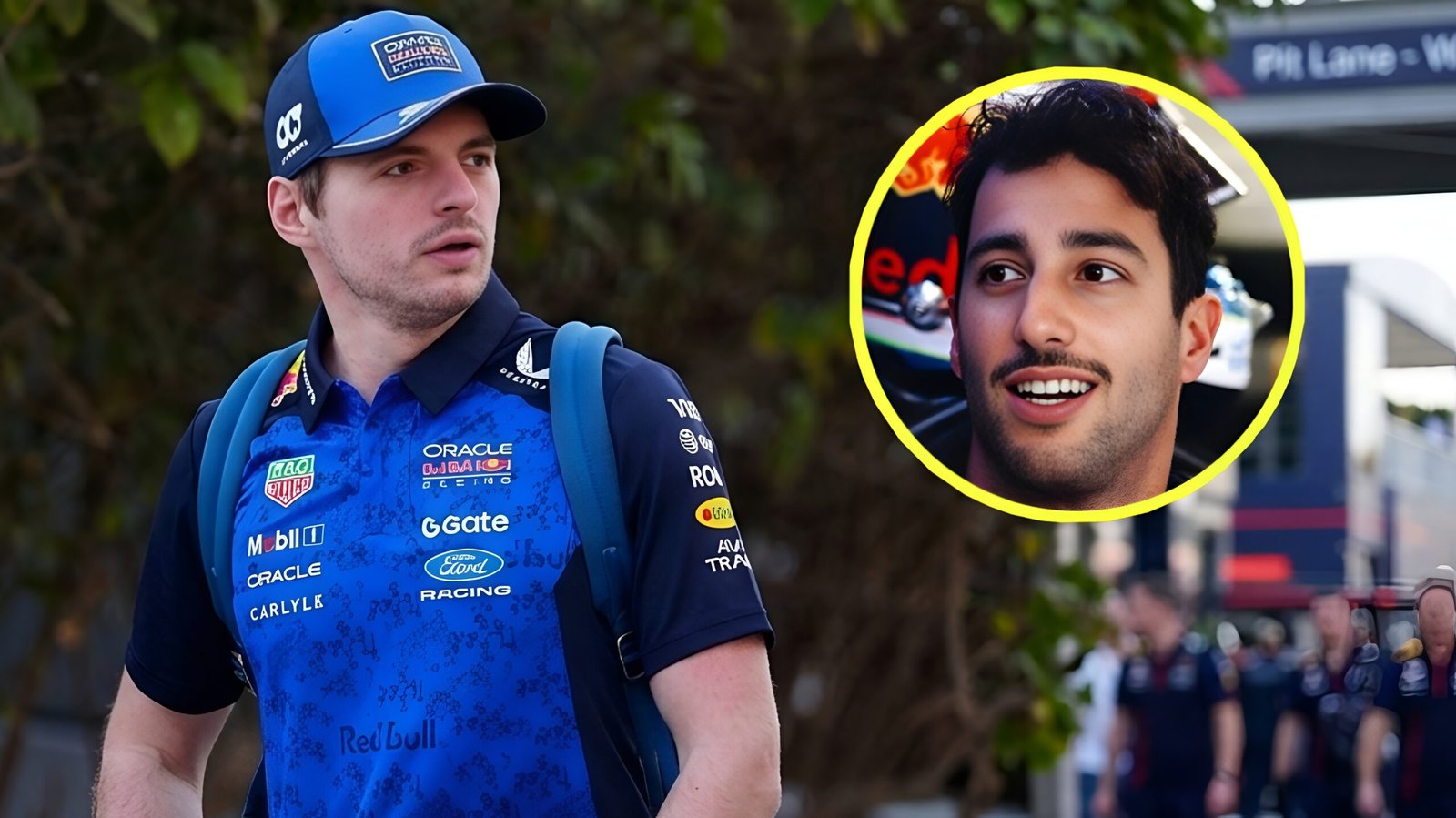
Max Verstappen adopted the #3 for the 2026 season, a move that fans are already linking to the early-career misfortunes of former teammate Daniel Ricciardo.
Published by: AutodromeF1 Editorial Team
The Daniel Ricciardo Curse: A Numerological Footnote or a Subtle Reminder of Motorsport’s Enduring Fragility?
In the meticulously calibrated universe of modern Formula 1, where milliseconds separate triumph from oblivion and regulatory frameworks govern every component from power-unit mapping to tyre allocation, the notion of a “curse” might appear anachronistic. Yet the sporting world has never fully emancipated itself from the human impulse to discern patterns in misfortune. The latest manifestation of this tendency has coalesced around Max Verstappen’s decision to relinquish his long-familiar number 33 in favour of the single digit 3 at the outset of the 2026 championship season. Within days of this ostensibly innocuous change, a sequence of setbacks—first a rare retirement at the Chinese Grand Prix, followed by a post-race disqualification in the Nürburgring Langstrecken-Serie—ignited an online narrative that fans have christened the “Daniel Ricciardo curse.”
This label is neither supernatural invocation nor journalistic invention; it is a wry, self-aware meme born at the intersection of historical coincidence and social-media amplification. Its genesis lies in verifiable events, yet its resonance reveals something deeper about the psychology of elite athletes and the tribal memory of the paddock. To dismiss it outright would be to overlook the layered context that renders the story compelling: a former teammate’s legacy, the immutable rules of endurance racing, and the quiet weight that numbers continue to carry in a sport ostensibly liberated from superstition by data analytics.
The catalyst was Verstappen’s formal request, conveyed during the 2025 United States Grand Prix weekend, to adopt number 3—the same identifier that had accompanied Daniel Ricciardo through the majority of his Formula 1 career. Verstappen has long maintained that 3 was his preferred numeral as a child; the opportunity to claim it arose only after Ricciardo confirmed he had no proprietary attachment to the number following his departure from full-time competition. The handover was framed by both drivers as a collegial footnote, devoid of portent. Yet within weeks of the 2026 season’s commencement, the narrative shifted.
At the Shanghai International Circuit, Verstappen’s Red Bull RB22 suffered an uncharacteristic engine-related cooling failure that forced an early retirement—only the second DNF of his championship reign in more than two years. The incident itself was technical rather than driver-induced, yet it arrived at a moment when the team was still calibrating the new chassis and power-unit package. Six days later, Verstappen crossed the Nürburgring’s legendary 20.8-kilometre Nordschleife in a Winward Motorsport Mercedes-AMG GT3, sharing driving duties with Dani Juncadella and Jules Gounon. The trio secured pole position, dictated the race pace throughout the two-hour NLS2 round, and appeared to have secured a comfortable victory.
Post-event scrutineering, however, revealed a compliance breach that proved decisive. The team had utilised seven sets of slick tyres during the race day window, exceeding the regulatory limit of six stipulated by the Nürburgring Langstrecken-Serie technical regulations. The penalty was unambiguous: the result was expunged, the win awarded to the competing ROWE Racing BMW entry, and Verstappen’s first podium-equivalent result in GT3 competition erased from the record. The infraction was not one of performance advantage—tyre wear had remained within expected parameters—but of procedural oversight, a reminder that even the most dominant driver cannot outrun the fine print of sporting regulations.
The parallel with Ricciardo’s own debut under number 3 was impossible to ignore. When the Australian adopted the numeral at the beginning of the 2014 season—his first full campaign with Red Bull Racing—his opening race at the Australian Grand Prix ended in disqualification. Having crossed the line second behind teammate Sebastian Vettel, Ricciardo was stripped of the result after stewards determined that his RB10 had exceeded the mandated fuel-flow limit of 100 kg/h. Red Bull’s appeal was rejected, and the podium was lost. The following two races brought further setbacks: mechanical retirements that left the new number 3 with only a single classified finish from the first three starts. The symmetry—DSQ followed by early disappointment—was not lost on observers when Verstappen’s 2026 sequence unfolded in analogous fashion.
What elevates this episode beyond mere coincidence is the cultural machinery of contemporary Formula 1 fandom. Social platforms, particularly X (formerly Twitter), have transformed isolated incidents into instantaneous lore. Hashtags such as #Number3Curse and #RicciardoCurse proliferated within hours of the NLS disqualification, accompanied by side-by-side imagery of the two drivers’ respective early-season misfortunes. The meme’s appeal lies in its affectionate irony: it does not genuinely accuse Ricciardo of hexing his former teammate but rather acknowledges the whimsical continuity of racing misfortune across generational lines. Ricciardo himself has yet to comment publicly on the developing narrative, though he previously described the number transfer as “a cool story” when first approached in late 2025.
To understand the phenomenon fully, one must situate it within the broader evolution of driver numbering in Formula 1. The permanent number system introduced in 2014—allowing drivers to retain their chosen numeral for the duration of their careers—replaced the traditional sequential allocation that had prevailed since the championship’s inception. Prior to that reform, numbers were reassigned annually based on the previous season’s constructors’ standings, rendering personal attachment impossible. The new regime granted drivers agency over their on-track identity, yet it also introduced an unforeseen psychological dimension: once a number becomes indelibly linked to a personality, its transfer carries symbolic freight.
Number 3, in particular, carries a modest but distinct historical resonance. Before Ricciardo, it had been worn by drivers of varying fortune, from Damon Hill’s championship-winning campaigns to occasional one-off appearances. Ricciardo’s tenure imbued it with a distinctive character—fast, flamboyant, and occasionally star-crossed. Verstappen’s adoption therefore represents not merely a change of livery but a subtle inheritance of narrative legacy.
The tyre-regulation breach at the Nürburgring further illuminates the technical and philosophical gulf between Formula 1 and the GT3 ecosystem. The Nürburgring Langstrecken-Serie operates under strict cost-control measures designed to preserve accessibility for privateer teams. Limiting race-day tyre sets to six is not an arbitrary cap; it prevents unlimited practice and qualifying runs that would otherwise inflate budgets and distort the endurance ethos. Winward Motorsport’s error, while inadvertent, underscored the razor-thin margin between compliance and infraction in a series where factory-supported entries coexist with customer squads. Verstappen’s participation in such events has long served as both relaxation and data-gathering exercise; the disqualification, however, inadvertently fed the burgeoning curse narrative.
Sceptics will rightly observe that correlation does not imply causation. Verstappen’s Chinese Grand Prix retirement stemmed from a cooling-system anomaly traceable to new aerodynamic demands on the 2026 regulations, while the NLS penalty was administrative rather than performance-related. Yet the human mind, particularly within the pressure cooker of elite sport, instinctively seeks causal threads. Sports psychologists have long documented the role of superstition in high-stakes environments: rituals, lucky charms, and numerical associations serve as cognitive anchors when variables exceed an athlete’s control. Verstappen, renowned for his analytical approach and aversion to extraneous distraction, has never publicly endorsed mystical interpretations. Still, the sheer volume of commentary—ranging from light-hearted fan edits to more considered analyses—suggests the story has transcended its origins.
Comparisons with earlier motorsport “curses” provide instructive perspective. The number 13 has periodically been avoided in Formula 1 for decades, a legacy of unlucky associations dating back to the 1960s. Ayrton Senna’s refusal to drive a car bearing number 13 during his early career is well documented. Similarly, the “curse of the number 27” attached itself to Gilles Villeneuve and later to certain Williams entries. Even the celebrated rivalry between Alain Prost and Senna acquired quasi-mystical overtones in media retellings. In each instance, observers retrofitted narrative coherence onto random variance. The Ricciardo-Verstappen parallel follows the same pattern, albeit with notably less malevolence and considerably more humour.
From a regulatory standpoint, the NLS incident also highlights ongoing convergence between Formula 1 and customer racing. Manufacturers such as Mercedes-AMG invest heavily in GT3 programmes precisely because they offer development pathways and brand exposure without the prohibitive costs of prototype endurance racing. Verstappen’s occasional appearances in these series have historically been uncontroversial; the 2026 disqualification, however, arrives at a sensitive moment when Red Bull is navigating the transition to new power-unit suppliers and aerodynamic philosophies mandated by the 2026 technical regulations. Any external distraction, however trivial, risks magnifying internal scrutiny.
Yet the true significance of the “curse” may lie less in its predictive power than in its capacity to humanise an otherwise clinical sport. Formula 1 in the 2020s is governed by budgets caps, wind-tunnel restrictions, and algorithmic strategy tools. The re-emergence of numerological folklore serves as a cultural counterbalance—an acknowledgment that even world champions remain susceptible to the same interpretive biases as their most passionate supporters. It also underscores the enduring influence of Daniel Ricciardo within the paddock long after his full-time tenure concluded. The Australian’s affable persona and distinctive racing style left an imprint that transcends statistics; the playful attribution of a “curse” is, in its own way, a tribute.
As the 2026 season unfolds, the focus will inevitably shift from memes to measurable performance. Verstappen enters the campaign as the undisputed benchmark, armed with a Red Bull package that, despite early teething issues, remains the class of the field on paper. Whether the number 3 ultimately proves auspicious or merely neutral will be determined not by retrospective pattern-matching but by lap times, race craft, and mechanical reliability. Should further misfortune accumulate, the meme will intensify; should dominance resume, it will recede into affectionate footnote.
In either outcome, the episode offers a salutary reminder: motorsport’s greatest dramas often originate not in dramatic crashes or strategic masterstrokes but in the quiet intersections of regulation, legacy, and human storytelling. The Daniel Ricciardo curse is, at present, little more than a digital campfire tale. Its longevity will depend less on supernatural forces than on the inexorable logic of competition itself. For now, the paddock watches with the mixture of amusement and curiosity that has always accompanied the sport’s most enduring myths—one number, two drivers, and an entire community ready to weave coincidence into legend.


