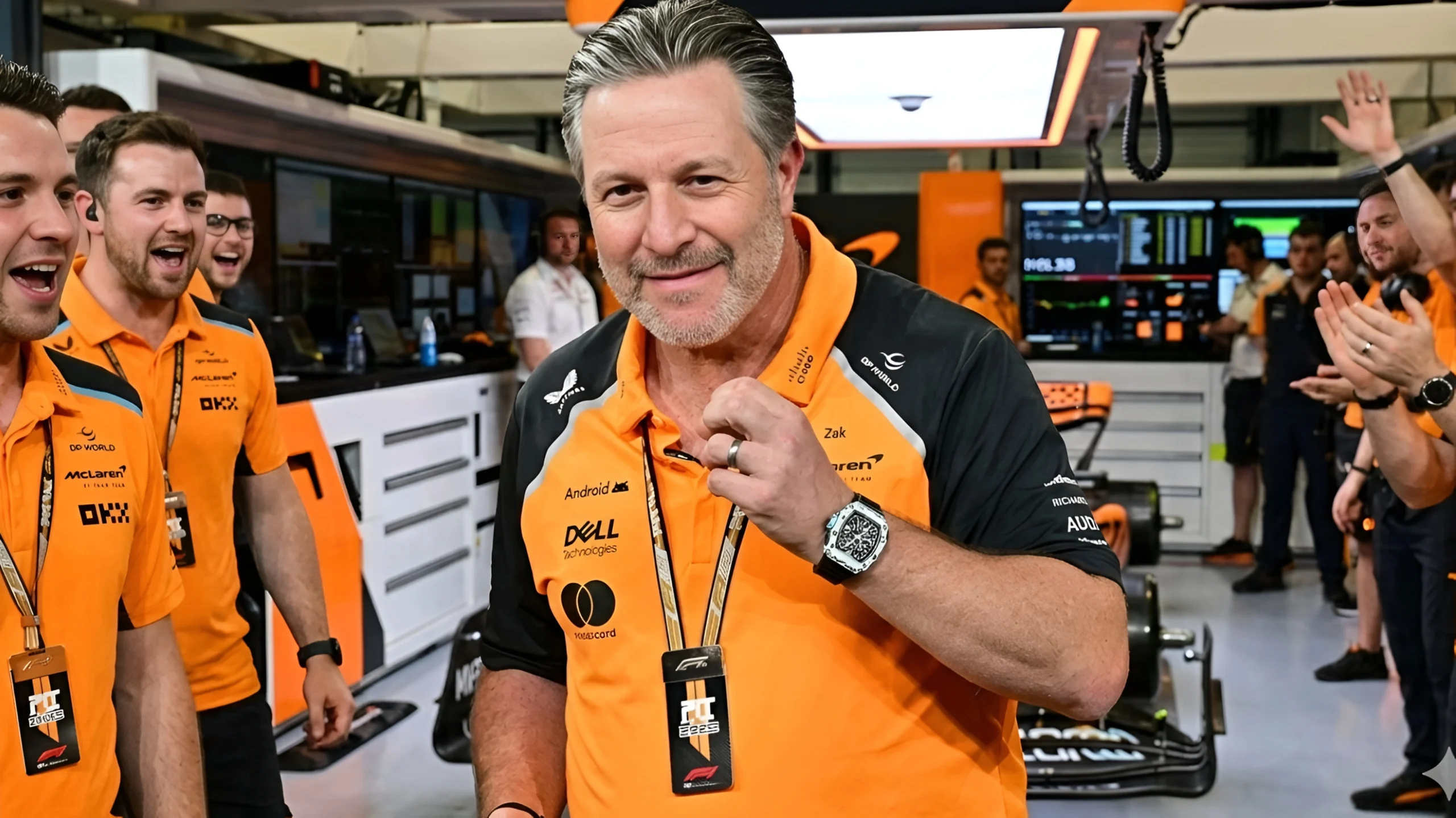
McLaren CEO Zak Brown rallies the team at the Woking headquarters following the technical setbacks of the 2026 Chinese Grand Prix.
Published by: AutodromeF1 Editorial Team
McLaren’s Leadership Recalibration: Zak Brown’s Strategic Imperative for Resilience in the 2026 Formula 1 Campaign
London, 24 March – In the rarefied corridors of the McLaren Technology Centre in Woking, Surrey, a moment of collective introspection unfolded on the Monday following the 2026 Chinese Grand Prix. Chief Executive Officer Zak Brown, addressing the assembled engineering, operational, and support personnel of the McLaren Racing team, delivered a meticulously crafted address that transcended the immediate disappointment of a double did-not-start (DNS) result. This address, delivered with the poise of a seasoned executive who has orchestrated one of motorsport’s most remarkable modern turnarounds, served not merely as a motivational exercise but as a deliberate recalibration of the team’s strategic and psychological posture amid the nascent challenges of their title defence.
The Chinese Grand Prix weekend in Shanghai had crystallised into an uncharacteristic nadir for a squad that entered the 2026 season as reigning constructors’ champions, having secured back-to-back titles in 2024 and 2025. For the first time in more than two decades, both McLaren entries—driven by Lando Norris and Oscar Piastri—failed to take the start. The root cause, as subsequently confirmed by the team, lay in separate but concurrent electrical anomalies traced to the integrated battery systems within the Mercedes-AMG High Performance Powertrains (HPP) power unit. These issues, manifesting during final pre-race preparations, rendered the cars non-compliant with regulatory safety thresholds and forced their withdrawal before the formation lap. The episode marked an unprecedented operational setback for a team renowned for its meticulous preparation, underscoring the unforgiving margins inherent in Formula 1’s 2026 regulatory framework, which has introduced heightened demands on energy recovery and electrical architecture.
Brown’s intervention, however, was calibrated to reframe this adversity. Rather than dwelling on the technical minutiae—speed traces, telemetry logs, or the intricacies of battery thermal management—he directed the organisation’s gaze toward a singular, unambiguous objective: the pursuit and celebration of Grand Prix victories. “We will secure a race win sooner rather than later,” he assured his team, a declaration delivered not as hollow rhetoric but as a data-informed conviction rooted in the organisation’s demonstrated capacity for iterative excellence. By pivoting the narrative from diagnostic introspection to forward-looking execution, Brown sought to insulate the team’s morale from the corrosive effects of early-season turbulence, a leadership philosophy honed over nearly a decade at the helm of McLaren.
This cultural realignment is no incidental flourish; it represents the culmination of a deliberate philosophical overhaul that Brown has championed since assuming the role of CEO in 2018. Upon his arrival, McLaren languished in the lower echelons of the constructors’ standings, its once-vaunted infrastructure fractured by successive cycles of strategic missteps and internal discord. Brown’s tenure has been defined by an insistence on fostering an environment where elite talent—whether on the track, in the design office, or within the operational support apparatus—operates within a framework of unassailable trust, accountability, and shared ambition. The results have been transformative: from the tentative podiums of the early 2020s to the dominant campaigns of 2024 and 2025, where McLaren not only clinched consecutive constructors’ championships but also cultivated a driver pairing widely regarded as the most potent in the paddock.
Central to Brown’s address was an unequivocal affirmation of that driver strength. Norris and Piastri, he emphasised, constitute “the two finest drivers in the world,” a characterisation that extends beyond mere superlative praise to reflect empirical performance metrics accumulated across multiple seasons. Norris’s blend of raw speed, racecraft, and resilience has matured into championship-calibre consistency, while Piastri’s precocious adaptability and strategic acumen have established him as a formidable protagonist in his own right. Their complementary styles—Norris’s instinctive aggression tempered by Piastri’s measured precision—have forged a partnership that has repeatedly proven decisive in high-stakes scenarios. Yet, as Brown acknowledged implicitly, even the most gifted athletes require an ecosystem of unwavering reliability to translate potential into results. The battery-related DNS in China deprived both drivers of that opportunity, amplifying the frustration articulated by Team Principal Andrea Stella, who described the failures as “uncontrollable” and expressed deep empathy for the competitors who had prepared rigorously only to be sidelined at the final hour.
Stella’s assessment, delivered in the immediate aftermath of the race weekend, provided a complementary layer of technical candour that reinforced Brown’s broader message. The Australian-born engineer, whose own stewardship has been instrumental in McLaren’s resurgence, underscored that the anomalies were not attributable to deficiencies in design or execution but rather to the inherent complexities of integrating next-generation power-unit components under the stringent 2026 regulations. These regulations, which emphasise sustainable energy deployment and advanced electrical storage, have introduced novel variables across the grid. Mercedes HPP, McLaren’s long-term partner, has mobilised its full resources to expedite root-cause analysis and corrective measures, a process that Stella confirmed is progressing with the urgency the situation demands.
The broader context of McLaren’s 2026 campaign renders Brown’s intervention particularly salient. Having concluded the preceding two seasons with an aura of invincibility—securing multiple race victories, pole positions, and a commanding points tally—the team entered the new year as clear favourites. Yet the opening rounds have yielded no victories and a modest haul of just 18 points, positioning McLaren third in the constructors’ standings. This early deficit, while statistically modest in the grand scheme of a 24-race calendar, carries psychological weight, especially against the backdrop of intensified competition from rivals who have capitalised on the regulatory reset. The Japanese Grand Prix at Suzuka, scheduled for the coming weekend, thus assumes heightened significance as a litmus test for the team’s capacity to convert latent performance into tangible success.
Brown’s directive to “prepare for Suzuka with confidence in our capabilities” is underpinned by a comprehensive review of the organisation’s strengths. The Woking-based infrastructure remains the envy of the paddock: a state-of-the-art campus that integrates simulation, wind-tunnel testing, and real-time data analytics with unparalleled efficiency. The racing team itself—comprising aerodynamicists, strategists, and mechanics—embodies a culture of precision that has been refined through successive iterations of process optimisation. This cultural capital, Brown argued, is the intangible yet decisive differentiator that will enable McLaren to navigate the current headwinds. By exhorting his colleagues to celebrate forthcoming victories rather than lament transient setbacks, he sought to embed a mindset of proactive optimism, one that aligns individual contributions with collective triumph.
The speech also invited reflection on the cyclical nature of Formula 1 excellence. History is replete with examples of championship contenders encountering unforeseen obstacles at the outset of a defence—be they regulatory disruptions, supply-chain interruptions, or unforeseen technical integrations. McLaren’s own archives document similar episodes, from the reliability crises of the early 2010s to the aerodynamic miscalculations that preceded the current renaissance. What distinguishes the present chapter is the organisation’s institutional memory and adaptive capacity, attributes that Brown has cultivated assiduously. His leadership model draws upon principles observable in other high-stakes domains, from elite military units to multinational corporations: the primacy of clarity of purpose, the cultivation of psychological resilience, and the strategic deployment of narrative to shape outcomes.
Looking ahead, the implications of Brown’s address extend beyond the immediate horizon of the Japanese Grand Prix. Should the electrical architecture prove robust in Suzuka’s demanding configuration—with its high-speed sweeps, technical chicanes, and variable weather patterns—McLaren could rapidly reassert its competitive primacy. Norris and Piastri have already demonstrated, in pre-season testing and early 2026 outings, that the MCL39 chassis possesses the inherent pace to challenge for pole positions and race wins when unencumbered by ancillary failures. The forthcoming collaboration with Mercedes HPP will likely yield incremental gains in energy deployment efficiency, further enhancing the power unit’s competitiveness under the revised 2026 power-flow regulations.
Moreover, the episode illuminates a broader truth about contemporary Formula 1: success is no longer predicated solely on aerodynamic or mechanical supremacy but on the seamless orchestration of human, technological, and regulatory variables. In this ecosystem, leadership that fosters cohesion amid adversity assumes paramount importance. Brown’s address exemplifies this paradigm, positioning McLaren not as a team in crisis but as an organisation poised for resurgence through disciplined refocus.
As the paddock converges on Suzuka, the motorsport community will observe whether McLaren’s recalibration translates into on-track momentum. The absence of victories thus far in 2026 has tempered expectations, yet Brown’s message resonates as a reminder that championships are forged not in unblemished beginnings but in the crucible of adaptive resolve. For a squad that has already rewritten its narrative once under his stewardship, the prospect of a swift turnaround remains not merely plausible but probable. The papaya livery, long synonymous with resilience and ambition, may soon once again illuminate the winner’s circle—precisely as its chief executive has envisioned.
In sum, Zak Brown’s address at the McLaren Technology Centre was more than a motivational interlude; it constituted a masterclass in executive stewardship, one that harmonised technical pragmatism with cultural fortitude. As the 2026 season unfolds, its efficacy will be measured in grid positions, podium finishes, and, ultimately, championship contention. For now, the team departs Woking with a renewed mandate: to channel frustration into focus, setbacks into momentum, and ambition into achievement. The Japanese Grand Prix awaits, and with it, the opportunity for McLaren to reaffirm its status among Formula 1’s pre-eminent protagonists.


