Published by: AutodromeF1 Editorial Team
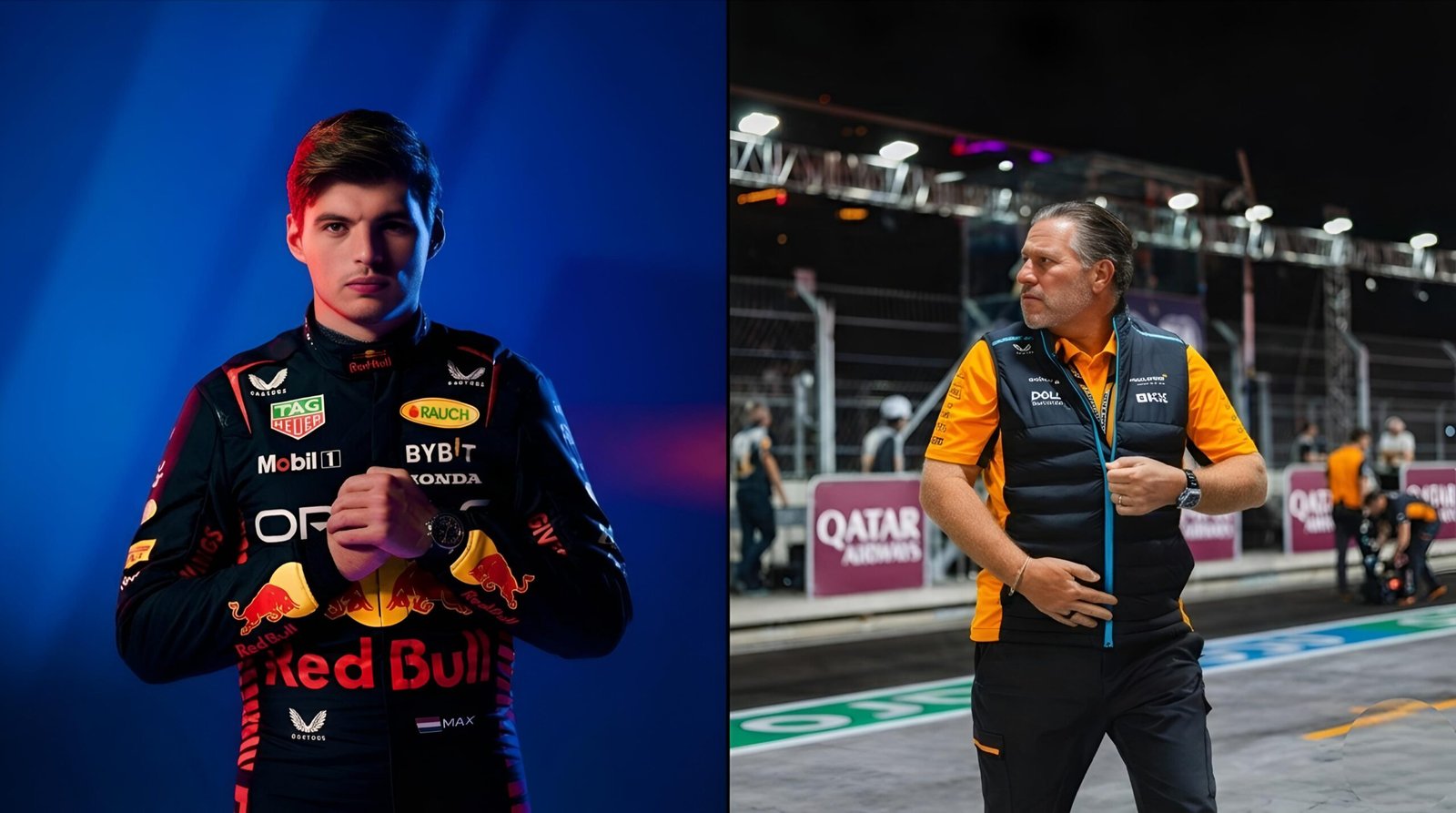
London, United Kingdom April 9 – In the high-stakes arena of Formula 1, where technical precision intersects with human ambition and strategic foresight, few figures command as much attention as Zak Brown, the CEO of McLaren Racing. As the 2026 season unfolds under the transformative new regulations, Brown finds himself at the center of swirling speculation regarding one of the sport’s most dominant talents: four-time world champion Max Verstappen and his increasingly scrutinized tenure at Red Bull Racing.
Recent reports from paddock insiders suggest that Brown is monitoring Verstappen’s situation with keen interest, amid Red Bull’s evident struggles to adapt to the radical 2026 technical framework. While no formal overtures have been confirmed, the narrative underscores a broader truth in motorsport: performance dictates destiny, and McLaren’s strengthened position—bolstered by recent personnel maneuvers and a robust junior talent pipeline—affords the team strategic flexibility should opportunities arise.
The Context of Uncertainty at Red Bull
The 2026 Formula 1 season has proven a stark departure from the competitive landscape of previous years. The new regulations, which introduce lighter chassis designs, heavily revised aerodynamics, and a power unit architecture emphasizing 50% electric deployment from sustainable fuels, were intended to foster closer racing and greater road relevance. Instead, they have exposed vulnerabilities across the grid, with Red Bull appearing among the most affected.
Max Verstappen, whose relentless driving style and engineering feedback have long been the cornerstone of Red Bull’s success, has not minced words about the challenges. Following difficult sessions in Australia and Shanghai, the Dutchman described the RB22 as “completely undriveable,” citing persistent issues with balance, grip, tyre degradation, and energy recovery efficiency. “Every lap is like survival,” he noted, highlighting the car’s unpredictable handling characteristics that demand constant corrections, particularly in high-speed sections where the new active aero elements and reduced downforce complicate matters.
Team principal Laurent Mekies and the technical leadership have acknowledged “significant shortcomings” in the package, pointing to chassis limitations and power unit integration hurdles rather than isolated reliability gremlins. Early results reflect this: Verstappen recovered to sixth in Melbourne after a qualifying crash linked to an ERS failure, but struggled in subsequent rounds, with reports of qualifying exits in Q2 and time losses exceeding 1.7 seconds per lap to the frontrunners in certain conditions. His teammate, Isack Hadjar, has faced similar hurdles, underscoring that the issues extend beyond one driver’s setup preferences.
These difficulties arrive against the backdrop of Red Bull’s post-2025 transition. Having finished third in the constructors’ championship behind McLaren’s dominant campaign and Mercedes, the Milton Keynes outfit entered the new era with high expectations rooted in Adrian Newey’s legacy and Verstappen’s proven ability to extract maximum performance. Yet the radical reset—encompassing not just aero but a fundamental shift toward more electrically dependent hybrids—has tested the team’s development philosophy. Verstappen’s public critiques of the regulations themselves, labeling aspects “anti-racing,” have amplified discussions about driver satisfaction and long-term commitment, though his contract remains intact with no publicly activated exit clauses as of early April 2026.
Internal stability adds another layer. While key figures like race engineer Gianpiero Lambiase (“GP”) have faced external interest, Red Bull confirmed his continuation in dual roles for 2026, providing continuity for Verstappen. Speculation linking high-profile departures to broader unrest has circulated, but the team maintains that performance recovery remains the priority. Verstappen continues to push, demonstrating the resilience that has defined his career, yet the cumulative strain of an uncompetitive car in a regulation set he openly dislikes cannot be understated.
Zak Brown’s Calculated Vigilance
Zak Brown, a seasoned executive with decades of experience spanning IndyCar, endurance racing, and F1 commercial leadership, has built McLaren into a formidable force through data-driven decisions and cultural emphasis on balance over individual stardom. His interest in Verstappen’s predicament aligns with a pragmatic assessment of the market rather than reactive opportunism.
In late 2025, as McLaren clinched the constructors’ title with a commanding 833 points (ahead of Mercedes on 469 and Red Bull on 451), Brown offered nuanced commentary on Verstappen. He likened the champion’s comeback prowess to a “horror movie” antagonist—one who appears defeated only to re-emerge with renewed threat. “He’s like that guy in a horror movie, that right as you think he’s not coming back, he’s back!” Brown remarked, urging his own drivers, Lando Norris and Oscar Piastri, to remain vigilant. Verstappen responded with characteristic wit, suggesting they “call me Chucky,” a light-hearted exchange that nonetheless highlighted mutual respect amid rivalry.
Brown has previously expressed admiration for Verstappen’s raw talent while critiquing Red Bull’s perceived “one-man team” approach, suggesting it stems from fear of losing their star asset. In interviews, he has described a Verstappen-led Mercedes as “scary” and noted cultural preferences for McLaren’s collaborative ethos. Yet he has also positioned himself as an “interested spectator” in the broader driver market, emphasizing that McLaren’s current pairing delivers consistent results without requiring a singular focal point.
The monitoring of Verstappen’s situation, as reported, reflects strategic prudence. Should Red Bull’s recovery falter into the mid-season or beyond—particularly with 2027 regulations on the horizon—market dynamics could shift rapidly. Brown’s leadership style prioritizes long-term positioning: investing in infrastructure, power unit partnerships (via Mercedes), and aerodynamic innovation while nurturing depth rather than relying on superstar volatility.
The “GP” Clarification and Personnel Leverage
A point of clarification is essential amid circulating claims: the “GP” referenced in recent speculation pertains to Gianpiero Lambiase, Verstappen’s trusted race engineer, rather than any direct link to young driver Gabriel Bortoleto. While Lambiase drew interest from rival squads due to his deep understanding of Verstappen’s preferences and strategic acumen, Red Bull secured his services for 2026 and beyond. His potential future movements (with some reports eyeing longer-term horizons around 2028) could theoretically offer McLaren or others valuable insights into Verstappen’s operational needs, should a transfer materialize. However, sources stress no causal connection between Lambiase’s status and Verstappen’s future decisions.
Separately, Gabriel Bortoleto—the talented Brazilian who progressed through McLaren’s driver development program, securing F3 and F2 titles—represents the team’s forward-looking investment. After departing the junior program upon signing with Sauber (now transitioning to Audi) for 2025 and beyond, Bortoleto has impressed in his rookie F1 campaign, earning praise for consistency and adaptability. McLaren’s early support and continued admiration for his potential underscore a philosophy of building sustainable talent pipelines. While not a direct “replacement” lever in the Verstappen context, securing and developing such prospects grants McLaren flexibility for the post-2026 era, where regulatory stability may reward depth over short-term heroics.
McLaren’s Strategic Ascendancy
McLaren’s 2025 triumph marked a watershed: back-to-back constructors’ titles after a 26-year drought, achieved through meticulous preparation, superior race execution, and a harmonious driver lineup. Norris claimed the drivers’ crown, with Piastri providing invaluable support, validating Brown’s vision of a balanced squad capable of neutralizing threats like Verstappen.
Entering 2026, the team has encountered its own teething issues with the new regulations—evident in modest early points hauls—but benefits from proactive development focus. Unlike reports suggesting Red Bull extended 2025 upgrades at the potential expense of 2026 readiness, McLaren shifted resources earlier, positioning itself to iterate swiftly on chassis and power unit integration. Team principal Andrea Stella has signaled openness to mid-season regulatory tweaks, particularly around qualifying energy deployment, reflecting a collaborative yet competitive stance within the FIA framework.
Brown’s approach diverges markedly from traditional media portrayals of F1 as mere soap opera. It emphasizes empirical performance metrics, cultural alignment, and regulatory mastery. McLaren’s papaya livery now symbolizes resurgence: a team that weathered years of transition to emerge as constructors’ benchmark, all while maintaining commercial vitality through innovative partnerships.
Broader Implications for the Driver Market and Regulations
This episode illuminates deeper currents in Formula 1. The 2026 rules, while ambitious in promoting sustainability and spectacle, have introduced unpredictability. Teams like Mercedes and Ferrari appear better adapted initially, while newcomers and established powers grapple with integration challenges. Verstappen’s frustrations echo those of past champions navigating disruptive shifts, raising questions about driver retention and the sport’s appeal.
For McLaren, the strategy remains clear: fortify the core (Norris and Piastri through 2026 and likely beyond), accelerate technical evolution, and evaluate external talent only when it enhances collective strength. Signing promising juniors like Bortoleto (in his developmental phase) or engaging experienced personnel provides optionality without destabilizing the current equilibrium.
Red Bull, conversely, must demonstrate rapid adaptation. History shows the team excels in crisis—recall their post-2021 resurgence—but sustained midfield contention risks testing even Verstappen’s legendary loyalty. Laurent Mekies’ leadership, combined with ongoing technical recruitment, will be pivotal.
A Measured Outlook
As the European leg of the 2026 calendar approaches, with races in Miami, Imola, and beyond, the narrative around Verstappen and Red Bull will intensify. Zak Brown’s vigilance is not sensationalism but the hallmark of astute leadership: anticipating scenarios in a sport where fortunes pivot on tenths of a second and regulatory nuances.
McLaren enters this phase from a position of strength—recent champions with a proven model of sustainable excellence. Whether Verstappen’s path intersects with Woking remains speculative; what endures is the professionalism driving both organizations. In an era of profound technical change, true success belongs to those who adapt with expertise, maintain trust through transparency, and prioritize the sport’s collective advancement.
Formula 1 thrives on such dynamics: rivalry tempered by respect, ambition channeled through engineering brilliance. Brown’s stewardship exemplifies this ethos—pragmatic, forward-thinking, and unyieldingly professional. As developments unfold, the paddock, fans, and stakeholders alike will watch with informed anticipation, recognizing that behind every rumor lies the rigorous pursuit of performance that defines the pinnacle of motorsport.


