Published by: AutodromeF1 Editorial Team
A Strategic Recalibration in Silverstone: Adrian Newey’s Return to Technical Mastery and the Imminent Arrival of Jonathan Wheatley as Aston Martin’s New Team Principal
In the rarefied world of Formula One, where the confluence of engineering brilliance and organisational discipline determines not merely competitiveness but legacy, Aston Martin Aramco has executed a leadership transition that is as pragmatic as it is profound. Adrian Newey, universally acknowledged as the pre-eminent aerodynamicist and designer of his generation, will step away from the day-to-day demands of the team principal role he assumed only months ago. His focus will revert entirely to the realm that has defined his career: the conceptualisation, refinement, and relentless optimisation of the racing machine itself.
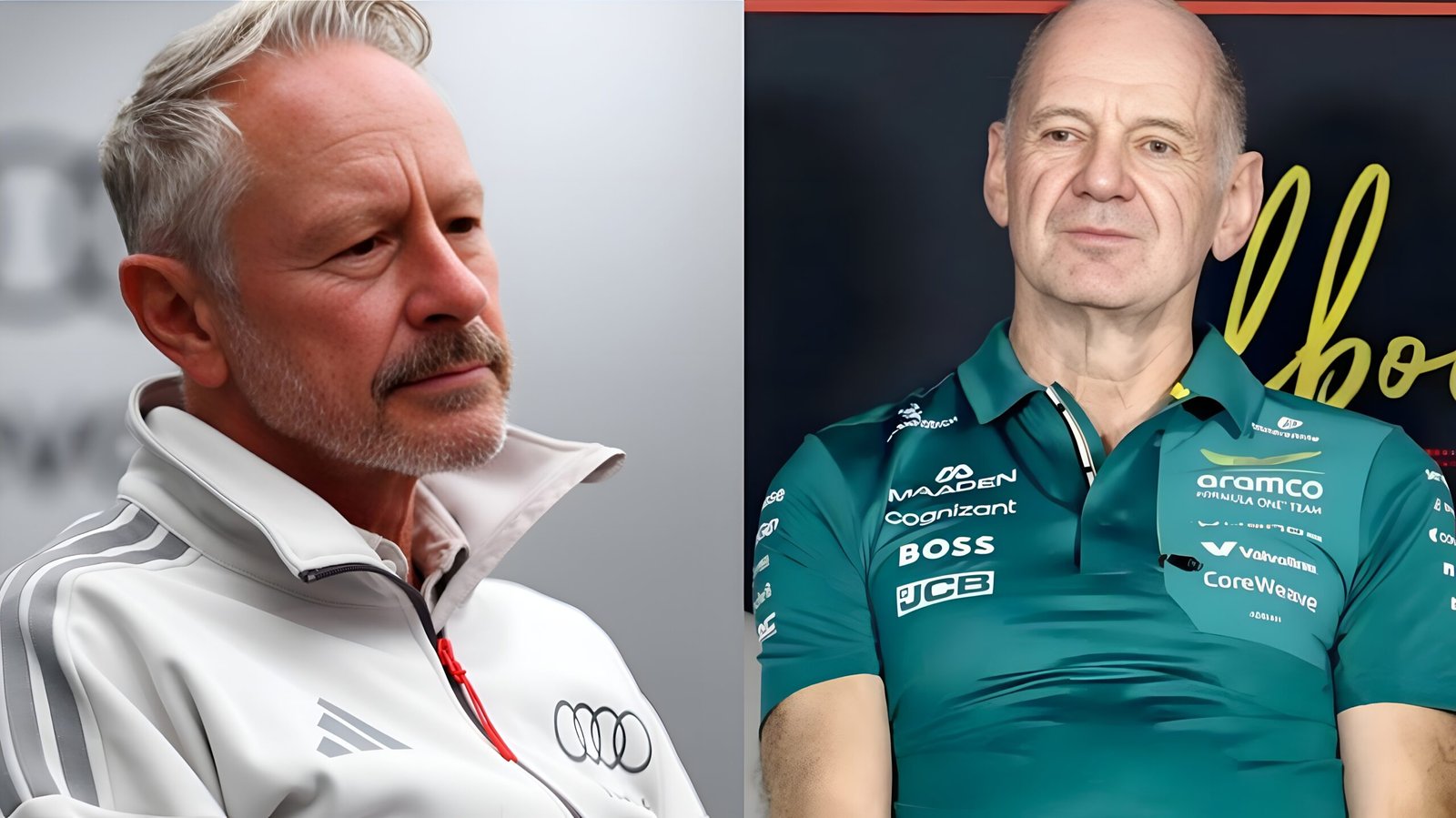
Simultaneously, the team has reached substantial agreement with Jonathan Wheatley, currently serving as team principal at the Audi Revolut F1 outfit, to succeed him. This development, confirmed through multiple high-level sources within the paddock on 19 March 2026, represents far more than a routine succession. It is a deliberate recalibration of roles, born of hard-won experience in the crucible of the new 2026 regulatory framework, and one that promises to realign Aston Martin’s formidable technical resources with the operational rigour required to translate potential into sustained performance.
The announcement, though not yet formally ratified pending the resolution of Wheatley’s contractual obligations at Audi, has been orchestrated with characteristic precision. Newey himself has been intimately involved in identifying his successor, a process that commenced well before the 2026 season’s early tribulations became apparent. That foresight alone speaks volumes about the strategic maturity now evident at Lawrence Stroll’s ambitious project.
When Newey was elevated to team principal in November 2025, succeeding Andy Cowell who transitioned to chief strategy officer, the decision was greeted with a mixture of admiration and scepticism. Here was a man whose intellectual fingerprints adorn thirteen constructors’ and drivers’ championships across Williams, McLaren, and Red Bull. For the first time in decades, Newey would assume not only overarching technical authority as managing technical partner but also the broader executive responsibilities traditionally associated with the team principal position: pit-wall decision-making, regulatory navigation, personnel management, and the public-facing representation of the squad.
It was an experiment rooted in necessity. Aston Martin, having secured Newey’s services after his acrimonious departure from Red Bull in 2024, sought to harness his genius at the apex of the organisation. The 2026 regulations, the most sweeping overhaul in the sport’s modern history, were widely expected to favour bold conceptual thinkers. Newey’s early involvement in the AMR-26 project, combined with Honda’s new power-unit partnership, positioned the team as a dark horse capable of challenging the established order. Yet the realities of Formula One governance and the sheer bandwidth required to steer a 1,000-strong organisation proved incompatible with the singular concentration demanded by groundbreaking design work.
Early-season performance has underscored the mismatch. The AMR-26 has struggled with persistent chassis vibrations, integration challenges with the Honda power unit, and a deficit in outright pace that has left the team scoreless after the opening rounds. While such teething problems are not uncommon in a regulatory reset year—particularly one that introduces lighter chassis, more powerful electrical deployment, and dramatically altered aerodynamics—they have exposed the limitations of asking even a polymath like Newey to shoulder both visionary leadership and granular operational oversight.
Newey’s decision to relinquish the team principal mantle is therefore neither a demotion nor a retreat. It is a restoration of roles to their natural equilibrium. As managing technical partner, he will retain ultimate authority over aerodynamic philosophy, suspension geometry, power-unit integration, and the long-term technical roadmap. Freed from the incessant demands of race-day strategy meetings, sponsor engagements, and regulatory lobbying, Newey can once again immerse himself in the wind tunnel, the simulator, and the iterative dialogue with his engineering cadre that has produced cars of transcendent capability.
Enter Jonathan Wheatley. The 58-year-old Briton brings a pedigree forged over three decades at the coalface of Formula One. Beginning as a mechanic at Benetton in the early 1990s, progressing through Renault, and then spending nearly two decades as Red Bull Racing’s sporting director, Wheatley has been the quiet architect of operational excellence. His tenure at Red Bull coincided precisely with the team’s ascent from midfield contender to dominant force, where he orchestrated the seamless choreography of pit stops, logistics, compliance, and driver management that complemented Newey’s technical sorcery and Christian Horner’s strategic acumen.
Their professional relationship is not merely collegial; it is symbiotic. Wheatley’s meticulous understanding of Newey’s working methods—his preference for iterative prototyping, his aversion to bureaucratic interference, his insistence on empirical validation—renders him uniquely qualified to serve as the buffer between genius and the exigencies of modern team management. After departing Red Bull at the end of 2024 and guiding the Sauber-to-Audi transition through 2025 into the 2026 campaign, Wheatley has demonstrated an ability to build culture and structure from the ground up. Yet reports suggest that, after barely ten months at the helm of Audi’s ambitious but still nascent project, personal and professional considerations have drawn him toward a return to England and a partnership with a designer he knows intimately.
The symmetry is striking. Where Newey will now operate with the creative latitude he has always craved, Wheatley will assume the operational portfolio he has mastered: optimising race-weekend execution, nurturing talent pipelines, ensuring regulatory compliance in an era of ever-tightening cost caps, and projecting the calm authority required to stabilise a team navigating turbulent waters. This division of labour mirrors the most successful models in contemporary Formula One—Red Bull’s longstanding structure being the most obvious template—and addresses a structural vulnerability that has plagued Aston Martin since its reincarnation under Stroll’s stewardship.
One must place this transition within its broader historical and economic context. Aston Martin’s Formula One programme is not merely a sporting endeavour; it is a flagship for a luxury automotive brand seeking to reclaim its racing heritage while leveraging the halo effect of grand prix success. Lawrence Stroll’s substantial personal investment, coupled with Aramco’s title sponsorship and Honda’s technical alliance, has created a resource base rivalled by few. Yet resources alone do not guarantee results. The 2026 regulations, with their emphasis on sustainable fuels, increased electrical power, and active aerodynamics, demand both radical innovation and flawless execution. By realigning its leadership, Aston Martin is signalling a mature recognition that these two imperatives are best served by specialists operating in concert rather than by any single individual, however gifted.
The timing is also instructive. With the European leg of the calendar approaching and the first major upgrade package scheduled for the summer, the team requires immediate operational stability. Wheatley’s expected arrival—subject to the customary gardening leave that accompanies senior personnel moves—will coincide with a period when decisive leadership on matters of strategy, tyre management, and driver feedback loops becomes paramount. His reputation for fostering transparent communication and decisive decision-making should prove invaluable in an environment where early-season frustrations have tested internal cohesion.
Nor should one underestimate the psychological dimension. Newey’s presence as an active designer has already exerted a galvanising effect on Aston Martin’s technical department. Young engineers speak of an almost palpable elevation in ambition and rigour. By removing the administrative distractions that inevitably accompany the team principal title, the organisation is preserving that intellectual capital while injecting proven operational expertise at the highest level. It is a model that acknowledges human limitations without diminishing individual brilliance—a nuance often lost in the sport’s more headline-driven narratives.
Looking further ahead, the implications extend beyond Silverstone. Should Wheatley formalise the move, Audi will face the immediate challenge of identifying a successor capable of sustaining momentum in their inaugural works season. For Aston Martin, the appointment could mark the beginning of a genuine ascent through the constructors’ standings. The 2026 car, though currently uncompetitive, carries the DNA of Newey’s conceptual vision. With Wheatley’s stewardship ensuring that development iterations are executed with military precision and that race-day decisions maximise whatever performance is available, the foundations for a mid-season resurgence—and perhaps a genuine title challenge in subsequent years—are being laid.
This is not the first time Formula One has witnessed a technical luminary stepping back from executive overreach. History is littered with examples where brilliant designers, when overburdened with managerial responsibilities, saw their creative output diluted. Conversely, the most enduringly successful teams have maintained a clear demarcation between those who conceive the car and those who ensure it crosses the finish line first. Aston Martin’s move, far from an admission of failure, is an embrace of that proven philosophy at precisely the moment when the regulatory sands have shifted most dramatically.
In the final analysis, this leadership evolution reflects the maturing sophistication of a team that has spent the past half-decade transitioning from plucky underdog to credible contender. Adrian Newey will remain the intellectual cornerstone, his genius now liberated to pursue the aerodynamic and mechanical breakthroughs that could redefine the sport in the second half of the decade. Jonathan Wheatley, with his unparalleled operational pedigree and personal rapport with the designer he once supported so effectively, arrives not as a replacement but as the complementary force required to translate that genius into tangible results.
For Aston Martin, the message to the paddock and to its loyal supporters is unequivocal: this is not retreat, but refinement. It is the recognition that in Formula One’s most complex regulatory era yet, victory will belong to those organisations wise enough to align exceptional talent with complementary expertise. As the 2026 season unfolds, the partnership between Newey’s visionary mind and Wheatley’s disciplined hand may well prove the catalyst that finally elevates the famous winged badge to its rightful place among the sport’s elite.
The coming weeks will bring formal confirmation, contractual finalisation, and the inevitable speculation about timelines and integration. Yet the underlying strategic intent is already clear. Aston Martin has chosen clarity over compromise, specialisation over consolidation, and long-term architectural ambition over short-term expediency. In doing so, it has positioned itself not merely to survive the rigours of the new era, but to shape it.


