Published by: AutodromeF1 Editorial Team
Audi’s 2026 Power-Unit Reckoning: How a Single Design Choice in the Turbo Compressor Is Reshaping the German Manufacturer’s Formula 1 Ambitions
London, United Kingdom 2 April – In the rarefied world of Formula 1 power-unit engineering, where margins are measured in milliseconds and development cycles span years, a single component can redefine an entire project’s trajectory. For Audi, the newest factory entrant to the grid in 2026, that component is the turbo compressor housed within its all-new, homologated power unit. What began as a deliberate engineering decision to maximise sustainable-fuel boost pressure has manifested as a pronounced inertia problem, delaying torque delivery and critically undermining race starts. Team Principal Mattia Binotto has been characteristically candid: this is not a glitch amenable to quick software patches or minor hardware revisions. The long lead times inherent in power-unit development, coupled with regulatory freeze periods, have locked the team into a methodical, long-horizon correction path that will test both patience and resources.
The issue is not abstract. During the Japanese Grand Prix, Audi’s drivers illustrated the problem in stark, lap-one terms. Nico Hülkenberg, starting from ninth on the grid, and Gabriel Bortoleto, lined up 13th, found themselves swallowed by the field within seconds of the lights going out. Hülkenberg dropped to 13th, Bortoleto to 19th; the deficit was immediate, measurable, and repeatable across recent races. Telemetry painted a clear picture: the large-diameter compressor, optimised for peak boost under the 2026 sustainable-fuel and higher-electric-deployment regulations, simply takes too long to spool without the assistance of the now-abolished MGU-H. The result is a momentary but decisive lag in power delivery that leaves the cars vulnerable at the most competitive phase of any grand prix weekend.
Binotto, speaking with the measured authority of a man who has steered Ferrari through its own hybrid-era turbulence, offered no false optimism. “Miracles are not possible,” he stated flatly when pressed on short-term remedies. The remark carries weight. Power-unit homologation under the 2026 regulations freezes major architectural changes once the season begins, meaning any meaningful evolution must occur through the tightly controlled development tokens and the later activation of the ADUO (Additional Development and Update Opportunity) mechanism. That window, however, will not open in earnest until at least the Monaco Grand Prix, and even then it offers only incremental latitude. The engineering team therefore finds itself navigating a narrow corridor: address the inertia without sacrificing the very boost advantage the compressor was designed to deliver, all while maintaining the reliability margins demanded by a full-season campaign.
To understand the depth of the challenge, one must appreciate the regulatory architecture that shaped Audi’s choices. The 2026 Formula 1 technical regulations represent the most radical power-unit overhaul since the introduction of hybrids in 2014. Sustainable fuels replace fossil-derived gasoline, electric deployment rises to 50 percent of total output, and the MGU-H—once the silent hero of instantaneous boost—is consigned to history. In this new landscape, manufacturers were forced to re-imagine the gas-turbine side of the equation. Audi’s decision to pursue a physically larger compressor was rooted in thermodynamic efficiency and the desire for higher absolute boost levels once the system is up to speed. The trade-off, now painfully evident, is rotational inertia. A heavier, larger-diameter rotating assembly stores more kinetic energy but resists rapid acceleration. Without the MGU-H to pre-spin the turbo, the driver’s right foot meets a momentary void where instant drive should be.

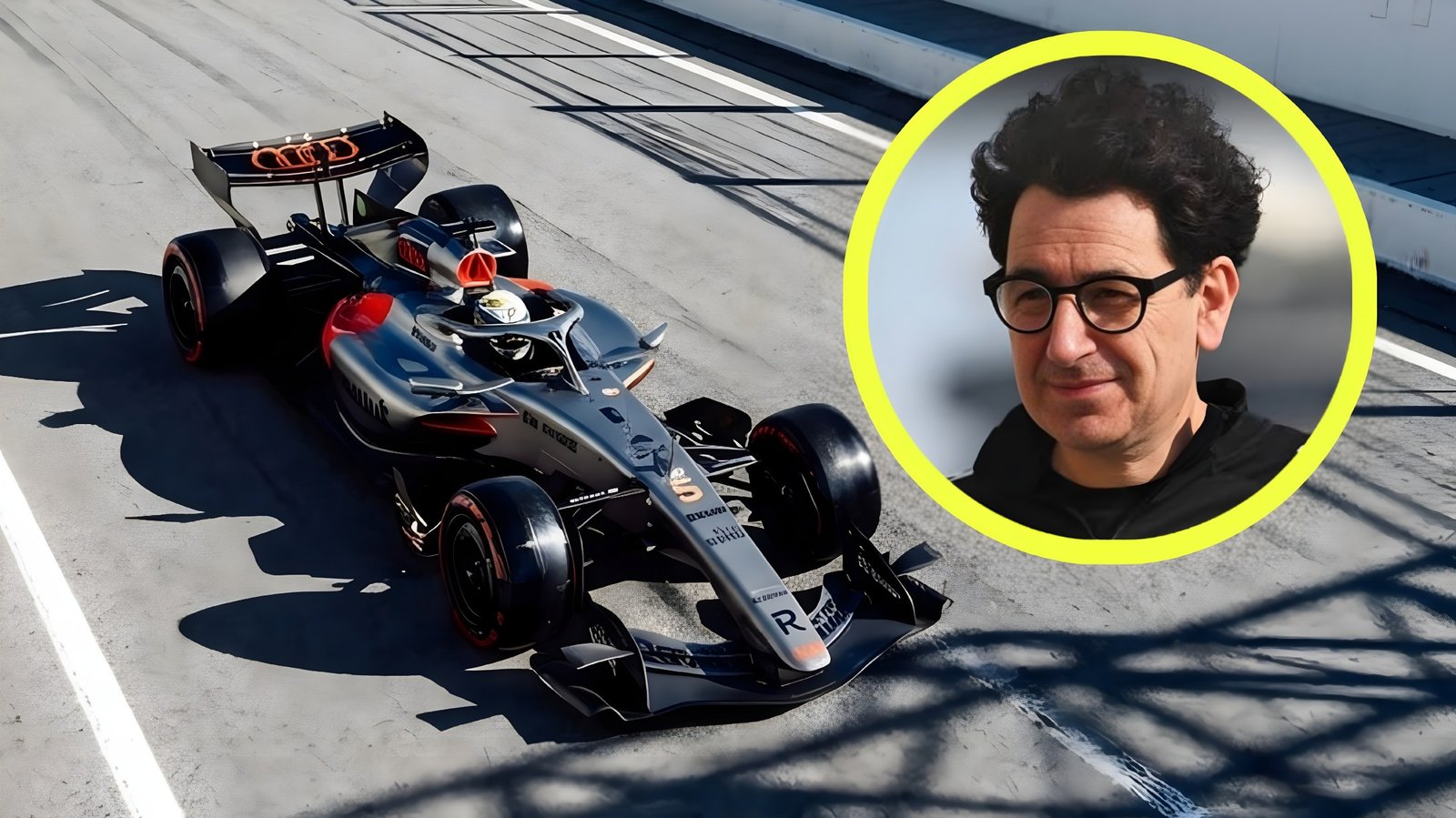
This is not merely a qualifying or practice curiosity. Race starts remain the most overt manifestation, but the inertia effect ripples through every acceleration zone: out of slow corners, under traction-control-limited getaways, and during defensive manoeuvres. Chassis integration compounds the difficulty. Prototype images circulating within the paddock reveal the intricate packaging compromises required to accommodate the bulkier turbo assembly within the tightly regulated 2026 monocoque envelope. The power unit is no longer an isolated component; it is a structural and aerodynamic partner to the chassis. Any late redesign risks cascading effects on weight distribution, centre-of-gravity height, and the aerodynamic philosophy that underpins the new active-aero regulations.
Yet Audi’s response has been one of quiet resolve rather than panic. Binotto’s appointment as team principal—following the departure of Jonathan Wheatley—brought precisely the steady hand required for such a moment. His experience at Ferrari during the early hybrid struggles of 2014-2016 taught him that public declarations of crisis achieve little when development timelines are measured in seasons, not weekends. Instead, the emphasis has remained on the bigger picture: a deliberate, three-phase roadmap explicitly articulated by the manufacturer since its entry announcement. Phase one, 2026 itself, is framed as the “challenger” year—consistent points, data collection, and the establishment of operational credibility. Phase two, targeted for 2027-28, envisions Audi as a genuine competitor capable of regular podiums and occasional race victories. Only by 2030 does the organisation expect to mount a sustained championship challenge.
This timeline is not marketing rhetoric; it is engineering realism. Early testing of the 2026 power unit had already flagged the compressor-inertia characteristics, yet the team viewed the gap as an anticipated cost of entry rather than a fatal flaw. New power-unit suppliers have historically paid a “new-entrant tax.” Honda’s return in 2015 with McLaren produced similarly painful early-season humiliations before the Japanese manufacturer climbed the performance curve. Renault’s works return in 2016 and even Mercedes’ own hybrid transition in 2014 required multiple seasons of iterative refinement. Audi, arriving with the full financial and technical backing of the Volkswagen Group, possesses the resources to absorb these lessons without the existential pressure that smaller independents once faced.
The human dimension cannot be overlooked. Hülkenberg, a veteran of 200-plus grands prix and a driver whose experience spans multiple power-unit generations, has absorbed the start-line penalties with characteristic stoicism. For rookie Bortoleto, however, the learning curve is steeper. The Brazilian’s raw talent is evident, yet the power-unit lag forces him to recalibrate race-craft fundamentals—braking points, defensive lines, and energy-management strategies—far earlier than anticipated. Both drivers, Binotto has emphasised, understand that their feedback is shaping a project whose payoff lies years ahead. In an era when driver contracts are increasingly tied to performance clauses, Audi’s long-term commitment offers rare stability.
Beyond the immediate competitive deficit, the turbo-inertia episode illuminates broader truths about modern Formula 1. The 2026 regulations were conceived to promote closer racing, sustainability, and cost control. Yet they have also amplified the premium placed on simulation fidelity and pre-homologation testing. Manufacturers can no longer rely on in-season “development races” to close performance gaps; the homologation freeze demands near-perfection at the point of submission. Audi’s experience may yet serve as a cautionary tale—or a blueprint—for any future entrant contemplating a full-factory return.
From a strategic standpoint, the power-unit issue has not derailed the overarching plan. The chassis side of the operation, now fully integrated under Sauber’s Hinwil base and rebranded for 2026, continues to evolve in parallel. Aerodynamic development under the new active-aero rules remains on target, and the team’s simulation tools have proven robust in predicting the inertia characteristics even if real-world validation has been sobering. The focus now shifts to incremental gains within the regulatory envelope: refined mapping strategies that mitigate the low-rpm torque hole, careful calibration of the electric motor deployment to mask the turbo lag, and continued dialogue with the FIA on the precise parameters of future ADUO windows.
For the wider Formula 1 ecosystem, Audi’s early difficulties underscore the sport’s enduring complexity. While casual observers may see only lost positions on lap one, insiders recognise a deeper narrative of institutional learning. The German manufacturer entered Formula 1 with eyes wide open, fully aware that its first season would be defined as much by setbacks as by breakthroughs. In an age of instant digital scrutiny, Binotto’s refusal to promise quick fixes is both refreshing and strategically sound. It signals to partners, sponsors, and the paddock that Audi is playing a longer, more disciplined game—one measured not by single-race headlines but by cumulative progress toward 2030 championship contention.
As the 2026 season unfolds, the narrative around Audi will likely evolve from “early struggles” to “methodical climb.” The large turbo compressor, once the symbol of a design compromise, may eventually be remembered as the catalyst that forced the engineering team to extract every last tenth from the sustainable-fuel architecture. For now, however, the priority remains clear: contain the performance deficit, protect reliability, and ensure that every kilometre of running yields data that accelerates the correction curve.
In the final analysis, Audi’s 2026 power-unit challenge is neither catastrophe nor surprise. It is the predictable consequence of a bold technical choice colliding with the unforgiving physics of a new regulatory era. Through Binotto’s leadership, the team’s disciplined roadmap, and the drivers’ resilience, the project retains its integrity and its ambition. The road to 2030 remains open; the first steps, however painful, are being taken with characteristic German thoroughness. Formula 1 has seen many such stories before. History suggests that those who endure the early inertia often emerge with the greatest momentum.


