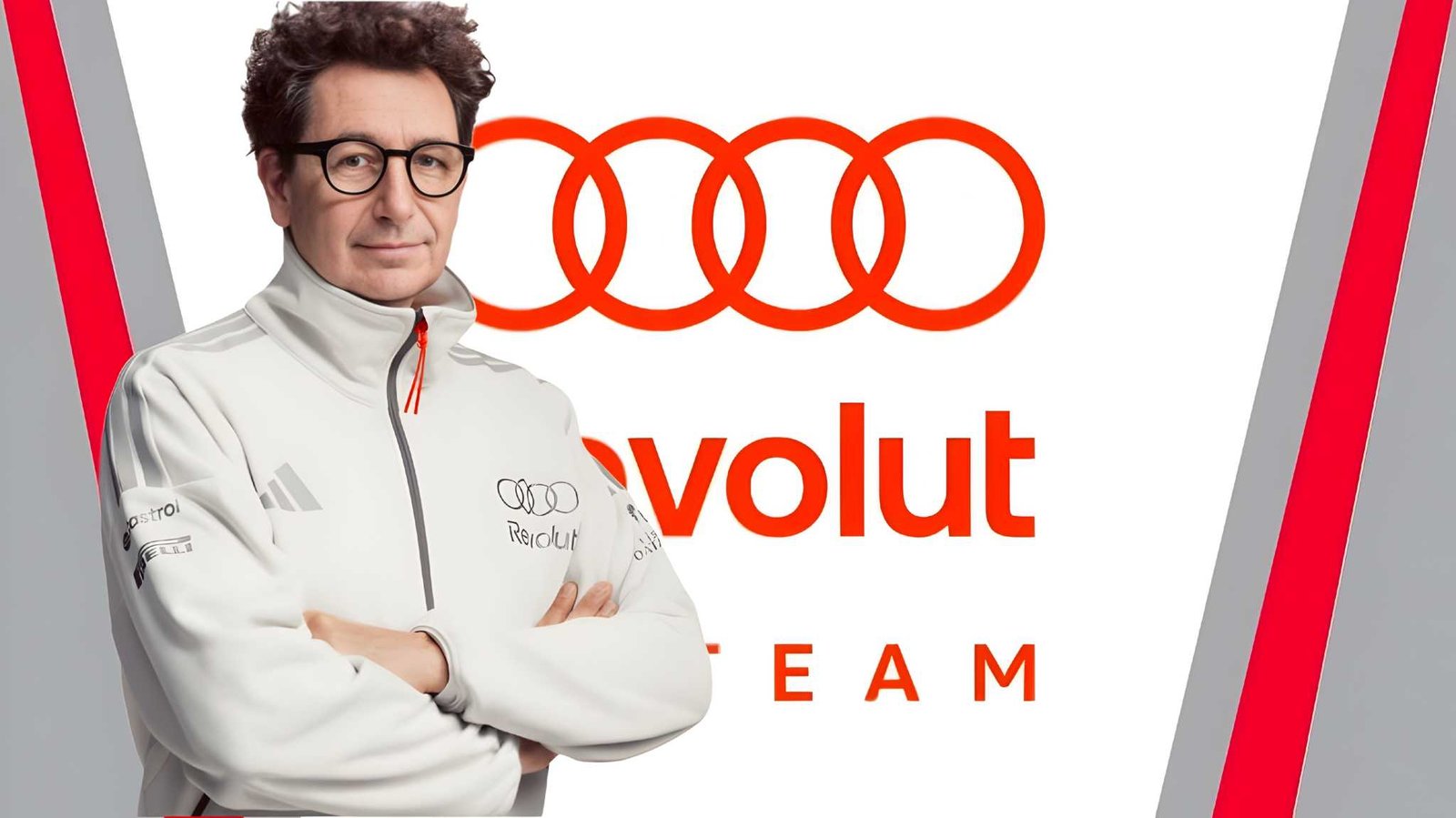
Published by: AutodromeF1 Editorial Team
Audi F1 2026: Binotto Assumes Full Command Amid Reliability Strain and Sudden Leadership Void
Audi F1 2026 Mattia Binotto has assumed full command amid reliability strain and the sudden exit of Jonathan Wheatley. This comprehensive assessment examines Audi’s turbulent start to its factory Formula 1 era and why Binotto is framing the five-week spring hiatus as a structural reset rather than a reprieve.
Audi’s first season as a full works entrant has arrived earlier than its maturity curve suggests. After acquiring Sauber and installing former Ferrari team principal Mattia Binotto as head of its F1 project, the German manufacturer entered 2026 with a dual mandate: learn the new power unit regulations while building operational credibility. Three races in, the scoreboard is thin, the start procedure is a liability, and the organizational chart has been redrawn.
Jonathan Wheatley, recruited from Red Bull to serve as team principal, left the Swiss-based operation after the second round for personal reasons. Binotto has absorbed the role and confirmed Audi will not appoint a direct successor in the short term. Speaking at Suzuka, he described the unexpected vacancy as a forcing function for reorganization, not a crisis.
On track, drivers Nico Hülkenberg and Gabriel Bortoleto have shown qualifying promise but have hemorrhaged positions at race starts, a weakness Binotto attributes primarily to power unit calibration and systems integration rather than driver procedure. The team finished both cars in Japan and executed clean pit stops, which Binotto cited as evidence of underlying operational discipline.
The cancellation of Bahrain and Saudi Arabia has created an unplanned five-week gap between Japan and Miami. Audi intends to use it for factory-side development, simulation correlation, and leadership redistribution. Binotto has been explicit: 2026 is not a championship year. The target remains 2030, and “miracles are not possible.”
Context: Why 2026 Was Always Going to Hurt
Audi’s path to the grid was never a simple rebrand. The project began with the purchase of Sauber, a midfield team that finished ninth in 2025, and accelerated with a sweeping 2024 restructure that removed Andreas Seidl and Oliver Hoffmann and placed Binotto in overall command.
The 2026 regulations compound the challenge for any new manufacturer. The power unit formula shifts to an approximate 50-50 split between internal combustion and electrical deployment, mandates 100% sustainable fuel, and imposes tighter energy management windows. For Audi, which is designing, building, and racing its own hybrid system for the first time, the learning slope is steep by design.
Binotto entered with more than 25 years at Ferrari, including technical directorship and team principal tenure during the 2022 title fight. His brief at Audi was broader than race-day leadership: oversee chassis and power unit integration at Hinwil and Neuburg, establish processes, and recruit a culture capable of sustained development.
Pre-season testing in Barcelona already flagged a long list of items. Both Hülkenberg and Bortoleto logged mileage but encountered early reliability interruptions. The team publicly tempered expectations, stating that closing the gap to Mercedes, Ferrari, McLaren and Red Bull would require multiple development cycles, not a single winter.
Binotto’s Leadership Test
The early races have confirmed that assessment. Audi sits in the lower midfield on pure pace, with occasional Q3 appearances offset by race-day losses. Mechanical issues have been less catastrophic than feared, but pace deficits, particularly in traction phases and energy deployment, have limited points opportunities.
Binotto’s messaging has remained consistent since Australia: acknowledge the gap, protect the development plan, and avoid reactive restructuring. After Japan, he characterized the weekend as “mixed feelings,” noting that completing the full distance with both cars represented tangible progress for a first-year power unit.
This is a different leadership posture than his Ferrari years, where external pressure demanded weekly explanations. At Audi, he controls both technical and sporting authority, reporting directly to the board. That concentration of responsibility is now total following Wheatley’s exit, placing Binotto at the center of factory transformation, trackside operations, and external communication.
Analysts inside the paddock describe this as Binotto’s most complex assignment: not optimizing an established winning machine, but building the machine itself while racing it. The early data suggests the chassis is competent in medium-speed corners, but the power unit’s driveability and start-mode torque delivery lag behind Ferrari and Mercedes, the current benchmarks for launch performance.
The Wheatley Departure
Wheatley’s tenure lasted roughly twelve months. He joined from Red Bull in April 2024, bringing a reputation for operational excellence and race control. Audi announced his departure last week, citing personal reasons and stating he could not commit long term.
Binotto told media at Suzuka that the decision was sudden. “It all happened very fast. Jonathan said he couldn’t commit for the long term for personal reasons. That is not for us to judge, we have to respect it,” he said, adding that Wheatley “had done very well in the team.”
Initial reports linked Wheatley to Aston Martin amid that team’s own restructuring around Adrian Newey. Audi did not confirm a destination, only that it had released him from duties immediately.
Crucially, Binotto confirmed Audi will not seek a like-for-like replacement. “We are not looking for a new team principal. We will reorganize ourselves and I will have to reorganize the structure of the team,” he told Germany’s Sky TV. The statement makes his interim role a semi-permanent one, at least through the European leg of the season.
Operationally, this means Binotto must split time between Neuburg, where the power unit program is based, and the track. He has acknowledged the strain: “My main focus is at the factory base where we need to transform the team… so I will need someone to support the team here at the race weekend.”
On-Track Reality: Starts, Reliability, and the Power Unit Gap
Japan crystallized Audi’s 2026 pattern. Both Hülkenberg and Bortoleto qualified within striking distance of the top ten, Bortoleto reaching Q3, but lost multiple positions at the start. “Poor starts have been a theme of Audi’s 2026 campaign so far,” with both drivers suffering another slow double getaway at Suzuka.
Bortoleto was blunt: “The start was not great, it’s something we know we need to work on as a team… It’s been terrible so far.” Hülkenberg echoed that the opening lap losses negated strong qualifying.
Binotto does not attribute this to procedure alone. “It has been a poor start, and it’s not the first time, so it’s certainly not our strength. At the moment, the reason it has not been addressed so far is because it’s not an obvious thing to be fixed.” He described starts as a top priority because strong grid positions are wasted if lost immediately.
The deeper issue is power unit maturity. Binotto assessed that “most of the gap we got to the top teams is from the power unit, which is not unexpected. We knew that would have been the biggest challenge.” Lead times for hardware concepts, energy store calibration, and software maps mean improvements will arrive in months, not weeks.
Reliability has been better than the headline suggests. In China, a pit stop failure cost Hülkenberg a points finish after a strong drive to eleventh. In Japan, by contrast, both cars finished without mechanical retirement. Binotto highlighted this as a baseline: operational execution must be flawless while performance is developed.
Operational Bright Spots
Despite the narrative of struggle, Audi’s race operations have shown discipline. After Suzuka, Binotto noted: “Reliability was strong throughout, and operationally the race was well executed, including consistent pit stops without issues.”
Pit stop times have been competitive with the midfield, and strategy calls have avoided the unforced errors that plagued Sauber in 2023-2024. For a team integrating new personnel, new tools, and a new power unit, clean execution is a non-trivial achievement. It suggests the Wheatley-era processes have embedded, even if the figurehead has departed.
Bortoleto’s ninth place in Australia delivered Audi’s first two championship points, a modest but symbolically important return for a debutant team. Hülkenberg’s experience has been central to correlating simulator data with track behavior, particularly around energy deployment strategies that are still evolving under the 2026 rules.
The Five-Week Reset
The 2026 calendar has been disrupted by geopolitical tensions in the Middle East, leading to the cancellation of Bahrain and Saudi Arabia. The result is an unusual five-week break between the Japanese Grand Prix and Miami.
Binotto has framed this not as a pause but as an engineering window. “A good opportunity for the necessary restructuring,” he said, referencing both organizational design and technical development. The extended factory time allows Audi to:
Reallocate Wheatley’s responsibilities across sporting, operations, and communications functions without the pressure of back-to-back flyaways.
Accelerate power unit reliability work and start-mode software iterations using dyno hours that would otherwise be consumed by race support.
Correlate Suzuka energy usage data with simulation models, critical for circuits like Miami and Barcelona where deployment strategy defines lap time.
Bortoleto has publicly called the break a “secret weapon,” a reflection of the team’s belief that development rate, not current performance, will determine its trajectory. Binotto tempers that optimism with realism: “We can improve a bit, but not in the short term to get to the Ferraris. I think it’s very difficult also with the Mercedes. I think we are still going to struggle a bit.”
Long-Term Direction: Integration Over Individuals
Audi’s public timeline has not changed. The board approved the F1 project on the basis of a learning phase through 2026-2027, competitiveness by 2028-2029, and title contention by 2030. Binotto repeats this cadence in briefings to manage expectations internally and externally.
His core thesis is that 2026 rewards adaptability. “The lead times on engine development are very long,” he explained, noting that Additional Development and Upgrade Opportunities (ADUO) will help but will not close the gap instantly. The team’s task is to identify the correct concepts now, validate them through the season, and introduce them when reliability is proven.
He has also pushed back against the cult of personality that often defines F1 leadership coverage. After assuming Wheatley’s duties, Binotto stressed collective responsibility over individual heroics, stating that Audi’s structure must function regardless of who occupies the pit wall. This aligns with his broader “Audi mindset” narrative introduced in 2024: process discipline, long-term thinking, and intolerance for short-term fixes that compromise 2027-2028 performance.
The power unit and chassis integration remains the central technical challenge. Unlike customer teams, Audi cannot iterate chassis around a mature engine. Both sides are evolving simultaneously, requiring tight feedback loops between Hinwil and Neuburg. Binotto’s dual technical and sporting role is designed to enforce that integration, even if it concentrates risk in one person.
What Comes Next
Miami will be the first test of the reset. Expect no major hardware step, but refined start procedures, updated energy maps, and potentially a revised operational structure trackside to reduce Binotto’s weekend load. The team is evaluating internal candidates to lead race operations, though no announcement is imminent.
The midfield battle remains fluid. Alpine, Haas, and Aston Martin have also struggled with the 2026 reset, meaning points are available through execution rather than outright pace. Audi’s best chance in the next three races is to qualify in the top twelve, survive the first lap, and capitalize on attrition, a strategy that requires exactly the reliability and pit stop consistency shown in Japan.
For Binotto, the measure of success in 2026 will not be podiums. It will be whether Audi leaves the season with a validated power unit architecture, a stable organization post-Wheatley, and a development slope steep enough to justify the 2030 ambition. He has been clear about the limits of rapid transformation: “We are very ambitious and we would like to see things solved in a couple of races. But sometimes that’s not the case… We are not here to create miracles.”
That candor may frustrate fans expecting immediate German efficiency, but it reflects the engineering reality of entering Formula 1 as a full works team under radically new regulations. The early pain is visible. Whether it becomes sustained gain will depend less on a single leadership appointment and more on whether the five-week reset produces the processes, tools, and culture Binotto has been hired to install.


