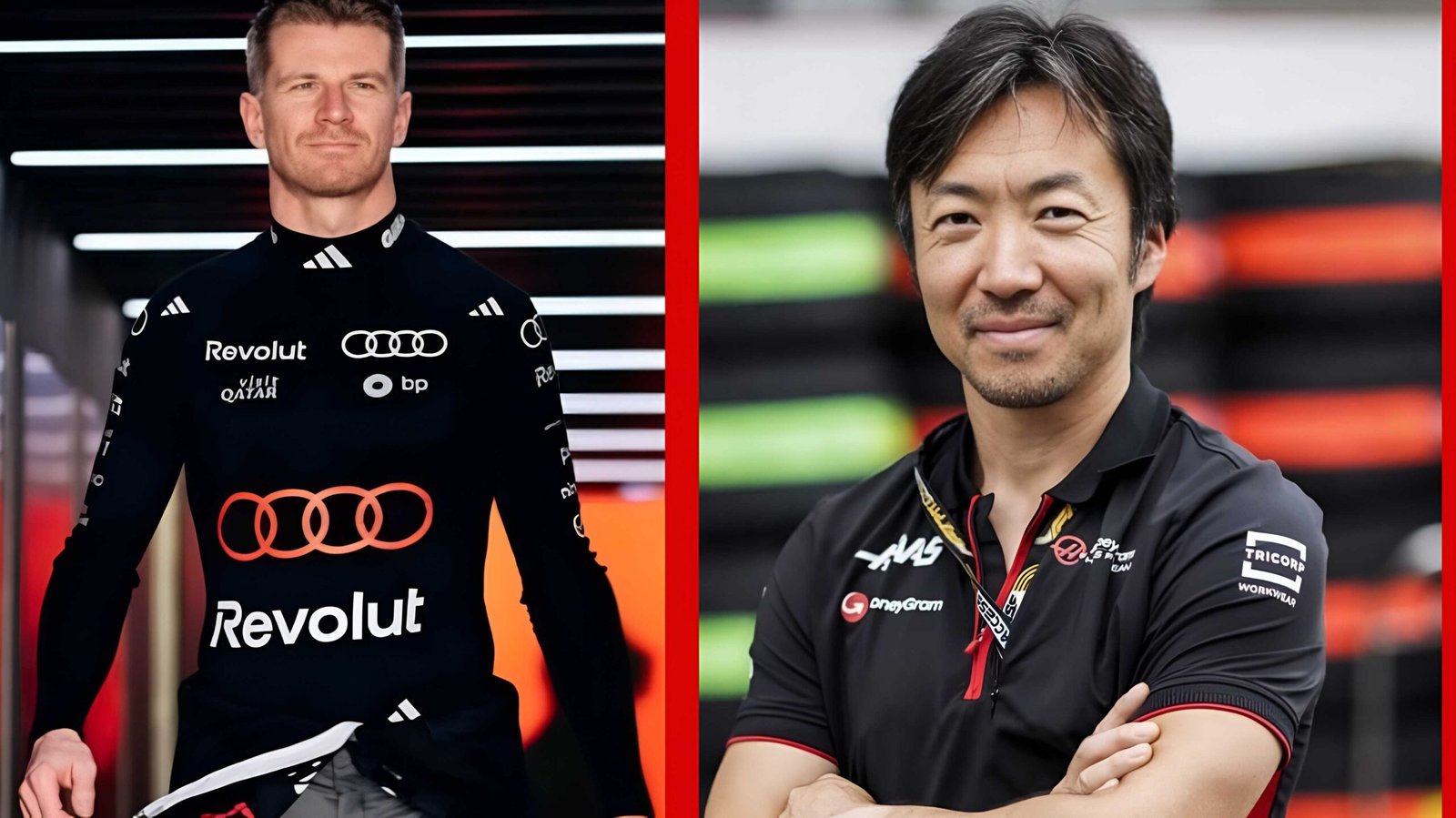
Formula 1 2026: Nico Hulkenberg in Audi-branded gear alongside Haas Team Principal Ayao Komatsu, who recently praised Audi’s engine data.
Published by: AutodromeF1 Editorial Team
London, 25 March – In an era of meticulously controlled narratives and guarded assessments, the Formula 1 paddock was stirred by an unusually candid and potent observation. It came not from an expectant insider or a hopeful partner, but from a direct competitor. Haas F1 Team Principal Ayao Komatsu, a man whose career is built on pragmatic engineering and data-driven analysis, delivered a verdict on Audi’s nascent 2026 power unit that has since reverberated through the sport’s corridors of power. Based on preliminary but critical GPS and straight-line speed data, Komatsu labeled the Audi project “very, very good.” This was no casual compliment; it was a stark, data-backed acknowledgment that a new and formidable force is rapidly coalescing on the horizon, poised to disrupt the established order even before its formal entry.
Komatsu’s remarks, coupled with the measured perspective of Audi’s own driver, Nico Hulkenberg, tear down the veil of speculation surrounding the 2026 regulations. They paint a picture not of a tentative newcomer finding its footing, but of a meticulously prepared giant awakening. Audi’s progress, evidenced by tangible performance metrics, challenges the very assumptions underpinning the current midfield hierarchy and signals the dawn of a new, technologically-driven power struggle in Formula 1. This is not merely a story about an engine; it is a deep-dive into the strategic, technical, and competitive shockwaves emanating from Ingolstadt, signaling that the 2026 battle has, in effect, already begun.
The Engineering Verdict: Deconstructing Komatsu’s Data-Driven Praise
In Formula 1, praise from a rival Team Principal is a rare currency, and when offered, it is seldom without profound underlying significance. Ayao Komatsu’s assessment of the Audi 2026 power unit was striking not only for its positive language but for its empirical foundation. By explicitly citing “GPS traces and straight-line speed data,” Komatsu elevated his comments from paddock chatter to a validated engineering observation. This is the language of performance analysis, where raw data strips away marketing spin and reveals undeniable truths about on-track capability.
GPS data in modern F1 provides a forensic level of detail far beyond simple top-speed measurements. It allows engineers to map a car’s velocity profile along every inch of a straight, revealing the intricate dance of energy deployment and regeneration. Komatsu’s analysis would have focused on key performance indicators (KPIs) that define the effectiveness of a contemporary power unit. He would have seen not just if the Audi-powered Sauber was fast, but how it was fast. This includes the initial acceleration phase, the efficiency of the MGU-K (Motor Generator Unit – Kinetic) in deploying its 120kW of electrical power, and, crucially, the power unit’s ability to sustain that performance without a significant drop-off towards the end of the straight—a phenomenon known as “clipping,” where the electrical energy store is depleted.
His statement that the unit is “very, very good” implies that the GPS traces showed a sophisticated and optimized energy management strategy. This suggests Audi is already mastering the complex interplay between its internal combustion engine (ICE) and its significantly more powerful 2026-spec electrical systems. The regulations for 2026 mandate a near 50/50 split between ICE and electric power, with the MGU-K’s output tripling to 350kW. Excelling in this new paradigm requires a fundamental rethink of power unit architecture and energy philosophy. Komatsu’s data indicates Audi is not just on the right path; they are significantly far along it.
Furthermore, his pointed dismissal of the notion that Haas’s current Ferrari power unit provides a “clear edge” was a masterstroke of strategic communication. On one level, it serves to manage expectations for his own team, subtly highlighting that their impressive early-season form is the result of operational excellence and aerodynamic efficiency, not merely engine superiority. On a deeper level, it sends a clear message to both competitors and the wider sport: the days of a clear and linear power unit hierarchy are ending. The 2026 regulations are a hard reset, and past performance is no guarantee of future success. By expressing “shock” at suggestions of Ferrari’s dominance, Komatsu is publicly recalibrating the competitive landscape, positioning Audi as an immediate and credible threat in the future midfield battle.
The Driver’s Reality: Nico Hulkenberg on the Frontline of Development
While Komatsu’s view from the pit wall provides the external validation, Nico Hulkenberg’s perspective from the cockpit offers the critical internal reality check. As the lead driver for the team that will become the full Audi works entry, his feedback is the ultimate arbiter of the power unit’s true performance. Hulkenberg, a veteran of over 200 Grands Prix, acknowledged the “solid role” the engine has played in the team’s competitive start to the season, confirming that the fundamental platform is strong. His comments align with Komatsu’s data, suggesting the power unit delivers effective and usable performance on track.
However, his immediate pivot to the “ongoing challenges” and the “lot of work and cleaning up to do” provides essential context. This is the voice of a development driver at the sharp end of an ambitious project. While the power unit’s core attributes—its power, its energy deployment—are evidently impressive, the process of integrating it into a cohesive and consistently performing race car is a monumental task. The “cleaning up” he refers to likely involves refining software, improving driveability, ensuring reliability under grueling race conditions, and optimizing the complex interactions between the power unit and the chassis.
Most revealing was his emphasis on a key strategic disadvantage: being the “only team without customer data.” In the world of F1 engine manufacturing, data is everything. Manufacturers like Mercedes, Ferrari, and Honda supply multiple teams, allowing them to gather millions of data points every weekend from different chassis, different drivers, and different operating conditions. This vast dataset accelerates development, helps identify and rectify faults, and allows for the rapid optimization of engine maps and operational strategies.
Audi, in its current guise as Sauber’s supplier, operates in a data silo. Every lap Hulkenberg and his teammate complete is a precious learning opportunity, but their pool of information is a fraction of what their rivals possess. This “data gap” means that while the core hardware may be excellent, the software and operational maturity will take longer to achieve. Hulkenberg’s honesty underscores the scale of the task ahead. Audi is not just building an engine; it is building the entire ecosystem of knowledge, processes, and experience required to operate a winning power unit at the highest level. His candidness serves as a necessary counterweight to the external hype, grounding the project in the reality of hard work and incremental gains that are still required. The potential is immense and clearly visible, but its full realization remains a work in progress.
The Strategic Context: 2026 and the Reshaping of the Midfield
The praise for Audi’s power unit is not happening in a vacuum. It is set against the backdrop of the most significant regulation change in a generation—the 2026 technical rules. These new rules, centered around a 50/50 power split and the use of 100% sustainable fuels, are expressly designed to level the playing field and attract new manufacturers. Audi’s decision to enter as a full works team, taking over the established Sauber operation, was a direct response to this opportunity.
Komatsu’s comments confirm that the regulations are having their intended effect. The impending arrival of Audi, alongside Ford’s partnership with Red Bull Powertrains, is creating a new dynamic. The traditional midfield, long dominated by customer teams reliant on established manufacturers, is facing a paradigm shift. Haas, currently a customer of Ferrari, will find itself competing against a full works Audi team with a power unit that is, by early indications, already a benchmark. Alpine, as a works team itself, will face a new and highly resourced rival. The competitive calculus is being rewritten.
This praise for Audi also shines a spotlight on the inherent challenges and vulnerabilities of the existing power unit manufacturers. While they possess a wealth of experience, they are also bound by legacy architectures and development paths. Audi had the strategic advantage of a “clean sheet” design. They could architect their power unit from the ground up, with its core design principles tailored specifically to the unique demands of the 2026 rules. There is no legacy code, no compromised hardware, no developmental baggage. This has allowed them to pursue innovative solutions and optimize for a high-output electrical system without being constrained by past designs.
The early success of this approach, as validated by rival data, serves as a warning shot to the entire grid. It signals that brand heritage and past championships may count for little in this new era. The teams and manufacturers who can most effectively master the new technical challenge—the complex interplay of a downsized ICE, a powerful hybrid system, and advanced sustainable fuels—will be the ones who thrive. Komatsu’s public acknowledgment of Audi’s prowess is the first concrete sign that the 2026 competitive order may look very different from today’s, with a well-prepared and data-driven Audi poised to be a central protagonist in the fight for midfield supremacy and beyond.


