Published by: AutodromeF1 Editorial Team
Audi Forges Leadership Stability Amid Ambitious 2026 Horizon: Mattia Binotto Absorbs Team Principal Responsibilities Following Jonathan Wheatley’s Abrupt Exit
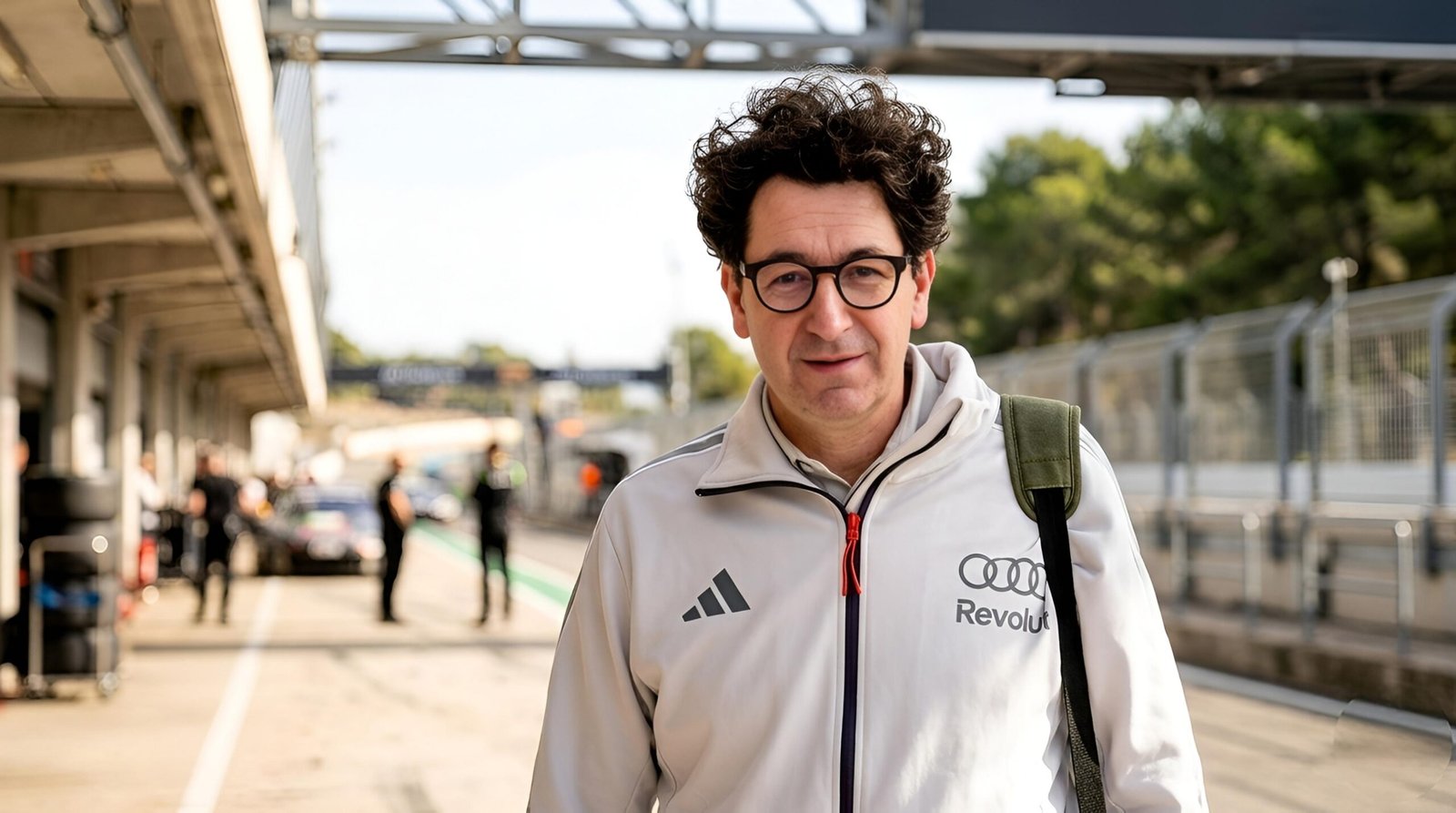
Berlin, Germany April 8 – In a decisive move that underscores Audi’s commitment to internal cohesion and long-term strategic oversight during the most critical phase of its Formula 1 re-entry, Mattia Binotto has confirmed that the German manufacturer will not appoint a direct replacement for Jonathan Wheatley as team principal. Binotto, who serves as the overarching leader of Audi’s entire F1 project, has elected to integrate Wheatley’s former duties into his own portfolio, thereby maintaining continuity at the apex of the organisation while supplementing race-weekend operations with dedicated trackside support rather than installing a like-for-like successor.
This development, disclosed by Binotto in a statement issued on 6 April 2026, represents a notable pivot from earlier indications that the squad—operating under the transitional Sauber banner this season—would move swiftly to fill the vacancy created by Wheatley’s sudden departure. The Briton’s exit, effective immediately prior to the Japanese Grand Prix in late March, was characterised by Binotto as “very unexpected,” with the official explanation centring on personal reasons. Nevertheless, paddock speculation has persistently linked the departure to overtures from rival constructor Aston Martin, a narrative that adds a layer of intrigue to an already complex transitional period for the Hinwil-based outfit.
The decision to retain the team principal role within Binotto’s remit reflects a calculated emphasis on stability and institutional knowledge at a juncture when Audi is investing unprecedented resources into transforming a customer team into a full-fledged works operation ahead of the sport’s landmark regulatory overhaul in 2026. With new power-unit regulations, chassis specifications, and a heightened focus on sustainable fuels set to redefine competitive hierarchies, the manufacturer is acutely aware that organisational friction could prove costly. By eschewing an external hire at this sensitive moment, Audi signals confidence in Binotto’s multifaceted expertise—honed across decades at the pinnacle of the sport—and a preference for evolutionary refinement over disruptive reinvention.
Binotto’s expanded remit is not without precedent in elite motorsport. Having previously guided Ferrari through periods of both resurgence and challenge during his tenure as team principal from 2019 to 2022, the Italian engineer-turned-leader brings a rare blend of technical acumen, operational rigour, and crisis management capability. His appointment to helm Audi’s F1 project was always envisioned as a holistic one, encompassing power-unit development at the marque’s dedicated facility, chassis integration at Hinwil, and overarching strategic direction. Wheatley, by contrast, was recruited specifically for his formidable trackside and race-operational pedigree, forged during more than two decades at Red Bull Racing, where he played a pivotal role in the team’s dominant championship campaigns. His brief but impactful tenure at Audi was widely regarded as a bridge between the squad’s current midfield status and the factory-level ambitions scheduled to materialise next season.
The timing of Wheatley’s exit could scarcely have been more delicate. Occurring just days before the Japanese Grand Prix—a venue historically significant for technical validation and aerodynamic correlation—the departure risked unsettling an already intensive preparation phase. Binotto, however, moved to quell any perception of instability. “We had always anticipated a period of adjustment as we scale the project,” he remarked in the 6 April clarification, implicitly addressing earlier reports of an active search for a successor. “Jonathan’s contribution was substantial, and his decision, though unforeseen, has prompted us to reinforce rather than replace. I will continue to lead at the highest level, supported by additional expertise at the circuit that will ensure seamless race-weekend execution.”
This nuanced approach—retaining ultimate authority while delegating operational trackside elements—marks a sophisticated evolution in Audi’s leadership architecture. It avoids the onboarding risks associated with parachuting in a new principal mid-season, when cultural alignment, technical familiarisation, and interpersonal dynamics within a rapidly expanding workforce (now numbering over 800 across key sites) are paramount. Industry observers with deep experience in Formula 1 governance note that such internal consolidation is frequently the hallmark of organisations prioritising long-term engineering excellence over short-term optics. In this regard, Audi appears to be drawing lessons from its own storied history in endurance racing, most notably its record-breaking successes at the 24 Hours of Le Mans, where sustained leadership continuity proved instrumental in translating technical innovation into on-track supremacy.
The broader context of Audi’s F1 restructuring further illuminates the strategic wisdom of Binotto’s stance. Since the manufacturer’s formal announcement of its full works entry—initially through a progressive stake acquisition in the Sauber Group—the project has been characterised by methodical, multi-year planning. Power-unit development at Audi Sport’s headquarters in Neuburg an der Donau has progressed in parallel with chassis and aerodynamic advancements in Switzerland, all calibrated to the 2026 regulations that will introduce more powerful electric components, reduced drag, and a mandatory sustainable fuel mandate. These changes are expected to level the playing field in ways not seen since the hybrid era’s inception, presenting both opportunity and peril for incumbent manufacturers and newcomers alike.
Wheatley’s departure, while unanticipated, occurs against this backdrop of deliberate acceleration rather than panic. Earlier media coverage in late March had suggested Audi might expedite a high-profile appointment to maintain momentum. Binotto’s latest pronouncement decisively reframes the narrative: the organisation is not in reactive mode but is instead optimising its existing leadership bandwidth. The addition of “trackside support” personnel—likely seasoned race engineers or deputy-level figures with proven circuit credentials—will allow Binotto to maintain strategic oversight from the factory while ensuring that operational decision-making during grands prix remains incisive and data-driven. This hybrid model echoes successful precedents at other constructors, where chief executives or technical directors have periodically assumed principal duties without compromising overall performance trajectories.
From an organisational psychology perspective, the move also mitigates the risk of “founder’s syndrome” in reverse—whereby an incoming external leader might inadvertently disrupt the delicate chemistry being cultivated between Audi’s German engineering precision and the pragmatic, race-hardened culture inherited from Sauber. Binotto’s familiarity with both the power-unit and chassis sides of the operation positions him uniquely to arbitrate resource allocation, prioritise development pathways, and foster cross-functional collaboration. His decision to forgo a direct replacement thus carries an implicit message of trust in the team’s internal talent pipeline, a quality that will be essential as Audi ramps up recruitment for specialised roles in simulation, aerodynamics, and vehicle dynamics ahead of next year’s step-change.
Financially and reputationally, the implications are equally significant. Audi’s parent company, the Volkswagen Group, has committed substantial investment—widely estimated in the hundreds of millions of euros—to ensure the project meets the exacting standards expected of a premium German marque. Any perception of leadership turbulence could have ripple effects on sponsor confidence, partner negotiations, and talent acquisition. By projecting measured continuity, Binotto not only safeguards internal morale but also reassures stakeholders that the 2026 debut will be approached with the same methodical discipline that has defined Audi’s most successful motorsport campaigns.
Looking ahead, the absence of a named successor raises intriguing questions about the depth of Audi’s bench. Will the trackside support role evolve into a more formal deputy principal position, or might it remain a flexible, rotating function filled by existing senior figures? Binotto has left the door open to further refinements, emphasising that the priority remains “building a structure that is robust enough to compete at the very highest level from day one in 2026.” With the current campaign serving as a developmental proving ground—where the team is expected to focus on reliability, correlation, and data accumulation rather than podium contention—this leadership model may prove prescient.
Comparisons with peer organisations are instructive. Mercedes, under Toto Wolff’s long-standing stewardship, has thrived on a similarly integrated leadership approach, blending commercial, technical, and racing responsibilities. Red Bull, conversely, has historically distributed authority across a triumvirate of senior executives, a model that delivered sustained dominance but required exceptional interpersonal alignment. Ferrari’s periodic leadership rotations have occasionally yielded short-term boosts at the expense of strategic consistency. Audi, it seems, is charting a middle path—one that leverages Binotto’s proven resilience while acknowledging the irreplaceable value of dedicated circuit presence.
In the final analysis, Binotto’s confirmation on 6 April 2026 is far more than an administrative footnote; it is a declaration of strategic intent. As Formula 1 stands on the cusp of its most profound regulatory transformation in a generation, Audi is choosing evolution over revolution in its leadership ranks. The manufacturer’s full 2026 entry will test not only its technical prowess but also the organisational maturity required to translate ambition into results. By placing faith in continuity and targeted reinforcement, Binotto has positioned the team to navigate the inevitable challenges with clarity and purpose.
Whether this approach yields the competitive breakthrough Audi craves remains to be seen on the asphalt of Bahrain, Melbourne, and beyond. What is already evident, however, is a level of executive confidence and forward-thinking pragmatism that distinguishes the project from more reactive counterparts. In an era when Formula 1’s commercial and technological stakes have never been higher, such measured leadership may ultimately prove the most potent competitive advantage of all.


