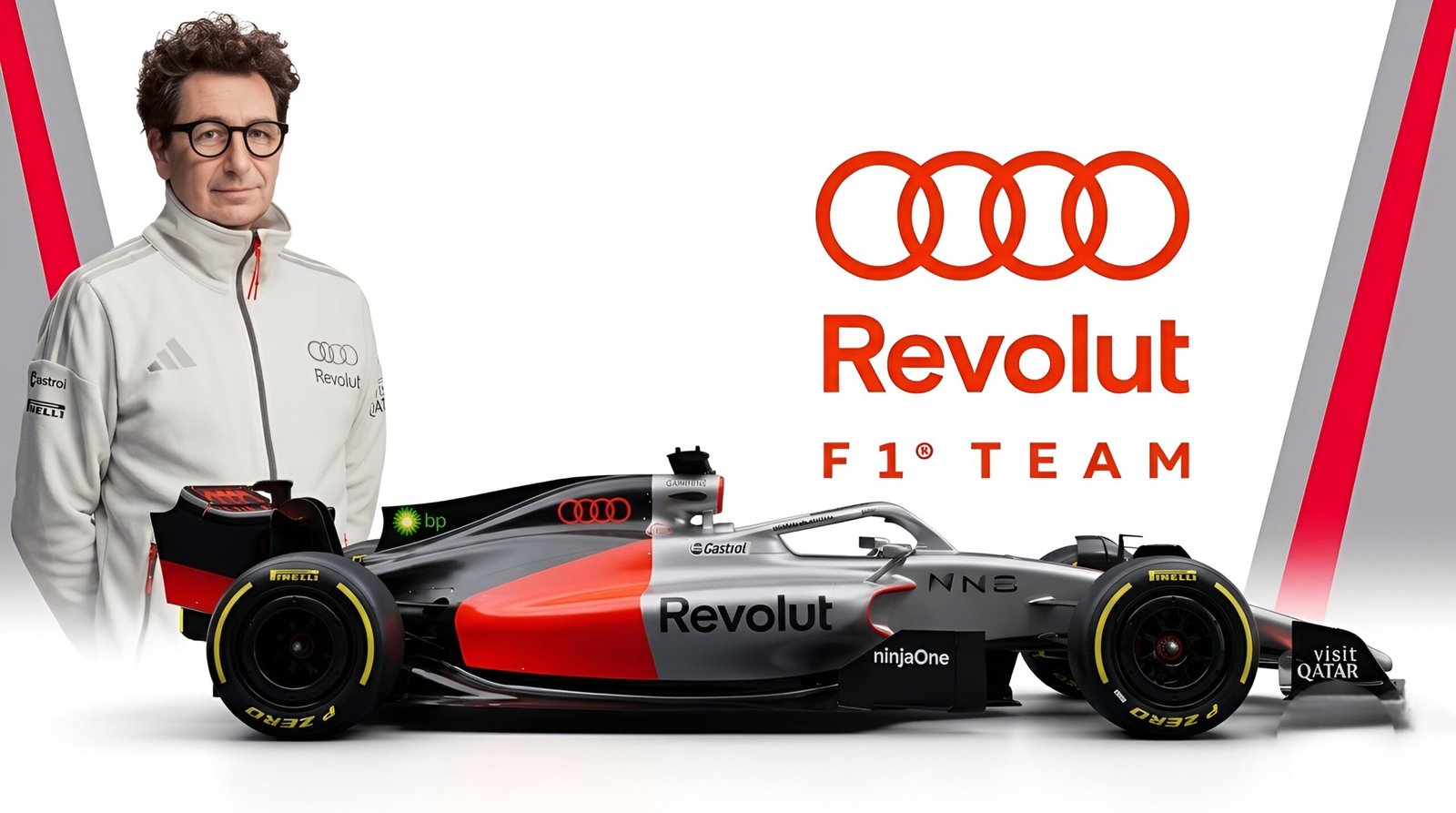
Audi Revolut F1 Team Confirms Urgent Recruitment for Senior Race Weekend Manager as Jonathan Wheatley Departs After Brief Tenure
Published by: AutodromeF1 Editorial Team
Mattia Binotto to Shoulder Temporary Trackside Leadership While Steering Factory Transformation; Move Underscores Audi’s Unwavering Long-Term Commitment to F1 Excellence
In a development that has sent ripples through the Formula 1 paddock just two races into the 2026 World Championship season, the Audi Revolut F1 Team has officially confirmed it is actively seeking a new senior race weekend manager. The announcement follows the sudden and unexpected departure of Jonathan Wheatley, whose exit—framed by the team as motivated by personal reasons—has nonetheless ignited widespread speculation about a potential move to Aston Martin.
The news was delivered with characteristic precision by Mattia Binotto, who holds the dual mantle of Head of the Audi F1 Project and Team Principal. Speaking from the team’s Hinwil base in Switzerland, Binotto emphasised that the transition reflects no disruption to core operational stability but rather a strategic recalibration to ensure dedicated, high-calibre leadership at the track while he maintains overarching responsibility for the project’s broader transformation.
“This is not a moment of crisis, but one of deliberate evolution,” Binotto stated. “Jonathan contributed significantly during the critical handover phase, and we respect his decision to step away for personal reasons. Our race operations remain robust, yet the demands of competing at the highest level in Formula 1 require a singularly focused senior figure on the pit wall and in the garage. I will assume temporary oversight of trackside activities to maintain continuity, allowing me to continue prioritising the factory-wide initiatives that will define our competitiveness for years to come.”
Wheatley’s tenure proved remarkably short. Having joined the organisation—then operating as Sauber—during the 2025 preparatory period, he oversaw the team’s first two grands prix of the new era under Audi branding. His responsibilities encompassed the intricate coordination of race strategy, pit-crew execution, logistics, and real-time decision-making that separates midfield survival from podium contention. Insiders familiar with the situation describe his exit as amicable yet abrupt, with the personal reasons cited in the official statement serving as the sole public explanation.
While the official narrative remains centered on personal matters, industry observers have noted the vacant senior roles at Aston Martin following their recent restructuring. Within the high-pressure environment of the 2026 paddock, such vacancies naturally invite speculation regarding a potential move for a veteran of Wheatley’s caliber. However, it is important to note that neither Audi Revolut nor Aston Martin has validated these rumors, and the transition currently remains an internal operational shift for the Hinwil-based squad.
Binotto’s decision to retain Team Principal duties on an interim basis is a testament to his extensive experience and the trust placed in him by Audi’s board in Ingolstadt. The Italian engineer, who previously guided Ferrari through a period of resurgence before joining the Audi project in late 2024, brings unparalleled expertise in both technical development and high-pressure race management. His dual focus—factory transformation on one hand, temporary trackside stewardship on the other—illustrates a pragmatic approach to leadership that prioritises long-term architectural integrity over short-term expediency.
At the heart of Audi’s strategy lies an ambitious factory-wide overhaul. The Hinwil facility, once the modest home of Sauber, has undergone a multi-year modernisation programme that includes state-of-the-art simulation centres, expanded power-unit test benches, and enhanced aerodynamic infrastructure. Binotto has repeatedly described this as the “foundation phase,” essential for positioning Audi not merely as a participant but as a genuine championship contender by the end of the decade.
“The 2026 regulations represent a generational reset,” Binotto noted in a recent internal briefing made available to select media. “Sustainable power units, active aerodynamics, and a tightened cost cap demand a holistic re-engineering of processes. While the race team executes on Sundays, our engineers, designers, and strategists are building the platform for sustained excellence through 2030 and beyond. Trackside leadership must complement, not distract from, that mission.”
The team’s 2026 livery, unveiled earlier in the year and prominently displayed on the R26 chassis during pre-season testing and the opening rounds, embodies this forward-looking ethos. Rendered in a sophisticated titanium silver base with striking red accents, black carbon-fibre highlights, and the iconic four-ring logo prominently positioned on the engine cover and rear wing, the design projects German precision fused with Italian passion for motorsport heritage. The livery’s clean, minimalist aesthetic—free of excessive sponsor clutter thanks to the headline partnership with Revolut—has been widely praised for its visual elegance and symbolic weight. It signals Audi’s arrival not as a rebranded also-ran but as a manufacturer committed to redefining the sport’s technological frontier.
Early-season performance data remains closely guarded, as is customary for a new entrant navigating uncharted regulatory waters. However, reliable sources within the team indicate that technical teething issues typical of a power-unit debut have been managed effectively, with the chassis demonstrating encouraging traits in high-speed corners and braking zones. The departure of Wheatley, while disruptive at the operational level, has not compromised these foundational gains, according to Binotto’s assessment.
The search for a successor is already well advanced, with the team understood to be evaluating candidates possessing proven track records in senior race engineering or strategy roles at top-tier outfits. Industry observers suggest the ideal profile would combine deep technical acumen with exceptional crisis-management skills—qualities essential in an era where races are increasingly decided by split-second calls on tyre strategy, energy deployment, and safety-car interventions. Internal promotions remain a possibility, yet the complexity of the 2026 package may necessitate an external hire with fresh perspectives.
This episode also highlights a broader truth about modern Formula 1: the sport’s competitive intensity now extends far beyond the cockpit and wind tunnel. In an environment where budgets are capped yet performance expectations remain stratospheric, human capital at the operational apex has become a decisive differentiator. Teams such as Mercedes, Red Bull, and McLaren have historically thrived not solely on engineering brilliance but on the seamless integration of factory and trackside excellence. Audi’s proactive response to Wheatley’s exit demonstrates a mature organisational culture that refuses to allow personnel flux to derail its multi-year roadmap.
Looking ahead, the 2026 season offers Audi a unique platform. The regulatory overhaul—featuring more sustainable fuels, reduced downforce in certain configurations, and a greater emphasis on power-unit efficiency—levels the playing field in ways not seen since the hybrid era’s inception. For a manufacturer of Audi’s stature, with its storied success in endurance racing, rallying, and DTM, the transition to F1 represents both opportunity and obligation. Binotto’s leadership, forged in the crucible of Ferrari’s intense rivalry with Mercedes and Red Bull, positions the team to capitalise on this window.
By 2030, Audi envisions itself among the sport’s elite, challenging for constructors’ and drivers’ titles on merit rather than through transitional goodwill. Achieving that ambition will require continuity in key roles, relentless iteration on the power unit, and the cultivation of a culture that attracts and retains the finest talent. The current recruitment drive for a senior race weekend manager is but one piece in that intricate puzzle.
As the European leg of the calendar approaches, the paddock will watch closely how Audi navigates this transitional period. Binotto’s temporary assumption of trackside duties—while continuing to oversee power-unit development in Neuburg and chassis evolution in Hinwil—exemplifies the kind of versatile, high-stakes leadership that separates aspiring contenders from established powerhouses.
In an industry often criticised for its volatility, Audi Revolut F1’s measured response to internal change radiates quiet confidence. It reaffirms that true championship pedigree is built not in the glare of race-day spotlight alone, but through the disciplined, often invisible work of organisational resilience and strategic foresight. The team’s message is unambiguous: the journey has only just begun, and every recalibration serves a singular, unwavering goal—sustained excellence on the global stage of Formula 1.


