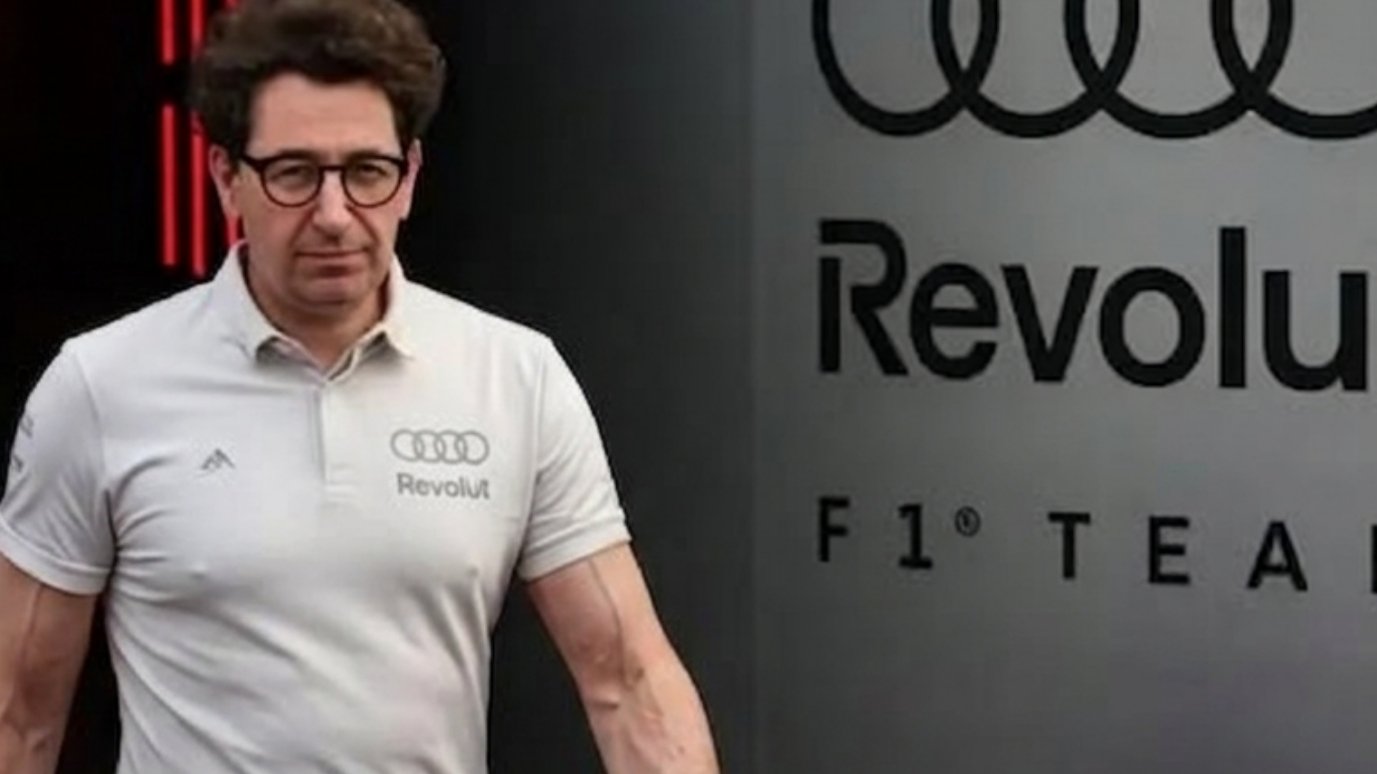
Mattia Binotto transitions to interim Team Principal for the Audi F1 project following the departure of Jonathan Wheatley in March 2026.
Published by: AutodromeF1 Editorial Team
Audi F1 Leadership Realignment: Mattia Binotto Takes Interim Helm as Jonathan Wheatley Departs in Surprise Transition
London, 27 March – In a development that underscores the meticulous precision with which Audi is engineering its long-awaited return to Formula 1 as a full works team, the German manufacturer has confirmed a significant leadership adjustment within its Sauber-to-Audi transition project. On Friday, 20 March 2026, Jonathan Wheatley, who had served as Team Principal since April 2025, stepped down from the role citing personal reasons. Audi acted with characteristic decisiveness, releasing him from his duties with immediate effect. Stepping into the breach on an interim basis is Mattia Binotto, the project’s Chief Operating Officer and Chief Technical Officer, whose appointment signals a deliberate, factory-centric recalibration at this pivotal juncture ahead of the 2026 regulatory overhaul.
This move, while framed as temporary, carries profound strategic weight. It reflects not merely a personnel change but Audi’s unwavering commitment to prioritising foundational engineering excellence over immediate operational theatre. Binotto’s dual mandate—retaining his COO and CTO responsibilities while assuming Team Principal duties—positions him at the nexus of Hinwil’s chassis development and Neuburg’s power-unit programme, the twin pillars upon which Audi’s 2026 ambitions rest. Far from a stop-gap measure born of expediency, the arrangement embodies a calculated refocus: one that channels senior leadership energy back into the design offices and test benches rather than the paddock’s daily rhythms.
The Departure of Jonathan Wheatley: Context and Implications
Jonathan Wheatley’s tenure, though brief, was integral to the early stabilisation of the former Sauber outfit. Recruited in April 2025 as part of the broader leadership infusion that accompanied Audi’s formal commitment, Wheatley brought with him a wealth of operational experience honed at the highest levels of the sport. His departure, announced just days before the Japanese Grand Prix weekend, was handled with the transparency and professionalism that has become synonymous with Audi’s corporate culture under its F1 stewardship.
Official statements from the manufacturer emphasised that the exit was prompted exclusively by personal circumstances, with no reflection on performance or strategic alignment. “We respect Jonathan’s decision and wish him every success in his future endeavours,” read the carefully worded release. Yet the speed of the separation—immediate effect rather than a phased handover—highlights Audi’s operational agility. In an industry where leadership transitions can linger amid contractual complexities, the swift resolution speaks volumes about the maturity of the Hinwil-based organisation and its preparedness for the demands of a manufacturer-led campaign.
Insiders familiar with the project note that Wheatley’s role had increasingly centred on paddock-facing responsibilities: race-weekend execution, stakeholder coordination, and the integration of new personnel into a squad still absorbing the cultural shift from independent team to corporate powerhouse. While these elements remain vital, the accelerating timeline toward 2026 has evidently prompted a strategic pivot. With the new power-unit regulations looming—featuring sustainable fuels, reduced displacement, and enhanced electrical deployment—Audi has determined that technical continuity at the factory level must take precedence.
Mattia Binotto: The Architect Assumes Command
Few figures in modern Formula 1 embody technical authority and institutional memory as comprehensively as Mattia Binotto. A mechanical engineer by training, Binotto’s career trajectory—from his early days at Ferrari’s engine department through to his stewardship of the Maranello operation as Team Principal—has been defined by an uncompromising focus on power-unit innovation, aerodynamic integration, and cross-functional collaboration. Since joining the Audi project in 2024, he has functioned as the de facto architect of its technical renaissance, orchestrating parallel development streams across Switzerland and Germany.
In assuming interim Team Principal responsibilities, Binotto will continue to divide his time between Hinwil, where chassis and aerodynamics are advanced under the watchful eye of the Sauber engineering nucleus, and Neuburg, the nerve centre of Audi Sport’s power-unit programme. This geographic duality is no coincidence; it mirrors the very structure of the 2026 regulations, which demand seamless harmony between chassis philosophy and energy-recovery systems. Binotto’s statement, issued shortly after the announcement, captured the essence of the realignment with characteristic clarity and foresight.
“We remain steadfast in our belief that sustainable success in Formula 1 is forged in the factories, not solely on the circuit,” he remarked. “My focus, alongside my existing duties, will be to ensure that every resource at Hinwil and Neuburg is optimally directed toward delivering a competitive platform for 2026. The paddock operations will continue under the capable day-to-day oversight of our established operational leads, allowing me to maintain the engineering momentum that has defined this project from its inception.”
The interim nature of the appointment is explicit. Audi has already signalled its intention to relaunch the search for a permanent Team Principal—or potentially a dedicated Race Director—once the immediate transition period concludes after April 2026. This measured approach avoids the pitfalls of hasty recruitment while preserving institutional knowledge. Binotto’s elevation is thus less a promotion than a strategic consolidation, enabling the organisation to weather the leadership vacuum without compromising the relentless development cadence required for the new era.
Strategic Context: Audi’s 2026 Horizon
To fully appreciate the significance of this leadership adjustment, one must situate it within Audi’s broader F1 odyssey. The manufacturer’s entry as a works team in 2026 represents the culmination of years of planning, investment, and cultural transformation. The acquisition and rebranding of Sauber—initially a customer outfit—into a fully integrated Audi Sport entity has demanded not only technical upgrades but a fundamental recalibration of organisational DNA. From infrastructure expansions at both sites to the recruitment of over 300 specialist engineers, the project has been executed with the methodical rigour expected of a company whose automotive pedigree includes multiple Le Mans victories and a relentless pursuit of technological leadership.
The 2026 regulations, with their emphasis on 50% electrical power contribution, sustainable drop-in fuels, and a chassis architecture that prioritises active aerodynamics and energy efficiency, present both opportunity and risk. Audi’s decision to develop its own power unit in-house—rather than relying on external supply—underscores its ambition to control the entire performance envelope. Yet this vertical integration also amplifies the importance of internal cohesion. Binotto’s technical oversight has already yielded tangible progress: advanced simulation capabilities, wind-tunnel correlation improvements, and power-unit dyno milestones that place the programme ahead of many internal benchmarks.
By refocusing senior leadership on these factory sites, Audi is effectively doubling down on its core differentiator: engineering depth. This is no retreat from competitive ambition but a recognition that the foundation must be impregnable before the superstructure can rise. The paddock, while critical for race execution, can be managed through delegated authority; the laboratories and design studios, by contrast, require the unfiltered attention of the project’s most experienced technical mind.
Operational Continuity and the Road Ahead
In practical terms, day-to-day race operations will proceed without disruption. The existing cadre of sporting and engineering directors—many of whom were retained or elevated during the transition—will continue to interface with the FIA, suppliers, and rival teams. Binotto’s presence at select events will ensure strategic alignment without diluting his factory mandate. This hybrid model draws precedent from successful manufacturer programmes elsewhere in the sport, where technical principals have periodically assumed broader oversight to shepherd critical development phases.
Looking forward, the post-April 2026 recruitment process promises to be both rigorous and forward-looking. Speculation within the paddock already swirls around candidates who combine operational acumen with regulatory fluency—individuals capable of navigating the complexities of cost-cap compliance, sustainability mandates, and the heightened scrutiny that accompanies manufacturer involvement. Audi’s criteria will undoubtedly prioritise cultural fit alongside pedigree, seeking a leader who can translate Binotto’s technical vision into consistent on-track results from the very first race of the new era.
This interim chapter also offers a window into Audi’s organisational philosophy. In an industry prone to reactive churn, the manufacturer’s preference for stability, technical primacy, and deliberate pacing stands in contrast to more volatile rivals. It is a philosophy rooted in decades of automotive excellence, now transposed to the pinnacle of motorsport. As the countdown to 2026 intensifies—with pre-season testing, regulatory freezes, and the debut of radically revised machinery—such disciplined leadership will prove decisive.
A Calculated Step Toward Long-Term Ascendancy
Mattia Binotto’s temporary assumption of Team Principal duties is, at its heart, a testament to Audi’s confidence in its own architecture. It is a move that prioritises substance over spectacle, engineering substance over short-term optics. By anchoring leadership within the factories, the company ensures that every design iteration, every simulation run, and every dyno hour contributes directly to a 2026 contender worthy of the four-ring emblem.
The coming months will test the resilience of this model. Yet if early indicators from Hinwil and Neuburg are any guide, Audi is not merely managing a leadership transition; it is refining the very engine of its future success. The sport will watch with keen interest as one of its most technically accomplished figures navigates this dual mandate. For Formula 1 observers, the message is clear: Audi’s 2026 campaign is not being assembled in the glare of the paddock but forged, methodically and relentlessly, where true performance is born—in the quiet intensity of the design office and the roar of the test bench.
In an era defined by regulatory upheaval and technological convergence, leadership decisions of this calibre may well determine who emerges not only competitive but transformative. Audi, under Binotto’s interim stewardship, has signalled its intention to be among them.


