Published by: AutodromeF1 Editorial Team
In the high-stakes arena of Formula 1, where engineering brilliance collides with ruthless operational precision and unyielding competitive ambition, leadership transitions rarely unfold without seismic ripples across the paddock. Yet few developments in recent memory have carried the weight of surprise and strategic implication as the abrupt departure of Jonathan Wheatley from Audi’s fledgling works team in March 2026, mere weeks into the new regulatory era.
Just two races into the 2026 campaign—marking Audi’s formal re-entry into the pinnacle of motorsport after its acquisition and rebranding of the Sauber operation—Wheatley exited with immediate effect, officially attributed to personal reasons. The move left the Hinwil-based squad in a state of transitional flux, with Mattia Binotto, the project’s overarching leader and former Ferrari principal, stepping in on an interim basis to shoulder both strategic oversight and trackside responsibilities.
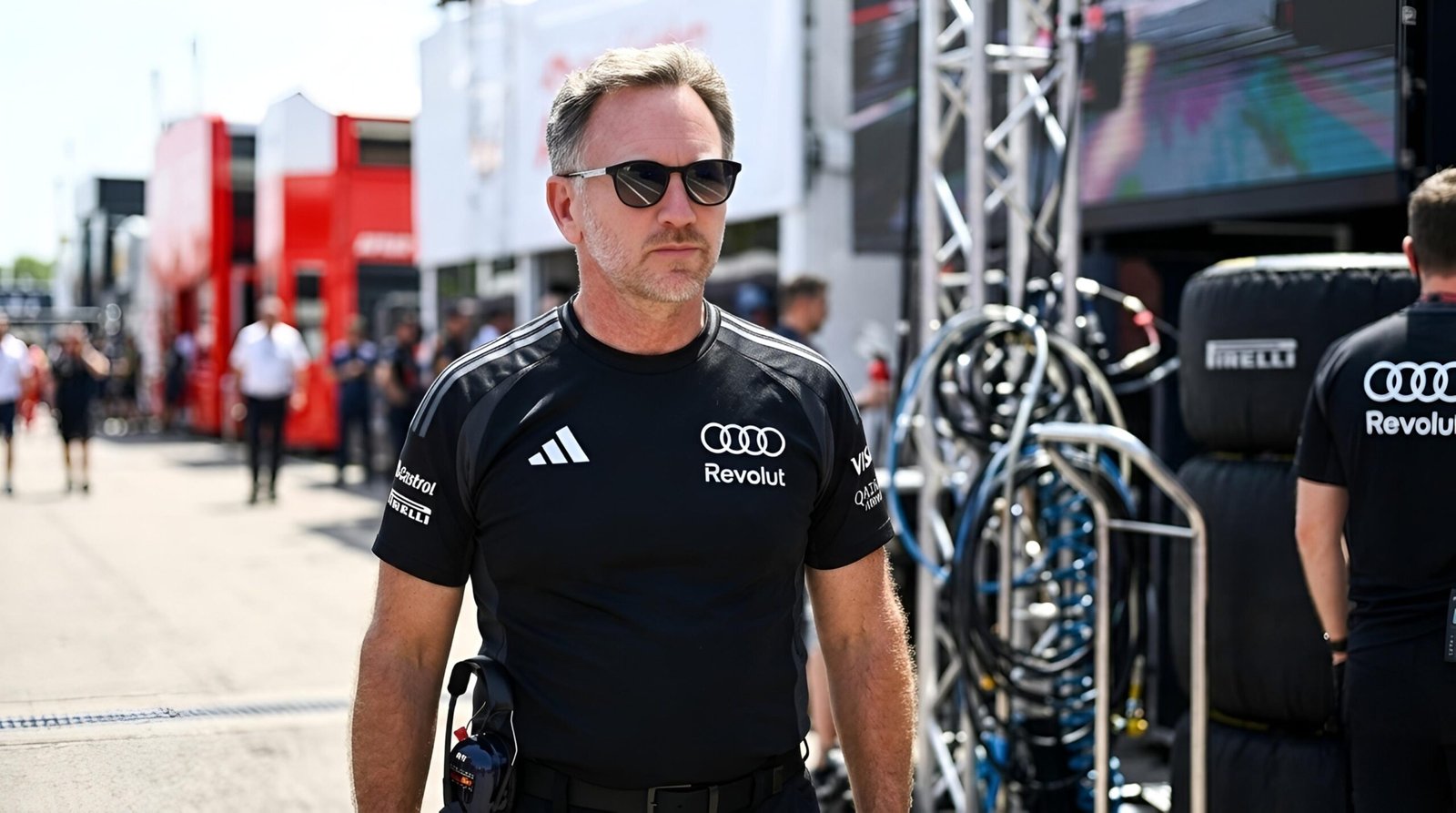
This vacancy has ignited intense speculation, none more pointed than the public endorsement from former Formula 1 race winner Juan Pablo Montoya, who has urged Audi to appoint Christian Horner as the permanent team principal. Montoya’s assessment, delivered with the candor of a driver who competed at the sport’s sharpest edge, cuts through the noise of rumor: Horner possesses the rare blend of experience, resilience, and winning pedigree essential for transforming an ambitious manufacturer project into a championship contender.
The Unraveling of a Short-Lived Appointment
Jonathan Wheatley’s tenure at what was then Kick Sauber, and subsequently the Audi F1 team, spanned less than a year in an operational sense. Having joined in April 2025 after nearly two decades as Red Bull Racing’s sporting director—a role in which he earned a reputation as one of the paddock’s most astute operators, adept at rules interpretation, pit-wall decision-making, and crisis management—Wheatley was positioned as the ideal bridge between the team’s modest midfield roots and Audi’s lofty 2026 ambitions.
His brief was clear: stabilize operations, integrate new technical and commercial structures, and prepare the squad for the transformative power-unit regulations that would see Audi field its own engine for the first time. Yet by mid-March 2026, following the Australian and Bahrain rounds, the team announced his immediate departure. Audi’s statement was characteristically measured: “Due to personal reasons, Jonathan Wheatley will depart the team with immediate effect. The team thanks Jonathan for his contribution to the project and wishes him the best for his future endeavours.”
Speculation, however, has proven far less restrained. Multiple reports have linked Wheatley to a potential return to the United Kingdom with Aston Martin, where his expertise could complement Adrian Newey’s technical genius by assuming day-to-day operational leadership. Such a move would allow Newey greater focus on aerodynamic and conceptual development amid Aston Martin’s own challenging start to 2026. Martin Brundle, a close associate, has publicly suggested the alignment makes sense for a man whose family roots remain in Britain and who may have found the full relocation to Switzerland more demanding than anticipated.
Mattia Binotto, speaking in the aftermath, described the exit as “very unexpected.” He confirmed that while he would absorb the additional responsibilities of team principal—covering race-weekend execution from the Japanese Grand Prix onward—the arrangement was not intended as a permanent solution. Binotto has long signaled a preference for a strategic, behind-the-scenes role overseeing the broader project, including power-unit development in Neuburg and the integration of resources across Audi’s global network. “We are considering it,” he noted regarding a dedicated replacement. “We will organise ourselves and I am pretty sure that very soon we can announce it.” This measured tone underscores Audi’s methodical corporate approach, yet it also highlights an immediate operational gap in a season already defined by the complexities of new chassis, aerodynamics, and hybrid powertrain architectures.
Juan Pablo Montoya’s Candid Endorsement of Christian Horner
Enter Juan Pablo Montoya, the Colombian firebrand whose own F1 career was defined by raw speed, tactical acumen, and an unwillingness to suffer mediocrity. In late March 2026 interviews, notably with outlets such as talkSPORT, Montoya did not mince words. Addressing the leadership void at Audi, he argued that the German manufacturer required a figure with proven championship-winning credentials to “fill the gap” left by Wheatley.
“They need somebody like Christian to do that,” Montoya stated. “I think people underestimate what Christian’s done, and for how long he did it at Red Bull. You might like him, you might hate him, but he could deliver.”
This was no idle speculation. Montoya had previously floated Horner’s name in connection with Aston Martin, emphasizing the need for decisive leadership at teams possessing substantial resources yet lacking cohesive direction. With Wheatley’s exit shifting focus squarely to Audi, the Colombian doubled down. He acknowledged Binotto’s formidable technical and project-management strengths but noted the Italian’s apparent reluctance to embrace the full frontline demands of team principal duties—race strategy, driver management, media scrutiny, and the relentless political maneuvering that defines modern F1 governance.
Montoya’s praise centers on Horner’s two-decade stewardship of Red Bull Racing. Appointed in 2005 when the team was little more than a rebadged Minardi operation backed by an energy-drink brand, Horner orchestrated one of the most remarkable ascents in sporting history. Under his leadership, Red Bull secured six Constructors’ Championships and eight Drivers’ titles, forging a culture of innovation, agility, and unapologetic competitiveness. From the early breakthroughs with Sebastian Vettel to the dominant hybrid-era campaigns alongside Max Verstappen and the late Adrian Newey’s technical wizardry, Horner’s tenure exemplified the ability to build, sustain, and evolve a winning organization through regulatory upheavals, internal challenges, and external pressures.
Critics may point to the turbulent final chapters at Red Bull, including Horner’s own ousting in July 2025 amid reported internal boardroom tensions and performance inconsistencies. Yet Montoya’s intervention deliberately separates personal controversies from professional competence: “He gets it and knows how to win.” In an era where manufacturer teams like Audi must navigate not only technical regulations but also corporate hierarchies, stakeholder expectations, and the integration of disparate talent pools, such institutional knowledge carries premium value.
Christian Horner: Profile of a Proven Architect
Christian Horner’s journey in Formula 1 offers a compelling case study in leadership under pressure. A former racer himself in junior categories, Horner transitioned early into team management, founding Arden International and achieving success in Formula 3000 and GP2 before Red Bull’s call. At Milton Keynes, he cultivated a flat, decisive structure that prized meritocracy and rapid iteration—qualities that proved decisive during regulatory shifts, such as the 2014 hybrid introduction and subsequent ground-effect returns.
His departure from Red Bull in 2025, reportedly accompanied by a substantial severance, left him without an immediate role. Since then, Horner has maintained a low public profile while signaling “unfinished business” in the sport. Links have surfaced with various opportunities, including potential investment or operational roles at teams seeking stability and direction. Audi’s project—transforming a perennial backmarker into a manufacturer powerhouse with eyes on podium contention by the late 2020s and outright titles by 2030—presents a canvas remarkably similar to the one Horner inherited two decades earlier.
The parallels are instructive. Like early Red Bull, Audi benefits from immense financial and technological backing, a state-of-the-art power-unit facility, and access to global talent. Yet it grapples with cultural integration challenges inherent in merging Swiss operational roots with German engineering rigor, all while competing against entrenched giants. A leader who has scaled such a transformation, forged alliances with key technical minds, and delivered consistent results under scrutiny could accelerate Audi’s trajectory significantly.
That said, Horner’s candidacy is not without complexity. The 2024–2025 controversies that contributed to his Red Bull exit have left a residue of scrutiny. Figures such as Mercedes team principal Toto Wolff have, in broader contexts, questioned the wisdom of associating a major manufacturer brand with unresolved baggage. Cultural fit within Audi’s structured corporate environment—distinct from Red Bull’s more entrepreneurial ethos—would require careful navigation. Moreover, Horner’s post-Red Bull freedom comes with expectations of equity or significant influence, elements that Audi’s leadership structure may need to accommodate.
Broader Context: Audi’s 2026 Ambitions and the F1 Landscape
Audi’s entry into Formula 1 as a full works team represents one of the most significant manufacturer commitments in decades. The 2026 regulations, emphasizing sustainable fuels, altered hybrid systems, and chassis redesigns, were conceived in part to level the playing field and attract new entrants. For Audi, success hinges not merely on power-unit performance but on seamless orchestration across chassis development in Hinwil, engine production in Germany, and race operations.
Wheatley’s short stint provided continuity from the Sauber era, but his exit underscores the human element in such grand projects: personal circumstances, family considerations, and lifestyle preferences can outweigh even the most lucrative professional opportunities. Binotto’s interim role brings continuity in strategic vision—he has overseen the technical roadmap since joining the project—but the demands of pit-wall leadership, driver briefings, and real-time crisis management differ markedly from high-level project coordination.
The wider 2026 landscape amplifies the stakes. Red Bull, now in its post-Horner era under new leadership, continues to evolve. Mercedes and Ferrari pursue recovery, while emerging or resurgent squads like Aston Martin seek to capitalize on regulatory disruption. In this environment, decisive leadership becomes a differentiator. Teams that combine technical excellence with operational sharpness and cultural cohesion will prevail.
Montoya’s intervention adds a layer of paddock realism. As a veteran observer who has witnessed multiple team rebuilds, his endorsement carries weight precisely because it transcends tribal loyalties. He does not claim infallibility for Horner, nor does he ignore the controversies. Instead, he highlights a pragmatic truth: in Formula 1, results often speak louder than reputation, and few executives have delivered sustained excellence over two decades as effectively.
Potential Pathways and Uncertainties
As of early April 2026, Audi has made no formal announcement regarding a permanent team principal. Other leadership adjustments, such as commercial and regional appointments (including Vito Paladino’s role in the United States market), indicate a broader organizational refinement. The team’s on-track performance in the opening races will likely influence the urgency and profile of any appointment.
Should Audi pursue Horner, the arrangement could take various forms: a full team principal remit focused on race operations, a co-leadership model alongside Binotto, or even a broader executive position encompassing strategic input. Negotiations would undoubtedly address governance, reporting lines, and alignment with Audi’s parent Volkswagen Group expectations.
Alternative candidates exist within the paddock—experienced operators with strong manufacturer pedigrees or those proven in turnaround scenarios—but few match Horner’s combination of championship hardware, regulatory navigation expertise, and public profile. The April 1 reports claiming his imminent appointment ahead of the Miami Grand Prix appear to have been speculative or tongue-in-cheek, lacking corroboration from credible channels. The situation remains fluid, emblematic of Formula 1’s perennial “silly season” dynamic, albeit accelerated by Wheatley’s early-season exit.
A Defining Moment for Audi’s F1 Odyssey
The leadership question at Audi transcends one individual. It speaks to the fundamental challenge facing any new manufacturer entrant: how to translate enormous investment and technological ambition into on-track competitiveness and long-term sustainability. Jonathan Wheatley’s departure, while disruptive, has crystallized the need for clarity in operational structure.
Juan Pablo Montoya’s advocacy for Christian Horner injects a provocative yet grounded perspective into the discourse. It challenges Audi’s decision-makers to weigh proven championship architecture against corporate caution, institutional memory against fresh perspectives, and personal reputation against collective ambition.
In the unforgiving crucible of Formula 1, where margins are measured in hundredths of a second and careers can pivot on a single boardroom conversation, such decisions define legacies. Audi’s project holds genuine potential to reshape the competitive order, provided it secures leadership capable of uniting disparate elements into a singular, relentless pursuit of excellence.
Whether that leader emerges as Christian Horner—or another figure of comparable stature—remains to be seen. What is clear, however, is that the coming weeks and months will prove pivotal. The eyes of the paddock, the industry, and millions of enthusiasts worldwide are fixed on Hinwil and Ingolstadt, awaiting a decision that could accelerate—or temper—one of modern Formula 1’s most intriguing manufacturer endeavors.
In an era of rapid technological convergence and intensifying commercial pressures, the sport demands leaders who not only understand the mechanics of winning but also the psychology of building enduring success. Horner’s track record suggests he possesses both in abundance. Audi’s response to Montoya’s call will reveal much about the German marque’s appetite for bold, transformative choices as it embarks on its long-term journey toward the summit of motorsport.


