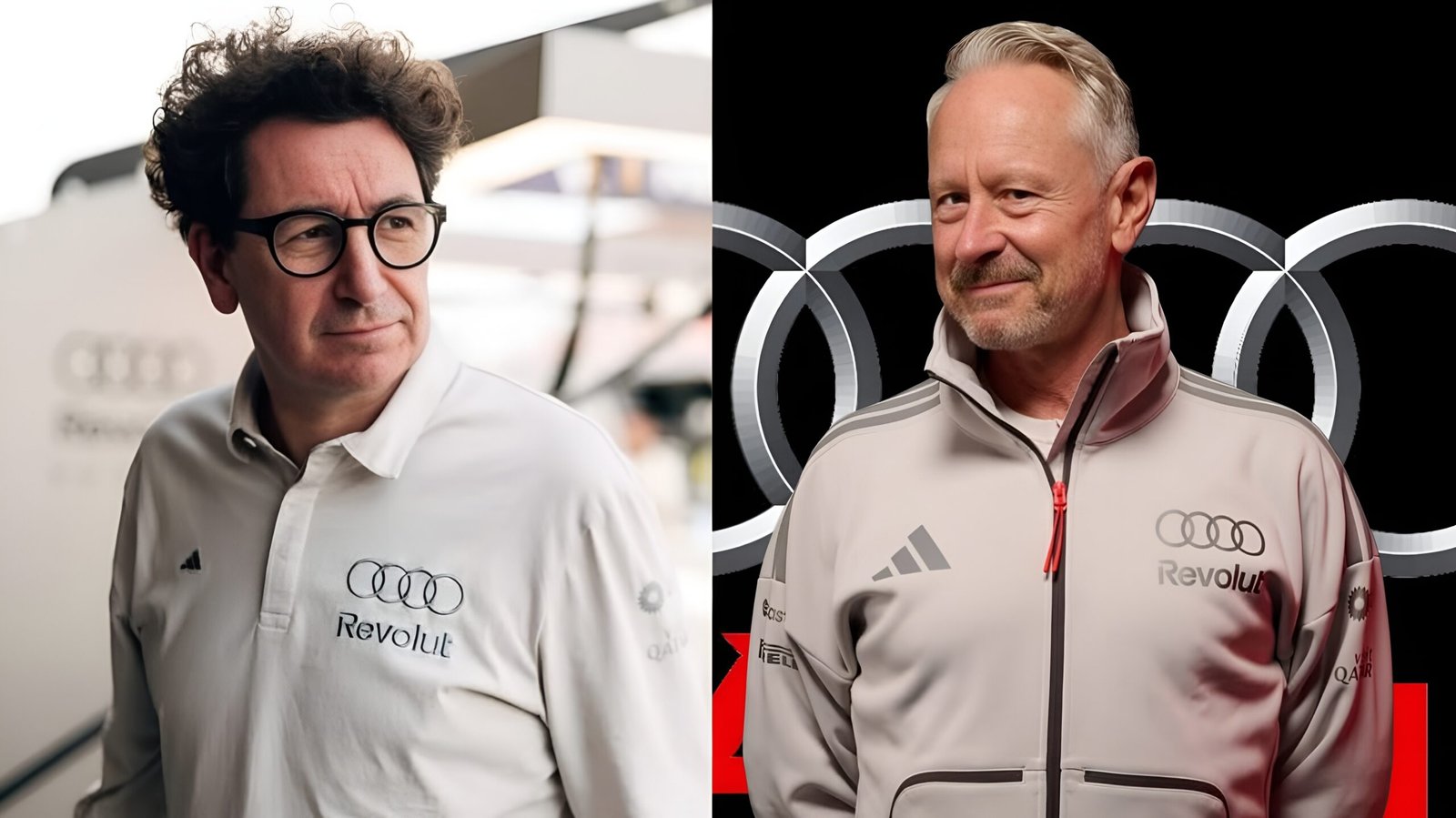
Mattia Binotto and Jonathan Wheatley at the Audi F1 launch. Wheatley’s sudden departure marks a major shift in Audi’s 2026 leadership structure.
Published by: AutodromeF1 Editorial Team
Jonathan Wheatley’s Departure from Audi: A Defining Moment in the German Manufacturer’s Formula 1 Odyssey
Berlin, 23 March – In the rarefied world of Formula 1, where precision engineering meets uncompromising ambition, leadership transitions are seldom inconsequential. Yet few have carried the weight of inevitability and strategic recalibration quite like the exit of Jonathan Wheatley from Audi’s fledgling works team, announced on 20 March 2026 and effective immediately. Occurring a mere two grands prix into the manufacturer’s long-awaited return to the pinnacle of motorsport, this development represents far more than the loss of a seasoned operator; it signals a profound recalibration of priorities at a moment when the 2026 regulatory framework demands absolute cohesion between chassis and power-unit development. What began as an audacious four-year transformation project under the Audi banner has, in the space of ten months, encountered its first major fracture—one that exposes both technical vulnerabilities and organisational fragilities at the very dawn of a new technical era.
Wheatley, whose credentials include orchestrating Red Bull Racing’s ascent to multiple world championships, joined the former Sauber outfit in April 2025 with a mandate to professionalise operations across Hinwil, Neuburg and the newly established Bicester facility. His brief tenure—precisely eleven months—has been characterised by quiet competence rather than headline-grabbing drama, yet its abrupt conclusion underscores a deeper truth: even the most meticulously planned manufacturer entries remain hostage to the unforgiving realities of the sport’s hybrid future. Sources close to the team confirm that Wheatley’s departure stems from a combination of personal considerations and professional divergence, though the timing could scarcely be more delicate.
Central to the narrative is Wheatley’s candid assessment of the Audi power unit, delivered in the aftermath of the Chinese Grand Prix. In what insiders describe as a pivotal debrief with Mattia Binotto, the outgoing team principal zeroed in on driveability as the most pressing deficiency. The 2026 specification powerplant, conceived under the stringent new regulations that slash internal-combustion output while elevating electrical deployment, has demonstrated commendable peak performance in simulation and straight-line testing. Yet its behaviour under the chaotic demands of wheel-to-wheel combat reveals a troubling latency in recovering the engine’s optimal operating window.
During Nico Hülkenberg’s spirited defensive manoeuvres in Shanghai, the German veteran repeatedly found himself constrained by a power unit that refused to respond with the instantaneous elasticity required when drivers must react rather than anticipate. “The engine simply does not yet offer the instantaneous recovery we need when the race situation forces reactive rather than proactive energy management,” Wheatley is understood to have told Binotto. Post-race telemetry from the opening rounds has corroborated this diagnosis: while aerodynamic efficiency and chassis balance have placed the car respectably in the midfield—yielding points in Australia—the power unit has emerged as the unequivocal priority for corrective action.
The issue is not one of outright power deficit but of transient response and thermal management. Under the 2026 regulations, the internal-combustion engine is downsized to 50% of previous capacity, with the MGU-K and MGU-H systems assuming greater responsibility for both propulsion and energy recovery. When a driver lifts off the throttle during overtaking or defensive braking, the system must rapidly re-establish boost pressure and electrical deployment without hesitation. Audi’s unit, still in its infancy, exhibits a measurable delay in this cycle—manifesting as momentary flat spots that prove decisive in the 300-kilometre crucible of modern grand prix racing. Post-race analysis from Melbourne and Shanghai has isolated these characteristics as the primary drag on competitiveness, notwithstanding occasional flashes of promise when operating within a narrow thermal band.
Such technical candour from a departing leader is rare and, in its honesty, potentially illuminating for the entire paddock. It also places immediate pressure on the power-unit division in Neuburg, where engineers have been granted an extended development window under the regulatory concessions afforded to new entrants. Yet concessions are finite; by the Canadian Grand Prix, the expectation within the FIA technical department is that all manufacturers will demonstrate parity in driveability metrics. Wheatley’s departure, therefore, arrives at the precise juncture when Audi must accelerate its recovery programme without the institutional memory he had begun to institutionalise.
Compounding the internal turbulence is the destination of Wheatley’s next chapter. Multiple credible sources across the sport confirm that Aston Martin is poised to appoint him as team principal, creating a formidable operational tandem alongside Adrian Newey, whom the Silverstone-based squad secured in late 2025. The alignment is both logical and strategically potent. Newey, the most decorated designer of his generation, has long expressed a desire to concentrate exclusively on aerodynamic and mechanical concept work, unburdened by the minutiae of day-to-day team management. Wheatley’s proven ability to translate engineering vision into race-winning execution—honed during a decade at Red Bull—offers the perfect counterpoint.
Aston Martin’s own 2026 campaign has opened with familiar frustrations: promising wind-tunnel numbers undermined by inconsistent race-day execution and a chassis that has yet to extract the full potential of Honda’s new power unit. Lawrence Stroll’s vision of transforming the team into a championship contender has always rested on attracting elite personnel. The financial package reportedly placed before Wheatley is understood to be substantial, yet the decisive factor appears to be the opportunity to return to the United Kingdom, nearer to family and to the spiritual home of British motorsport at Silverstone. After basing himself in Switzerland for the Audi project, Wheatley’s relocation aligns personal and professional imperatives.
While no contract has yet been formally executed—Wheatley is expected to observe a customary period of gardening leave—the preference expressed by Newey himself carries considerable weight. The designer has repeatedly signalled that operational leadership of Wheatley’s calibre would allow him to push the conceptual envelope without distraction. Should the appointment materialise, Aston Martin would suddenly possess one of the most formidable leadership pairings on the grid: a technical genius freed to innovate and an operational master capable of translating those innovations into consistent results. In an era when regulatory stability until 2030 is intended to reward long-term investment, such synergy could prove decisive.
For Audi, the immediate response has been pragmatic. Mattia Binotto, the respected engineer who has overseen the entire F1 project since his arrival from Ferrari in 2024, will assume the role of interim team principal while retaining overarching responsibility for the power-unit programme and strategic direction. The decision effectively terminates the dual-leadership experiment that had seen Wheatley focus on operational and sporting matters while Binotto concentrated on engineering and manufacturer integration. In a statement released through the Hinwil headquarters, Audi described the transition as “a natural evolution of our organisational structure at this early stage of our project,” emphasising that “stability and continuity remain paramount.”
Binotto’s expanded remit is no small undertaking. He must simultaneously address the power-unit driveability shortfalls, stabilise a workforce still adjusting to the cultural shift from Sauber’s independent ethos to Audi’s corporate rigour, and maintain competitive momentum in the midfield. The opening races have delivered mixed signals: Hülkenberg’s points in Australia demonstrated that the car possesses inherent potential, yet the double DNS—one in Melbourne due to an electrical sensor failure and another in Shanghai linked to power-unit thermal management—have eroded confidence. Binotto’s engineering pedigree, forged through years at Ferrari where he managed similarly complex hybrid transitions, positions him uniquely to spearhead the recovery. Yet the interim designation suggests that Audi intends to conduct a thorough global search for a permanent successor, one who can harmonise with the manufacturer’s long-term industrial objectives beyond the racetrack.
The broader implications of this upheaval extend well beyond the confines of the 2026 season. Formula 1’s new regulations were conceived to level the playing field, attract fresh manufacturers, and showcase sustainable propulsion technology. Audi’s entry, backed by the full weight of the Volkswagen Group, was heralded as validation of that vision. A leadership change so early in the cycle risks being interpreted as evidence of internal discord, potentially unsettling key technical partners and suppliers. Conversely, it may also demonstrate Audi’s willingness to act decisively when performance metrics fall short of expectation—a trait that could ultimately strengthen rather than undermine the project.
From a competitive standpoint, the timing could scarcely be more sensitive. The Japanese Grand Prix in Suzuka looms as the next test, a circuit that rewards precise power delivery and rapid energy recovery—precisely the areas where Audi’s unit has struggled. Hülkenberg and his teammate, the highly rated rookie Gabriel Bortoleto, will require seamless coordination from the pit wall if they are to capitalise on any aerodynamic strengths the chassis may possess. Meanwhile, the midfield battle remains intensely congested; Williams, RB and Haas have all shown flashes of pace, rendering every tenth of a second critical.
Beyond the immediate sporting narrative lies a deeper question about the sustainability of manufacturer involvement in an era of escalating costs and regulatory complexity. Wheatley’s departure, though framed around personal and family considerations, inevitably invites scrutiny of the cultural fit between high-performance racing teams and large industrial conglomerates. Audi’s methodical, process-driven approach has delivered impressive infrastructure gains—state-of-the-art simulation facilities in Neuburg and expanded aerodynamic capabilities in Bicester—yet the unforgiving tempo of grand prix weekends demands a different operational cadence. Whether Binotto’s consolidated leadership can bridge that gap will define not merely the remainder of 2026 but the trajectory of Audi’s entire F1 programme through the decade.
For Aston Martin, the potential acquisition of Wheatley represents more than personnel reinforcement; it embodies a philosophical realignment. Under Stroll’s stewardship, the team has consistently prioritised star talent—Newey being the most conspicuous example. Pairing him with an operator of Wheatley’s calibre would create a leadership architecture reminiscent of Red Bull’s championship-winning model, albeit within the constraints of a smaller organisation still scaling its ambitions. The proximity to Silverstone and the British motorsport ecosystem offers additional intangible benefits, from talent pipelines to logistical efficiencies.
As the 2026 season unfolds, the sport finds itself at a crossroads. The regulatory reset was intended to usher in an era of technical parity and manufacturer parity; instead, it has already produced the first significant leadership tremor. Jonathan Wheatley’s exit from Audi may prove a footnote or a catalyst—history will judge based on the performance that follows. What remains indisputable is that in Formula 1, even the most meticulously engineered projects are ultimately defined by the humans who steer them. In relinquishing one of its most experienced navigators at such an embryonic stage, Audi has placed its faith in internal resilience and technical rigour. The coming months will reveal whether that faith is well founded or whether the departure of Wheatley marks the beginning of a longer, more complex recalibration.


