Published by: AutodromeF1 Editorial Team
Audi F1 Team Confirms Immediate Departure of Team Principal Jonathan Wheatley in Landmark Leadership Transition
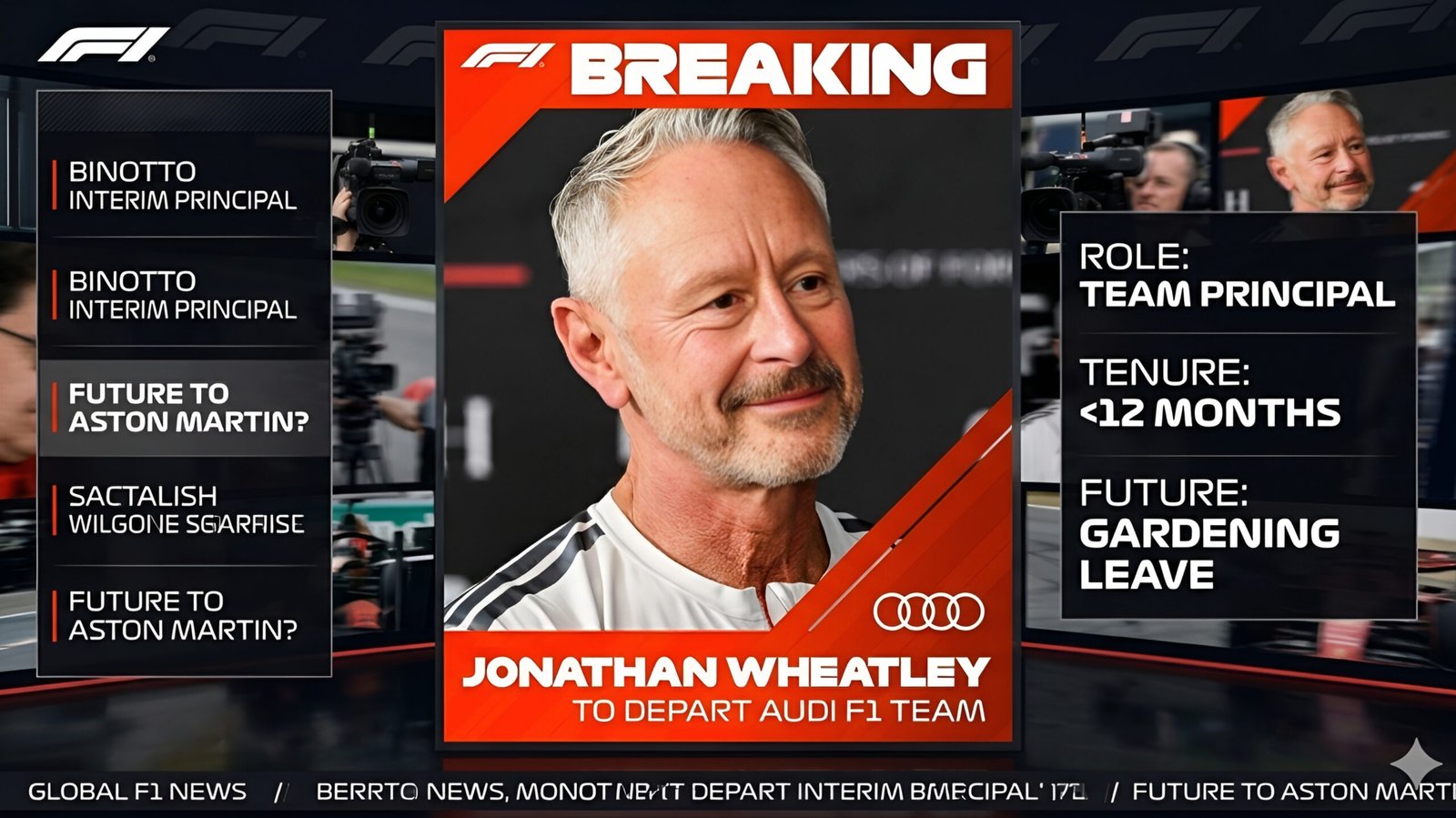
In a development that has reverberated across the Formula 1 community with profound implications for two of the sport’s most ambitious constructors, the Audi F1 Team has formally announced the immediate departure of Jonathan Wheatley from his position as Team Principal. The German manufacturer, operating under its transitional branding as the Revolut F1 Team, cited personal reasons for the exit, effective from today. Mattia Binotto, who has served as Chief Executive Officer and overall head of the Audi F1 project since its inception, will assume the additional responsibilities of Team Principal on an interim basis while the organisation conducts a structured search for a permanent successor.
This announcement, issued via an official statement from the team’s headquarters in Hinwil, marks the end of Wheatley’s tenure after fewer than twelve months in the role. It arrives at a critical juncture in Audi’s meticulously planned re-entry into Formula 1 as a full factory entity for the 2026 season, when sweeping new power-unit regulations and chassis frameworks are scheduled to reshape the competitive landscape. While the team has maintained a measured tone, emphasising Wheatley’s “invaluable contributions during the foundational phase of our project,” the timing of the departure has intensified long-standing speculation regarding his next destination.
Industry observers had already noted mounting interest from Aston Martin in securing Wheatley’s services, particularly in light of Adrian Newey’s recent appointment as the British squad’s Chief Technical Officer. Reports emerging over the past fortnight suggested that Aston Martin sought to install Wheatley as Team Principal, thereby allowing Newey to concentrate exclusively on the aerodynamic and conceptual design of the 2026 challenger. Both organisations had previously dismissed such links as unsubstantiated rumour; however, Wheatley’s abrupt exit now renders a move to Silverstone appear not merely plausible but highly probable, subject to the standard contractual gardening-leave provisions that typically accompany senior personnel transfers in Formula 1.
Jonathan Wheatley’s professional pedigree is beyond reproach. Having spent the better part of two decades at Red Bull Racing, initially as Chief Mechanic and subsequently ascending to the pivotal post of Sporting Director, he played an instrumental role in the team’s transformation from midfield contender to dominant force. Under his stewardship of race operations, Red Bull secured multiple Constructors’ and Drivers’ Championships, with Wheatley renowned for his forensic attention to regulatory detail, unflinching operational discipline, and ability to maintain composure amid the high-stakes volatility of grands prix weekends. His departure from Milton Keynes in early 2025 to join the then-Sauber organisation—rebranded under Audi’s stewardship—was widely interpreted as a strategic masterstroke by the German marque, injecting proven championship-winning expertise into a squad still rebuilding its infrastructure.
Upon joining Audi in April 2025, Wheatley was tasked with bridging the gap between the legacy Sauber operation and the fully integrated factory team required for 2026 compliance. His brief but impactful tenure saw tangible advancements: the establishment of more robust trackside procedures, enhanced coordination between the Hinwil design office and the new power-unit facility in Neuburg, and a discernible uplift in the team’s competitive posture during the latter stages of the 2025 campaign. Insiders credit Wheatley with fostering a culture of precision and accountability that had been somewhat lacking in the preceding years. Nevertheless, the brevity of his stay underscores the relentless pace of personnel movement in modern Formula 1, where even the most carefully orchestrated appointments can be upended by competing ambitions and personal considerations.
For Audi, the transition places heightened responsibility on Mattia Binotto, the Italian engineer whose tenure at Ferrari was characterised by technical rigour and organisational resilience. Binotto, who joined the Audi project in late 2024 after departing Maranello, has already orchestrated the recruitment of several key technical personnel and overseen the integration of the Volkswagen Group’s power-unit development programme. His elevation to Team Principal will consolidate decision-making authority, potentially accelerating the alignment of chassis, aerodynamics, and power-unit streams ahead of the regulatory reset. Audi has emphasised that this arrangement is designed to ensure continuity rather than disruption, stating: “Mr Binotto’s comprehensive oversight of the entire project positions him ideally to steer the team through this transitional period.”
Yet the move carries risks. Binotto will now juggle the multifaceted demands of day-to-day race operations—strategy calls, pit-crew coordination, and regulatory compliance—with the broader strategic imperatives of a manufacturer entering its maiden season as a works team. Observers will watch closely to determine whether the dual mandate dilutes focus or, conversely, streamlines governance in a manner that eluded previous iterations of the Sauber project. The 2026 regulations, which introduce sustainable fuels, revised aerodynamics, and more powerful hybrid systems, demand seamless collaboration across disciplines; any fragmentation could prove costly against rivals such as Mercedes, Ferrari, and the resurgent Red Bull organisation.
Meanwhile, Aston Martin stands to gain significantly should Wheatley indeed join its ranks. Lawrence Stroll’s vision for the Silverstone-based outfit has always centred on elevating it from midfield status to title contender, a trajectory turbocharged by Newey’s arrival. Newey, widely regarded as the pre-eminent aerodynamicist of his generation, has already begun conceptual work on the 2026 car, leveraging Aston Martin’s expanded facilities and substantial financial backing. Pairing his design brilliance with Wheatley’s operational mastery would recreate, in many respects, the alchemy that propelled Red Bull to sustained supremacy. Wheatley’s deep understanding of race-weekend execution, tyre management, and regulatory navigation would complement Newey’s focus on pure performance engineering, creating a leadership tandem that few teams could rival.
The potential transfer also highlights the enduring allure of the United Kingdom’s motorsport ecosystem for senior figures. Wheatley, a British national, is understood to value proximity to family and the established network of talent surrounding Silverstone. Aston Martin’s recent infrastructure investments, including the new aerodynamic campus and expanded technical campus, further enhance its appeal as a destination for those seeking long-term stability and championship-calibre resources.
This episode exemplifies the hyper-dynamic nature of Formula 1’s “silly season,” a period traditionally associated with driver contracts but increasingly encompassing technical and managerial talent. The 2026 regulatory overhaul has amplified such mobility, as teams scramble to assemble the optimal blend of expertise for an entirely new technical paradigm. Wheatley’s departure is merely the latest in a series of high-profile shifts: Red Bull’s own internal restructuring, Ferrari’s continued pursuit of stability under Fred Vasseur, and Mercedes’ strategic recalibration under Toto Wolff. Each change reverberates beyond individual squads, influencing supplier relationships, sponsor confidence, and the broader talent market.
From a wider perspective, Audi’s decision to part company with Wheatley so swiftly after his appointment invites reflection on the challenges facing new entrants in Formula 1. The manufacturer entered the sport with unequivocal commitment—acquiring Sauber outright, constructing dedicated power-unit facilities, and recruiting a cadre of elite engineers. Yet the sport’s unforgiving tempo means that even the most patient investors must navigate short-term turbulence. Wheatley’s exit, while framed as personal, may also reflect the intense pressures of aligning disparate corporate cultures: the methodical German engineering ethos with the agile, sometimes improvisational demands of grand-prix competition. Binotto’s expanded remit will be pivotal in demonstrating that Audi possesses the internal depth to weather such transitions without compromising its 2026 objectives.
Analysts have already begun modelling the competitive ramifications. Should Wheatley join Aston Martin after the requisite leave period, the British team could emerge as a dark horse for the new era, particularly if Newey’s conceptual innovations translate into tangible on-track superiority. Conversely, Audi’s ability to maintain momentum under Binotto will be a litmus test of the project’s resilience. Early indications from winter testing and simulator programmes suggest both organisations are making substantive progress, yet personnel stability remains the intangible variable that often separates podium contenders from also-rans.
In the paddock, reactions have been muted but telling. Colleagues from Wheatley’s Red Bull era have expressed private admiration for his professionalism and quiet authority, while rivals acknowledge the operational void his departure leaves at Audi. The FIA, for its part, has offered no comment, consistent with its policy of non-interference in contractual matters unless regulatory breaches are alleged.
Looking ahead, the coming weeks will clarify Wheatley’s precise destination and the identity of Audi’s permanent Team Principal. In the interim, the focus shifts to the Australian Grand Prix and the remainder of the 2025 season, where both Audi and Aston Martin must extract maximum performance from current-generation machinery while simultaneously laying foundations for 2026. For Wheatley, the chapter at Audi—however brief—represents a meaningful contribution to a historic manufacturer’s return; for Binotto, it signals an opportunity to etch his legacy deeper into the Audi narrative; and for Aston Martin, it potentially heralds the formation of a leadership pairing capable of challenging the established order.
Formula 1 has long thrived on such fluidity. Today’s announcement merely reaffirms that, beneath the technological sophistication and global spectacle, the sport remains fundamentally a human endeavour—one in which personal aspirations, strategic foresight, and organisational ambition intersect with relentless frequency. As the 2026 regulations loom, the realignment of Wheatley, Binotto, and Newey across rival camps may well prove one of the defining subplots of the new era.


