Audi F1 driver Nico Hülkenberg reacts to the sudden departure of Team Principal Jonathan Wheatley ahead of the 2026 Japanese Grand Prix.
Published by: AutodromeF1 Editorial Team
Nico Hülkenberg’s Maternal Dispatch: How a Simulator Session and a Mother’s Text Message Illuminated Audi’s Leadership Reckoning
Berlin, Germany 28 March – In the high-octane world of Formula 1, where milliseconds define careers and strategic decisions unfold behind layers of corporate discretion, news of seismic change rarely arrives via family text. Yet for Audi F1 driver Nico Hülkenberg, that is precisely how one of the season’s most startling developments reached him. Between simulator runs ahead of the 2026 Japanese Grand Prix, the veteran German glanced at his phone to discover an article forwarded by his mother. His immediate, unfiltered reaction—“Oh, shit!”—has since become the defining soundbite of Audi’s abrupt leadership transition, capturing both the shock and the human vulnerability rarely glimpsed in the paddock.
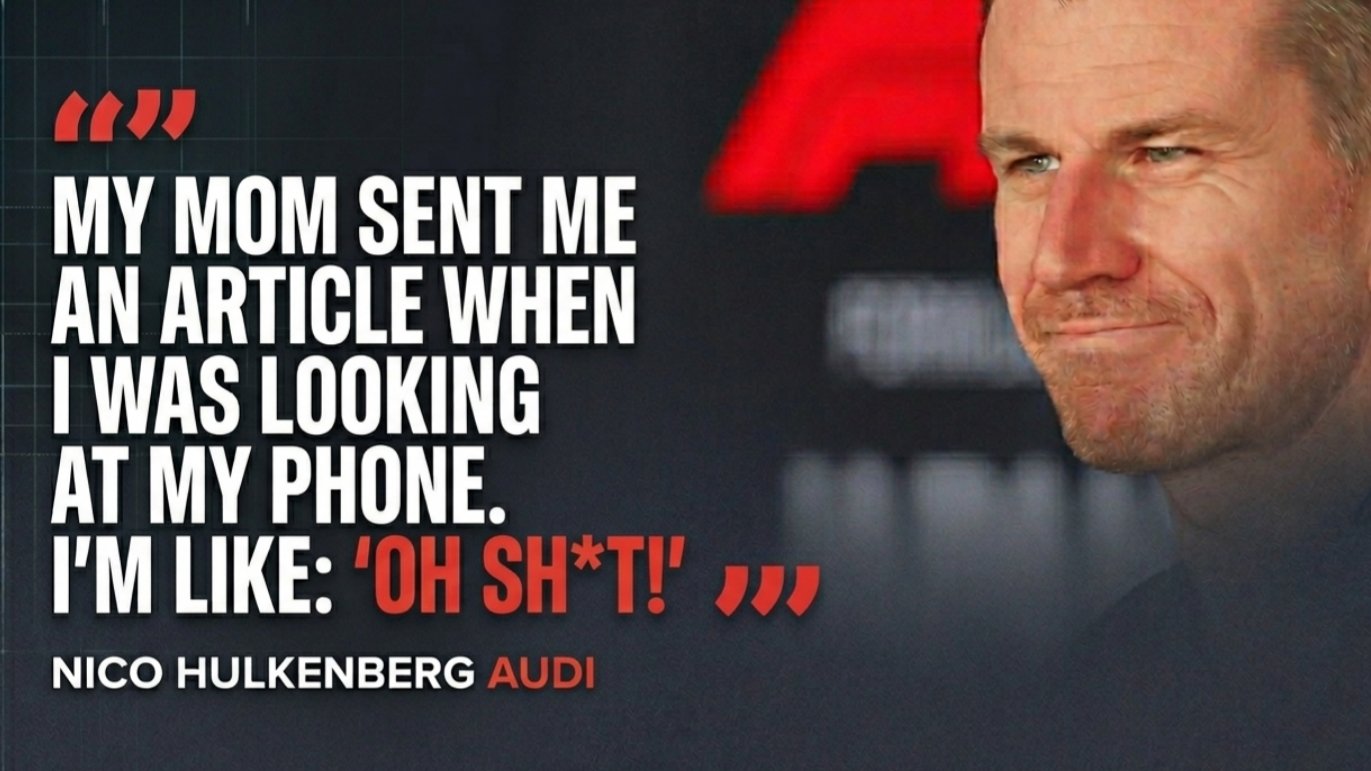
The image circulating across social platforms—a close-up of Hülkenberg’s wry, slightly bemused expression superimposed with a circular inset of the departing figure and the verbatim quote—encapsulates more than mere paddock gossip. It distills the collision between personal life and professional upheaval in an era when information travels faster than any DRS-assisted overtake. Jonathan Wheatley, the experienced British executive who had assumed the role of team principal less than a year earlier, departed Audi with immediate effect on 20 March 2026, officially citing “personal reasons.” Mattia Binotto, already heading the broader Audi F1 project, stepped in to assume additional responsibilities as interim team principal.
What makes Hülkenberg’s account particularly compelling is not merely its candour but its timing. The 38-year-old, now in his second season with the rebranded outfit formerly known as Sauber, was deep in preparation mode when the news broke. “I found out together with the world,” he told assembled media at Suzuka. “I found out on Thursday—last week Thursday—when it popped out. Actually, I was in the sim that day and my mum sent me an article. I’m like, between runs, looking at my phone, I’m like, ‘Oh shit!’”
This was no staged revelation for the cameras. Hülkenberg’s words carry the weight of authenticity forged through nearly two decades in the sport. A driver who has witnessed team upheavals at Williams, Renault, Force India, Racing Point, Haas, and now Audi, he possesses an institutional memory few active competitors can match. His response was measured yet revealing: he acknowledged the necessity of decisive action when “a fundamental problem with one of the central leaders of the team” arises, while simultaneously downplaying any long-term disruption. “It’s not a setback,” he insisted. “An F1 team is made of many people… with Mattia obviously still a leader, it’s not like we’re without leadership, without structure, and without a plan. Whilst it has changed unexpectedly, everything else is on target as we planned and intended before. On the operational side, on a race weekend, I don’t think it’s going to change too much. Formula 1 teams, and generally Formula 1, [are] bigger than one person.”
Such pragmatism is vintage Hülkenberg—experienced, battle-hardened, and resolutely focused on deliverables rather than drama. Yet beneath the surface lies a more nuanced story of Audi’s ambitious but turbulent entry into Formula 1’s top tier. Wheatley, a veteran of 25 years at Red Bull where he served as sporting director and orchestrated multiple championship campaigns, joined the Hinwil-based operation in April 2025 during its transitional phase from Sauber to full Audi works status. His appointment was widely hailed as a masterstroke: a steady hand to shepherd the project through regulatory upheaval, power-unit integration, and the intense scrutiny that accompanies a manufacturer return after decades away.
His tenure, though brief, coincided with visible progress. The team’s early 2026 performances demonstrated incremental gains in aerodynamic efficiency and reliability, metrics that insiders credited partly to Wheatley’s meticulous, hands-on approach. Hülkenberg himself noted the Briton’s immersion: “He was here a year ago when he started—actually, that was his first race, Japan in 2025. He was very involved. As a team principal, you’re very hands-on. He was working, he was busy. I saw that.”
The official narrative of “personal reasons” has fuelled speculation. Reports suggest Wheatley, a family man rooted in the United Kingdom, found the demands of relocating to Switzerland and the relentless travel schedule increasingly untenable. Whispers of interest from rival squads—notably Aston Martin, seeking to bolster its own leadership amid its partnership with Honda—have added layers of intrigue, though neither party has confirmed such overtures.
From an organisational standpoint, Audi’s response reflects strategic maturity rather than panic. By elevating Binotto without delay, the German manufacturer avoided the vacuum that has destabilised lesser teams in the past. The former Ferrari team principal brings his own formidable pedigree: technical acumen, regulatory expertise, and a proven ability to stabilise complex engineering ecosystems. His expanded remit ensures continuity in the critical areas of chassis development, power-unit calibration, and driver performance optimisation—precisely the domains where Audi must close the gap on frontrunners Mercedes, Red Bull, and Ferrari.
Hülkenberg’s teammate, Brazilian rookie Gabriel Bortoleto, offered a contrasting perspective that underscores the generational and experiential divide within the garage. While the veteran expressed genuine surprise, Bortoleto appeared less startled, hinting at underlying tensions that may have precipitated the change. Such candour from within the driver lineup is rare and illuminating; it suggests the departure was not entirely unforeseen at operational levels, even if external stakeholders were caught off guard.
To appreciate the broader significance, one must contextualise this episode within Formula 1’s historical pattern of leadership flux. Team principals are the invisible architects of success—figures like Ross Brawn, Toto Wolff, and Christian Horner whose tenures often span decades yet whose exits can trigger seismic shifts. Wheatley’s case is unusual only in its compressed timeline. The 2026 regulatory reset, with its emphasis on sustainable fuels, active aerodynamics, and cost-cap compliance, has amplified pressure on every organisation. Audi’s project, backed by the full might of the Volkswagen Group, carries expectations that extend far beyond the racetrack; it represents a strategic bet on electrification, brand prestige, and technological supremacy.
Hülkenberg’s reaction, delivered with characteristic dry humour, humanises the narrative in ways traditional press releases cannot. In an age of 24-hour news cycles and instant social-media dissemination, even seasoned professionals process corporate upheaval through the most intimate of channels: a concerned parent scrolling headlines. The moment resonates because it strips away the corporate veneer. Drivers, for all their superhuman reflexes and multimillion-dollar contracts, remain sons and daughters navigating the same familial bonds that anchor us all.
Yet the episode also highlights evolving dynamics in driver-team communication. In previous eras, such information might have been filtered through official briefings or trusted insiders. Today, the democratisation of information means athletes learn of pivotal changes alongside the public—sometimes ahead of internal channels. Hülkenberg’s composure in the aftermath speaks volumes about his professionalism. Rather than dwell on the surprise, he pivoted immediately to performance: “Focus goes back to racing, to driving tomorrow.”
Looking ahead, Audi faces a pivotal juncture. The Japanese Grand Prix weekend offered the first opportunity for the reconfigured leadership to demonstrate resilience under the Suzuka spotlight—one of the calendar’s most demanding circuits, where technical precision and mental fortitude intersect. Early indications suggest operational continuity: strategy calls, pit-stop drills, and engineering debriefs proceeded without discernible interruption. Hülkenberg’s public endorsement of the status quo serves as both reassurance to stakeholders and a subtle rallying cry to the workforce.
For the wider paddock, Wheatley’s exit prompts reflection on the sustainability of modern F1 leadership roles. The combination of regulatory complexity, geopolitical pressures, and personal sacrifices creates a high-attrition environment. Industry veterans note that successful teams are those that institutionalise knowledge rather than vesting it in single individuals. Audi’s structure—layered with Binotto’s oversight, technical directors, and a robust engineering cadre—appears designed precisely for such resilience.
In the final analysis, Nico Hülkenberg’s “Oh shit!” moment transcends anecdote. It encapsulates the unpredictable rhythm of elite motorsport: where personal texts intersect with billion-euro ambitions, where maternal concern momentarily eclipses aerodynamic spreadsheets, and where seasoned drivers remind us that even the most meticulously engineered organisations remain profoundly human. As the 2026 season unfolds, Audi’s trajectory will be measured not by this single transition but by its capacity to translate shock into sustained momentum. Hülkenberg, ever the pragmatist, has already signalled the way forward: acknowledge the change, respect the process, and return focus to the one element that ultimately defines legacy—the lap time.
The paddock, ever watchful, will be observing closely. In Formula 1, as in life, the most memorable stories often begin with the simplest of messages—from a mother, between runs, in the quiet intensity of preparation.


