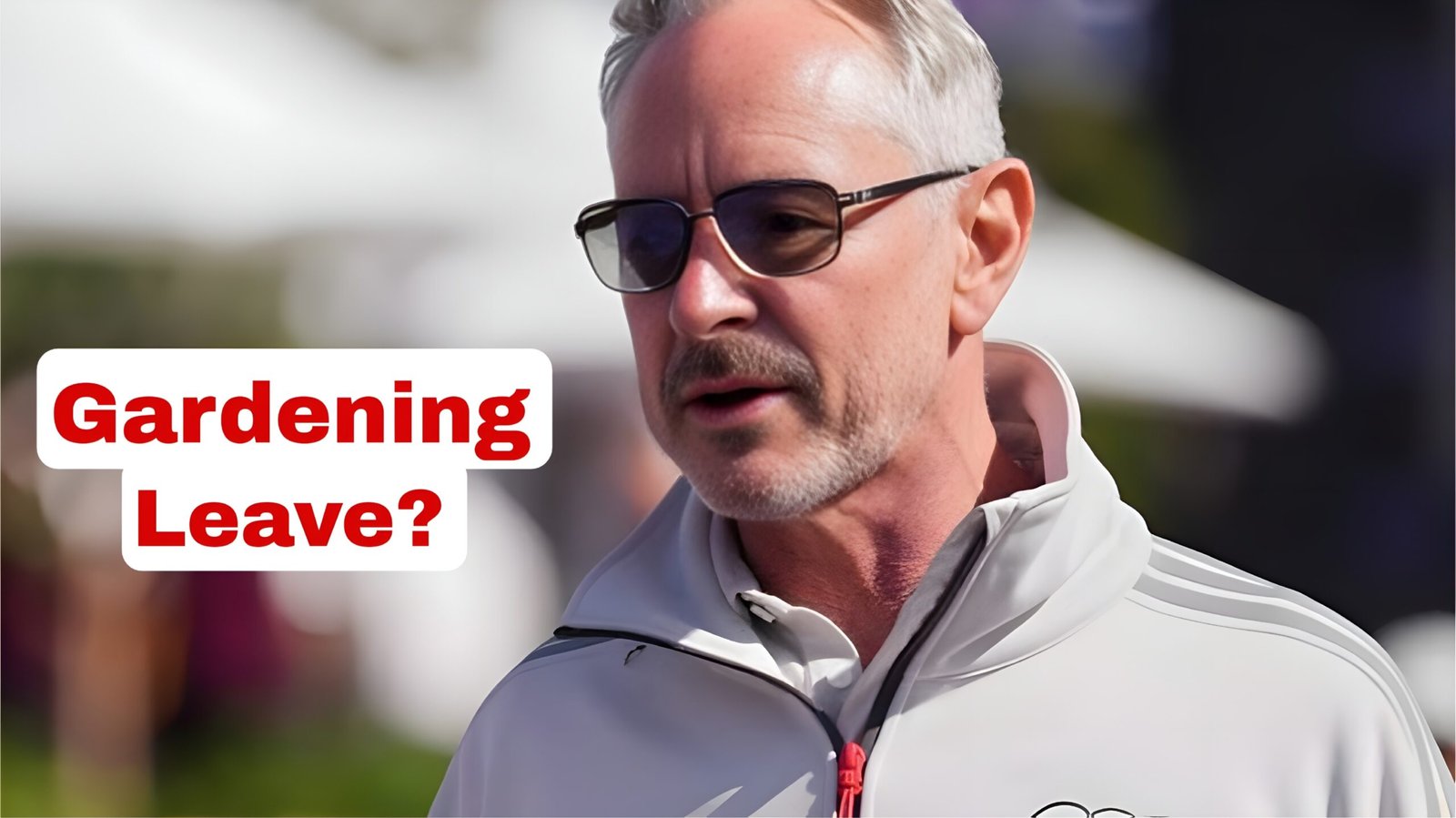
Jonathan Wheatley’s exit from Audi F1 triggers a mandatory 12-month gardening leave period ahead of the 2026 season.
Published by: AutodromeF1 Editorial Team
Jonathan Wheatley’s Garden of Strategic Restraint: A One-Year Hiatus That Redefines Power Dynamics in Formula 1
London, 24 March – In the rarefied arena of Formula 1, where microseconds separate triumph from obscurity and intellectual property constitutes the lifeblood of competitive advantage, the departure of a senior figure is seldom a quiet affair. On 20 March 2026, Audi Formula 1 formally announced the immediate exit of Jonathan Wheatley as team principal, citing personal reasons. Yet beneath the surface of this ostensibly routine transition lies a meticulously engineered mechanism of professional restraint: a period of gardening leave projected to last at least one full year. This contractual interlude, while permitting Wheatley’s formal release from Audi’s employ, simultaneously imposes an ironclad prohibition against his assumption of any operational role within a rival constructor until the stipulated window elapses.
Far from a mere bureaucratic footnote, Wheatley’s enforced sabbatical exemplifies the sophisticated legal and strategic architecture that underpins personnel movement in modern motorsport. During this interregnum, the veteran engineer and strategist will neither contribute to Audi’s day-to-day operations nor retain any active involvement in the development of the 2026 power-unit programme or chassis architecture. He is, in effect, placed in a state of professional limbo—off-site, detached from internal communications, and insulated from the granular technical and sporting intelligence that defines contemporary grand-prix engineering. This arrangement, while outwardly passive, serves as a deliberate firewall, safeguarding proprietary data accumulated over his tenure and preventing its inadvertent—or intentional—transfer to a competing outfit.
The nomenclature “gardening leave” itself evokes an almost pastoral irony: a period ostensibly devoted to horticultural leisure but, in reality, a high-stakes quarantine designed to neutralise the risk of knowledge leakage. In Formula 1’s ecosystem, where aerodynamic philosophies, simulation methodologies, and regulatory interpretations evolve with dizzying rapidity, such measures are not discretionary but existential. Wheatley’s case is emblematic. As a figure who transitioned from Red Bull Racing’s championship-winning machinery to Audi’s ambitious 2026 entry, he carries with him an encyclopaedic repository of institutional memory—ranging from tyre-management protocols under the new 2026 tyre compounds to the intricate interplay between chassis dynamics and hybrid powertrain calibration. Allowing immediate access to another team would not merely compromise competitive equity; it would undermine the foundational trust upon which multi-billion-euro manufacturer commitments rest.
Industry observers with deep institutional knowledge note that the baseline duration of twelve months is neither arbitrary nor inflexible. Negotiations between the departing executive, the incumbent employer, and any prospective new team frequently permit acceleration of the timeline, provided mutually acceptable financial and confidentiality undertakings are secured. In Wheatley’s instance, reports circulating within the paddock suggest that while Audi has anchored the restriction at a full calendar year, the precise endpoint remains subject to tripartite deliberation. Should an incoming constructor—widely speculated to include Aston Martin—propose a sufficiently compelling remuneration package coupled with robust non-disclosure enhancements, the leave period could be truncated. Such expedited resolutions have precedent: several high-profile migrations in the past decade have seen gardening leave compressed to six or even four months once commercial imperatives aligned.
This fluidity underscores a broader truth about Formula 1’s labour market. Unlike more conventional industries, where non-compete clauses are often blunt instruments, F1 contracts for principals, technical directors, and senior strategists function as bespoke instruments of risk mitigation. They balance the individual’s right to professional mobility with the collective imperative to preserve intellectual capital. Wheatley himself navigated an analogous period when he departed Red Bull for Audi in late 2024, a transition that required similar contractual choreography. The symmetry is instructive: the very safeguards he once accepted are now being invoked to protect the team he leaves behind.
To appreciate the magnitude of Wheatley’s impending absence, one must contextualise his contribution to Audi’s nascent F1 project. Appointed in the wake of the manufacturer’s headline-grabbing entry announcement, Wheatley was charged with instilling the operational rigour and cultural cohesion necessary for a greenfield programme to challenge established powerhouses. His brief encompassed not only technical oversight but also the calibration of human capital—recruiting specialists fluent in the forthcoming 2026 regulations that will fundamentally recalibrate power-unit architecture, chassis weight distribution, and active aerodynamics. Under his stewardship, Audi had begun to coalesce a cadre of engineers drawn from disparate backgrounds, forging a unified technical philosophy amid the complexities of Sauber’s transitional infrastructure.
The timing of his departure, mere months before the 2026 season’s regulatory reset, injects an element of uncertainty into Audi’s trajectory. While the team has emphasised continuity under interim leadership structures, the loss of Wheatley’s institutional continuity at this juncture raises legitimate questions about programme momentum. Can a constructor still in the throes of facility upgrades and power-unit homologation absorb the departure of its principal architect without perceptible deceleration? The answer, according to seasoned analysts, hinges on the depth of the bench Audi has cultivated. Mattia Binotto, recently installed in a senior technical capacity, is expected to shoulder an expanded remit, yet the vacuum left by Wheatley’s strategic acumen cannot be instantly replicated.
Speculation regarding Wheatley’s next port of call has, unsurprisingly, coalesced around Aston Martin. The Silverstone-based outfit, buoyed by Honda’s technical partnership and a burgeoning performance uptick under Lawrence Stroll’s stewardship, is widely viewed as a natural fit for a strategist of Wheatley’s calibre. Should negotiations crystallise, the gardening leave would serve as both a cooling-off period and a strategic buffer, allowing Aston Martin to refine its 2026 infrastructure while Wheatley remains contractually sidelined. Yet the precise mechanics of any such arrangement remain opaque. Industry insiders caution that premature announcements could jeopardise delicate tripartite negotiations, particularly if Audi perceives the acceleration of Wheatley’s availability as prejudicial to its own competitive positioning.
Beyond the immediate personnel calculus, Wheatley’s situation illuminates deeper structural shifts within Formula 1. The 2026 regulations—envisaging a dramatic reduction in power-unit complexity alongside the introduction of sustainable fuels and more stringent aerodynamic constraints—have precipitated an unprecedented talent arms race. Constructors are not merely competing for grid positions; they are vying for the intellectual architects capable of decoding an entirely new regulatory lexicon. In this environment, gardening leave emerges as both a defensive bulwark and a tacit acknowledgment that human expertise, once acquired, retains residual value long after formal employment ceases.
Critically, the mechanism also reflects the maturing professionalisation of the sport. Where once F1 operated on handshake agreements and informal loyalties, today’s landscape is governed by ironclad covenants, forensic compliance audits, and third-party legal oversight. The Fédération Internationale de l’Automobile (FIA), while not directly intervening in private contractual matters, has increasingly scrutinised the integrity of technical knowledge transfer, particularly in the context of cost-cap compliance and aerodynamic parity. Wheatley’s leave, therefore, is not an isolated episode but a microcosm of the governance architecture that sustains Formula 1’s credibility as a technological crucible.
From a broader macroeconomic perspective, the episode underscores the precarious economics of manufacturer involvement. Audi’s commitment to F1, estimated in the hundreds of millions annually, is predicated on the assumption that proprietary advantage can be ring-fenced. Any erosion of that confidence—whether through premature talent leakage or regulatory arbitrage—could prompt recalibration of investment strategies across the grid. In an era when automotive giants are simultaneously navigating electrification mandates and sustainability imperatives, the return on motorsport investment must remain demonstrably robust.
For Wheatley personally, the coming twelve months represent a rare interlude of enforced reflection. At a stage in his career where many contemporaries might contemplate retirement or consultancy roles, the gardening leave affords an opportunity to recalibrate without the daily exigencies of wind-tunnel schedules and simulation deadlines. Industry veterans suggest that such periods often catalyse renewed creativity; freed from operational minutiae, senior executives frequently emerge with fresh conceptual frameworks that later redefine team philosophies.
Yet the narrative extends beyond one individual. Wheatley’s enforced absence compels Audi to demonstrate organisational resilience, Aston Martin (or whichever suitor ultimately prevails) to exercise patience, and the wider paddock to contemplate the delicate equilibrium between mobility and protectionism. In a championship where the margin between pole position and the back row can be measured in hundredths of a second, the twelve-month garden becomes a strategic chessboard upon which future championships may well be seeded.
As the 2026 season hurtles toward its regulatory inflection point, Jonathan Wheatley’s story serves as a compelling reminder that Formula 1 is not merely a contest of machinery but an intricate tapestry of human intellect, contractual foresight, and institutional memory. The garden may appear tranquil, yet beneath its surface lie the seeds of tomorrow’s competitive battles—carefully tended, rigorously protected, and destined to bloom under new colours when the contractual winter finally thaws.


