Toto Wolff reveals inside details of the $2M Manor deal
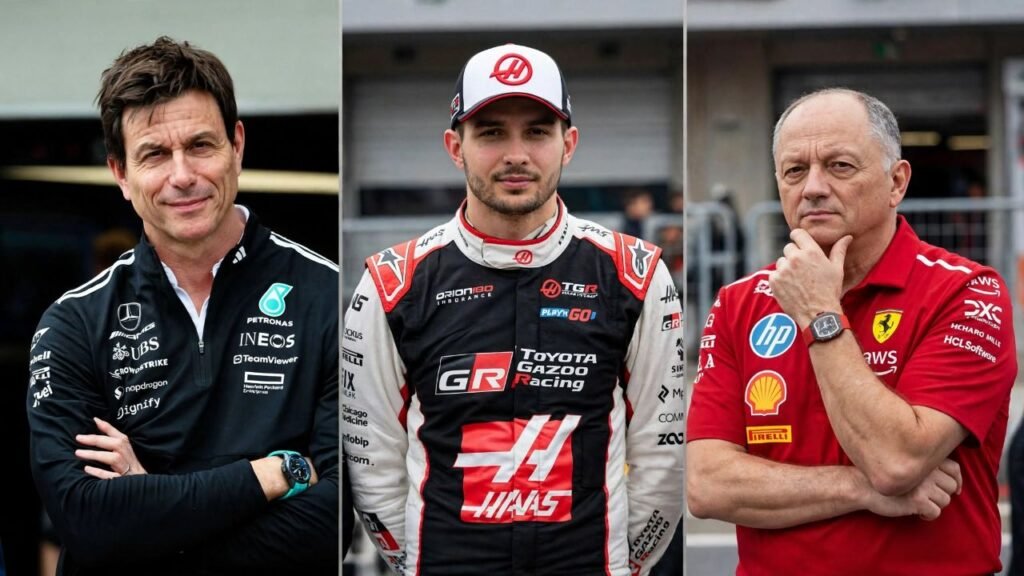
Toto Wolff has revealed that Frédéric Vasseur personally funded half the cost of Esteban Ocon’s first Formula 1 seat in 2016. The disclosure came during the Friday team principals’ press conference at the 2026 São Paulo Grand Prix. Alan Permane, Vasseur and Wolff shared the panel, and the story emerged as the three discussed Ocon’s long and eventful journey in the sport. It is a revealing glimpse into how a young driver’s Formula 1 career nearly stalled before it began. The account follows, with each claim attributed to the Friday press conference.
Wolff Details the $2 Million Funding Gap
Wolff said a seat suddenly became available at Manor Racing from the Belgian Grand Prix at Spa-Francorchamps onwards, and that it required $2 million to secure. Mercedes could provide $1 million, but the other $1 million was still missing.
That is when Vasseur stepped in. In Wolff’s words, as recorded in the press conference: “We said we could provide $1 million for that seat, but we were missing $1 million, and Fred put the money in personally to give Esteban the opportunity.”
Wolff framed the gesture as one part of a much longer period of support. “Over all those years, I think we were all very supportive and very strong in trying to make sure that Esteban would have the best possible opportunity,” he added.
The detail is notable because it places Vasseur’s personal funds, rather than a corporate budget alone, at the centre of a young driver’s breakthrough. It also shows how financial backing, as well as results, can determine who reaches the grid, a point underlined by the circumstances of the vacancy itself.
How Ocon Reached the Manor Opportunity
Ocon won the 2014 FIA Formula 3 European Championship with Prema Racing and followed it with the 2015 GP3 Series title alongside ART Grand Prix. Those results established him as a leading prospect.
Wolff said Mercedes took on Ocon’s management through driver development advisor Gwen Lagrue, then agreed to work with Vasseur in GP3, and the partnership delivered the championship. When no Formula 1 opening followed, a door opened in DTM, and they pursued that route together.
That sequence matters because it shows the support Wolff referred to was not a single transaction. Mercedes’ management role, the GP3 title with Vasseur and the DTM programme formed a continuous thread leading up to the Manor seat.
During 2016, Ocon balanced his DTM commitments with a role as reserve driver for Renault’s Formula 1 team. The Manor vacancy appeared after Rio Haryanto was dropped; contemporary reporting indicated that his sponsors had failed to fund the remainder of his season.
Ocon’s Debut and Rise Through Formula 1
Ocon made his Formula 1 debut at the 2016 Belgian Grand Prix at Spa-Francorchamps, aged 19 years and 345 days. He contested the final nine grands prix of that season, turning a funding shortfall into a genuine opening on the grid.
He moved to Force India in 2017, where he partnered Sergio Pérez. Later, at the rebranded Alpine team in 2021, he lined up alongside Fernando Alonso and took his maiden race victory at the Hungarian Grand Prix that year. The sequence illustrates how a single mid-season seat can shape a long career.
Ocon’s early career therefore ran through a clear chain of decisions: the junior championships, the DTM detour, the reserve role at Renault and, finally, the Manor vacancy.
Why the Revelation Came Up in São Paulo
The story arose during a wider discussion of Ocon’s departure from Haas. The team decided that Ocon would not race for it again. Reserve driver Ryo Hirakawa replaces him in Mexico, while 2027 rookie Rafael Camara receives an early debut in Brazil.
Wolff said the end point arrived when Haas team principal Ayao Komatsu needed to represent and protect the team, while Ocon felt personally that he was not wrong in what he had said. “You’ve got to respect that at the end, the team calls the shots,” Wolff said.
Vasseur, who worked with Ocon in both GP3 and DTM, described him as a pure competitor. He said huge respect was owed for the energy Ocon had put into staying in Formula 1. Taken together, the comments presented a measured tone: acknowledgement of the team’s authority at Haas, alongside recognition of the effort and history behind Ocon’s career.
ALSO READ: Leclerc Declares Hamilton Ferrari Tension Over
What the Verified Record Shows
Accuracy matters when a story involves private money, so the sourcing needs to be stated plainly. The $2 million figure and the personal $1 million contribution are Wolff’s account, given on the record in the official press conference transcript. They are not the result of an independently audited payment record.
What is verified is that Wolff made the statement publicly, in front of the other panellists, including Vasseur himself. It is also verified, through the competitive record, that Ocon appeared on the grid at Spa for the final nine races of 2016. The intervention Wolff described closed the funding gap that made that debut possible.
Three points stand out for readers. First, the seat required $2 million, split equally between Mercedes and Vasseur according to Wolff. Second, the opportunity came from Manor’s vacancy after Rio Haryanto’s departure. Third, the conversation arose during a wider discussion of Ocon’s exit from Haas and the path that began in 2016.
As the 2026 season continues, Wolff’s account adds a human dimension to a story otherwise defined by contracts, results and team decisions. It is also a reminder that behind every driver’s debut there is often a network of people willing to take a financial and professional risk.