
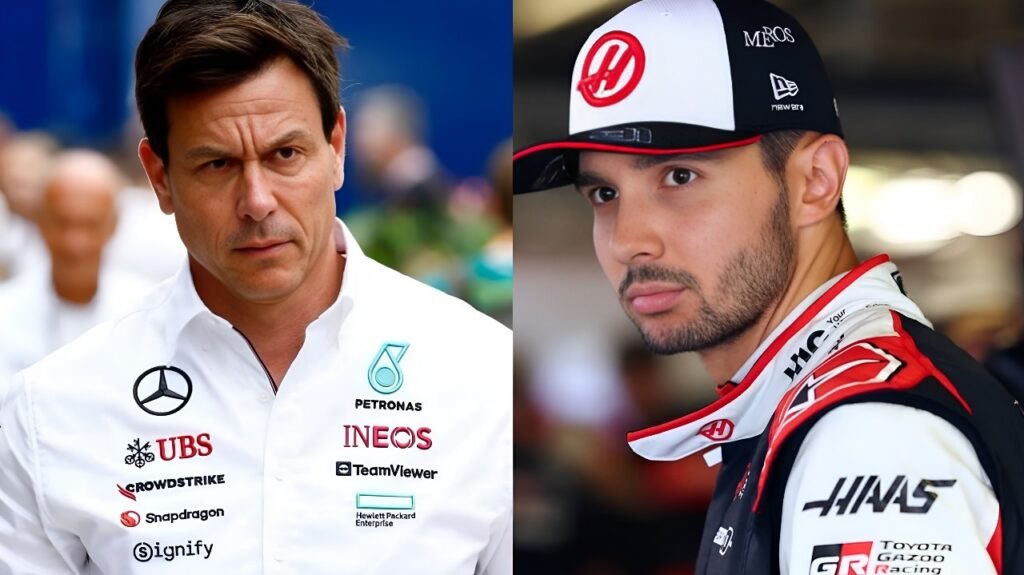
Mercedes boss backs Komatsu over driver’s sudden exit.
Toto Wolff has offered the first senior paddock explanation for Esteban Ocon’s abrupt exit from Haas. The Mercedes team principal says Ayao Komatsu had to protect his team from damaging rhetoric. His comments arrive days after a radio dispute in Mexico City ended the Frenchman’s time with the American outfit, and they reveal how much history connects Ocon to Mercedes.
Radio Dispute Behind the Ocon Haas Exit
The trouble began on Friday at the Autodromo Hermanos Rodriguez. During second practice, Ocon argued over team radio with race engineer Laura Mueller after Haas changed his planned run from the soft compound to the medium tyre. A heated conversation with Komatsu followed that evening, and on Saturday morning the team confirmed that Ocon would take no further part in the weekend.
Reserve driver Ryo Hirakawa, who is with Haas through its technical partnership with Toyota, took over the car and made his Formula 1 debut. Ocon, already confirmed to leave the team at the end of 2026, later denied media reports of a physical altercation with Komatsu in a public statement.
On Tuesday Haas went further and announced that Ocon would not drive in any of the four remaining grands prix this season. Rafael Camara, previously named as Ocon’s replacement for 2027, was therefore handed his Formula 1 debut at the São Paulo Grand Prix in front of his home crowd. For a driver with a race victory to his name, it was an unexpectedly sudden conclusion.
What happened behind closed doors beyond the radio exchange and the conversation that followed remains unclear. Neither the team nor the driver has offered a complete public account, which explains why Wolff’s comments have drawn such attention. In a sport where driver changes normally follow weeks of speculation, a removal triggered within a single race weekend is highly unusual.
Wolff on Komatsu’s Team Principal Decision
Wolff, who has known Ocon since his junior career, is the first senior paddock figure to address the breakdown publicly. Speaking to media including RacingNews365, he framed it as a clash between a team principal’s duty and a driver’s conviction.
“At the end it came to the point where Ayao needed to represent the team and protect the team from certain rhetoric,” Wolff said. “On the other side, Esteban felt that personally, he wasn’t wrong in the things he said. You’ve got to respect that in the end the team calls the shots. The team principal needs to decide when it’s enough, and that is what Ayao did.”
The remarks are measured rather than critical. Wolff neither condemns the driver nor questions the team, instead acknowledging that both sides acted according to their own convictions. That balance matters, because Haas has said little about what happened. Komatsu has stated that he acted in the best interest of the team and that an ongoing process prevents him from sharing details, while also admitting that the situation surprised many of his colleagues. Wolff’s remarks reflect his own perspective as an outsider, and not an official statement from either party.
Team radio disputes are common in Formula 1, yet they rarely end a driver’s tenure. Wolff’s reference to rhetoric points to concern about how the disagreement played out in public, not merely the disagreement itself. For a team principal, protecting the working environment of engineers and mechanics is a core responsibility, and Wolff’s words suggest Komatsu weighed the matter in those terms.
How Mercedes Built Ocon’s Formula 1 Path
Wolff’s views carry weight because of his long involvement in Ocon’s career. According to his account, Mercedes took over the driver’s management through Gwen Lagrue after Gravity defaulted. The programme then placed Ocon alongside Fred Vasseur in GP3, where the pair won the championship together.
When no Formula 1 opportunity was immediately available, the partnership continued in the DTM while the search for a genuine opening on the grid went on. That patient route eventually led to the Manor deal that launched Ocon’s grand prix career.
The sequence Wolff outlined shows how carefully Ocon’s route to Formula 1 was assembled. It combined management support, a title-winning partnership and a deliberate racing programme before a seat finally appeared on the grid. That background makes the abrupt ending at Haas all the more notable for those who followed his rise.
ALSO READ: Norris Takes Wet São Paulo Pole; Russell Fumes
Vasseur’s $2 Million Gamble and Ocon’s Future
The most striking detail concerns the 2016 Belgian Grand Prix. A seat at Manor suddenly became available from Spa onwards, but it required a significant sum. Wolff described the moment in his own words: “I don’t know if this is known, when suddenly there appeared to be a free seat at Manor from Spa onwards, it needed $2 million. We said we could provide $1 million for that seat, but we were missing $1 million, and Fred put the money in personally to give Esteban the opportunity.”
Ocon made his Formula 1 debut at that Belgian race in 2016 and later won the 2021 Hungarian Grand Prix with Alpine, which remains his only grand prix victory. He joined Haas for 2025, and his departure from the team had already been scheduled for the end of this season, as the team had previously confirmed, before the events in Mexico accelerated it.
For Haas, attention now turns to the final races of 2026 and the preparation of Rafael Camara for next season. For Ocon, the coming months will show how he moves forward after leaving the team on such difficult terms. Wolff’s account provides valuable context about the relationships behind that career, yet the full story of what happened in Mexico City is still waiting to be told.