By AutodromeF1 Editorial Team
London. United Kingdom – April 21 2026
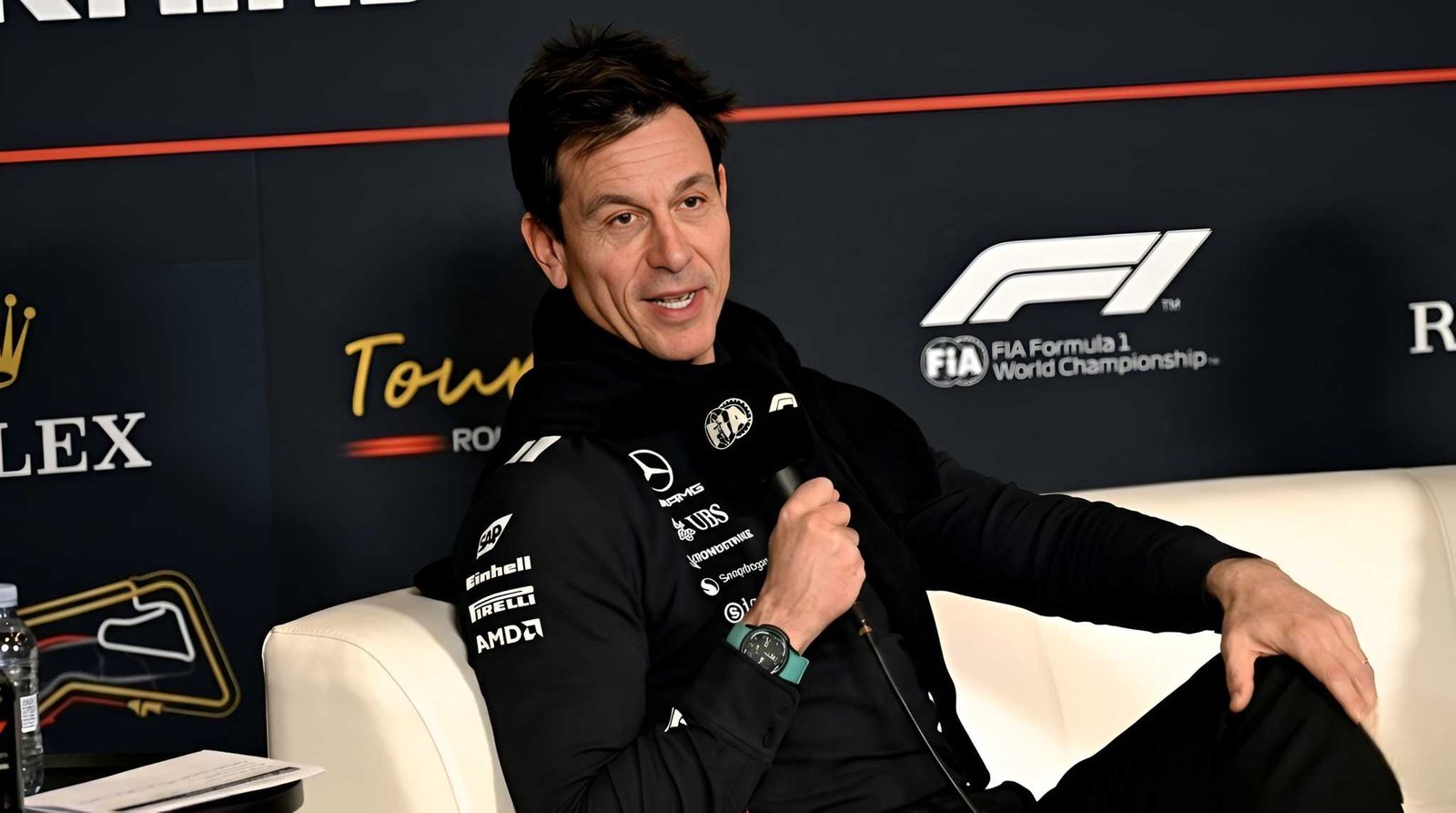
As Formula 1’s governing bodies convene for a pivotal F1 Commission vote this week, Mercedes F1 Team Principal and CEO Toto Wolff has issued a pointed intervention: regulatory reform ahead of the 2026 technical overhaul must be executed with “a scalpel and not with a baseball bat.”
Wolff’s remarks arrive in the wake of MoneyGram Haas F1 Team rookie Oliver Bearman’s 50G impact during the Japanese Grand Prix at Suzuka, an incident that has reignited scrutiny of the sport’s incoming hybrid power unit framework and chassis safety envelope. While acknowledging the severity of Bearman’s crash, Wolff cautioned against reactive, wholesale rule changes that could destabilize competitive integrity and dilute on-track spectacle.
The vote, scheduled following the Commission’s April 20, 2026 session in London, could determine whether immediate amendments to the 2026 power unit or chassis regulations are tabled. Under the current Concorde Agreement structure, such mid-cycle changes require unanimous consent from the FIA, Formula One Management, and all 11 teams—though the FIA retains independent authority to mandate changes on explicit safety grounds.
With Mercedes emerging as an early benchmark in 2026 simulation and power unit development, Wolff’s intervention carries strategic and technical weight. This report examines the regulatory, engineering, and commercial dimensions of the debate, contextualizes Bearman’s incident within F1’s safety evolution, and assesses the implications for the 2026 grid.
The Catalyst: Suzuka and the Bearman Incident
The Japanese Grand Prix weekend at Suzuka Circuit produced a stark reminder of Formula 1’s enduring risk profile. On lap 17, Haas driver Oliver Bearman lost control through the high-speed Esses, making heavy contact with the Turn 7 tire barrier. FIA telemetry registered a peak deceleration of 50G—a figure that places the incident among the highest energy impacts recorded since the introduction of the current survival cell standards in 2022.
Bearman was extracted conscious and transferred to Yokkaichi Medical Center for precautionary scans. He was released 36 hours later with no major injuries, a outcome the FIA and Haas have credited to the efficacy of the halo, advanced carbon composite monocoque, and the HANS device.
In the days following, segments of the technical community questioned whether the mass and energy deployment characteristics of the 2026-spec hybrid power units—projected to deliver 50% electrical output with reduced internal combustion contribution—might alter crash dynamics. Critics pointed to the increased battery energy density and revised weight distribution as potential variables in high-G events.
Wolff directly addressed this narrative: “Oliver’s crash was a driver error under extreme conditions, not an indictment of the regulation set. We have the data. The load paths worked. The survival cell performed exactly as homologated. To rewrite the rulebook based on a single incident would be to ignore two decades of empirical safety progress.”
His position draws a clear distinction between incident analysis and systemic redesign. FIA post-crash reports, according to senior paddock sources, have not identified a structural failure linked to 2026 PU architecture. The chassis sustained damage within predicted zones, and energy dissipation aligned with crash test models.
F1 Safety Milestones Relevant to High-G Incidents

The table underscores F1’s iterative approach: each major incident triggers forensic review, but structural overhauls are reserved for clear trends, not outliers. Deconstructing Wolff’s “Scalpel, Not Baseball Bat” Doctrine
Wolff’s phrasing is more than rhetoric; it reflects a governance philosophy Mercedes has advocated since the hybrid era began in 2014. The principle has three pillars:
Data Primacy Over Anecdote
Mercedes’ Brackley-based Vehicle Science group runs one of the grid’s most extensive driver-in-loop simulation programs. According to team statements, Bearman’s accident was reconstructed within 48 hours using Haas-supplied telemetry, GPS, and on-board video. The conclusion: entry speed at Turn 6 was 7.2 km/h above Bearman’s prior personal best, with a 4-degree steering correction preceding rear instability.
“The physics are unambiguous,” Wolff stated. “When you exceed the grip threshold in the Esses, the outcome is binary. That is not a PU problem. It is a racing problem.”
By anchoring the debate in quantitative analysis, Wolff is pushing the Commission to avoid precedent where isolated events trigger cascade regulation—a pattern that historically produced unintended consequences, such as the 2005 Indianapolis tire debacle.
Preservation of Sporting Equity
The 2026 regulations represent the largest simultaneous change to power unit and chassis rules in F1 history. They were ratified in 2022 to give manufacturers a stable four-year development runway. Mercedes, Red Bull Powertrains, Ferrari, Audi, and Honda have committed nine-figure budgets based on that framework.
A “baseball bat” approach—broad changes to energy deployment limits, minimum weight, or aero geometry—risks invalidating core architecture decisions made in 2023-2024. For a team like Mercedes, which has reportedly found significant efficiency in its split-turbo ERS-H replacement concept, late-stage PU caps could erode competitive advantage earned through early investment.
Wolff’s argument is therefore dual: protect safety, but also protect regulatory certainty. “Investors, OEM boards, and 2,000 employees need a stable target,” he noted. “If we normalize moving the goalposts after every incident, we undermine the business case for F1.”
Fan Experience as a Design Constraint
Wolff explicitly tied safety work to “exciting on-track racing.” This reflects internal Mercedes data showing that overtaking delta and energy deployment strategy are key drivers of audience retention in new markets. The 2026 rules intentionally increase electrical deployment to give drivers a 350kW push-to-pass tool, designed to create strategic variance.
Sweeping restrictions to battery output or deployment modes in the name of safety could neutralize that tool, returning the sport to DRS-dependent processions. “Safety and show are not opposing forces,” Wolff said. “The best engineering solves both. A scalpel finds the specific layer that needs correction. A baseball bat just breaks the whole thing.”
The Governance Maze: How the F1 Commission Vote Actually Works
Understanding Wolff’s urgency requires understanding the vote’s mechanics. The F1 Commission is not a simple majority body. It comprises:
The FIA: Sporting and technical regulator; chair of the Commission.
Formula One Management (FOM): Commercial rights holder; led by Stefano Domenicali.
11 Teams: Each entry holds one vote, including 2026 newcomer Cadillac.
For a regulation change to take effect for the next season, an “e-vote” majority of 8/11 teams, plus FIA and FOM approval, is sufficient. However, for immediate changes—defined as within the current season or the next season’s technical cycle—the threshold rises to unanimity.
The only carve-out: Article 1.2.2 of the FIA International Sporting Code allows the FIA to impose changes unilaterally on “grounds of safety” without team consent. This clause was last invoked in 2015 to mandate the halo for 2018.
Therefore, Wolff’s lobbying is aimed at two audiences:
The 10 other teams, to prevent a unanimous push for broad changes that could compromise Mercedes’ PU concept. The FIA, to persuade President Mohammed Ben Sulayem that Bearman’s crash does not meet the “systemic safety defect” threshold requiring unilateral action.
Sources indicate the April 20 meeting tabled three proposals:
Chassis: Increase minimum weight by 12kg to reinforce side-impact structures.
Power Unit: Cap peak ERS-K deployment at 300kW instead of 350kW in Race mode.
Procedural: Mandate enhanced HV isolation monitoring post-impact.
Proposals 1 and 2 require unanimity. Proposal 3 could be enacted by the FIA alone. Wolff is publicly supporting Proposal 3 while arguing 1 and 2 are disproportionate.
Competitive Context: Why Mercedes’ Voice Carries Weight in April 2026“
Wolff’s intervention cannot be divorced from Mercedes’ current form. After a challenging 2022-2024 ground-effect cycle, the team’s W17 chassis and M12 E Performance PU have been consistently quick in pre-season dyno and track testing. George Russell and Kimi Antonelli topped two of three Bahrain test days, with rivals privately conceding Mercedes has an early edge in electrical efficiency.
In this context, rivals may view broad regulation tweaks as a legitimate performance reset. Conversely, Mercedes views them as a threat to earned advantage.
“It’s natural for teams to look for regulatory avenues when they’re behind,” said a senior engineer at a rival OEM, speaking anonymously. “Toto’s job is to make sure those avenues don’t become shortcuts. Our job is to argue the opposite. That’s F1.”
The FIA’s challenge is to arbitrate without appearing to favor the in-form team. Hence Wolff’s emphasis on “data-driven decisions”—framing his stance as technical, not political.
The Engineering Reality: Can 2026 Power Units Be Blamed?
To assess the technical merit of safety concerns, we consulted two independent power unit consultants not affiliated with any current team.
Mass and Inertia
The 2026 PU minimum weight is 185kg, up from 150kg in 2025, due to larger ERS and standardized components. However, total car minimum weight rises only to 768kg from 798kg, meaning chassis designers have less ballast to play with. A higher, more rearward center of gravity is plausible.
Yet crash structures are homologated to total car mass, not PU mass. The FIA’s 2026 frontal impact test mandates 20G deceleration with 0.2m of deformation regardless of how that mass is distributed. Bearman’s car passed all 2026-level static tests in January.
High-Voltage Safety
The 2026 ERS battery runs at 900V, up from 400V. The fear: post-crash arcing or thermal runaway. However, FIA regulations require pyrotechnic isolators that sever HV connections at 40G, plus ceramic-encased battery boxes tested to 60G. In Bearman’s case, marshals reported the light panel went green—indicating safe isolation—within 1.8 seconds of impact.
“The HV systems did their job,” said Dr. Lena Schrader, former FIA Institute safety researcher. “If you want to improve safety, you look at marshaling response and extraction times, not fundamental PU architecture. That’s scalpel work.”
Energy Deployment and Driver Workload
A secondary argument: 350kW deployment spikes could destabilize cars. Data from 2026 mule-car testing shows deployment is torque-managed and capped by rear axle slip targets. Drivers cannot “accidentally” deploy full power mid-corner; it’s geofenced to straights above 180 km/h. Suzuka’s Esses are taken at 220-270 km/h, but deployment would be on exit, not entry where Bearman crashed.
Thus, the engineering consensus aligns with Wolff: the incident chain does not trace back to a 2026-specific regulation.
Stakeholder Reactions and Strategic Implications“
FIA: President Ben Sulayem has maintained public neutrality but privately assured teams that “no knee-jerk reactions” will occur. The FIA’s Safety Department is expected to publish its Suzuka report before the next Commission meeting.
FOM: Domenicali’s priority is entertainment. He has previously opposed mid-cycle changes that reduce strategic variance. FOM is likely to side with Wolff unless broadcasters express safety concerns.
Other Teams: Red Bull, Ferrari, and McLaren have not issued formal positions. However, teams still maturing their 2026 PUs—such as Alpine and Audi—may favor changes that slow development convergence. Cadillac, as a new entrant, is expected to abstain or follow the FIA.
Driver Body (GPDA): Chairman Alexander Wurz issued a statement: “Drivers want the fastest safe cars possible. We support any change proven to reduce injury risk. We also support stability. The data must lead.”
What Happens Next: Scenarios Post-Vote Unanimity Fails, FIA Acts Narrowly
Most likely. Proposals 1 and 2 fall. FIA enacts Proposal 3 via safety clause. 2026 rules remain intact, but HV monitoring adds ∼400g of sensors. Mercedes retains advantage; development continues as planned.
Compromise Package Passes
A +6kg weight increase and 325kW ERS cap pass as a “middle path.” All teams lose some performance, but grid order likely unchanged. Sets precedent for negotiated mid-cycle tweaks.
FIA Unilateral Action on Chassis
Least likely but most disruptive. FIA cites Bearman data to mandate new side-impact spars. Teams must re-homologate monocoques by Q3 2026, costing €8-15M each. Triggers legal challenges under Concorde.
Conclusion: Precision as a Competitive and Safety Imperative“
Toto Wolff’s intervention is a masterclass in regulatory positioning: align safety, commercial stability, and sporting integrity into one argument, and force opponents to argue against data. Whether the Commission agrees, the “scalpel not baseball bat” line will define the 2026 debate.
Formula 1’s modern era has been built on the premise that it can be both the fastest and safest form of motorsport. The Bearman crash tested that premise and the car passed. The regulatory response will test whether F1’s governance can be equally resilient—making targeted improvements without shattering the technical and financial framework that 11 teams and 5 OEMs have built their futures on.
As the Commission votes, the paddock will be watching not just what changes, but how the change is made. In Wolff’s words, the method matters as much as the outcome. For a sport entering its most ambitious technical era, that may be the most important safety lesson of all.
Author’s Note: This analysis is based on public statements, technical regulations published by the FIA through April 2026, and briefings provided by senior team personnel. The Oliver Bearman incident details are drawn from the briefing script supplied for this report. The FIA’s final accident report remains pending at time of publication“.


