
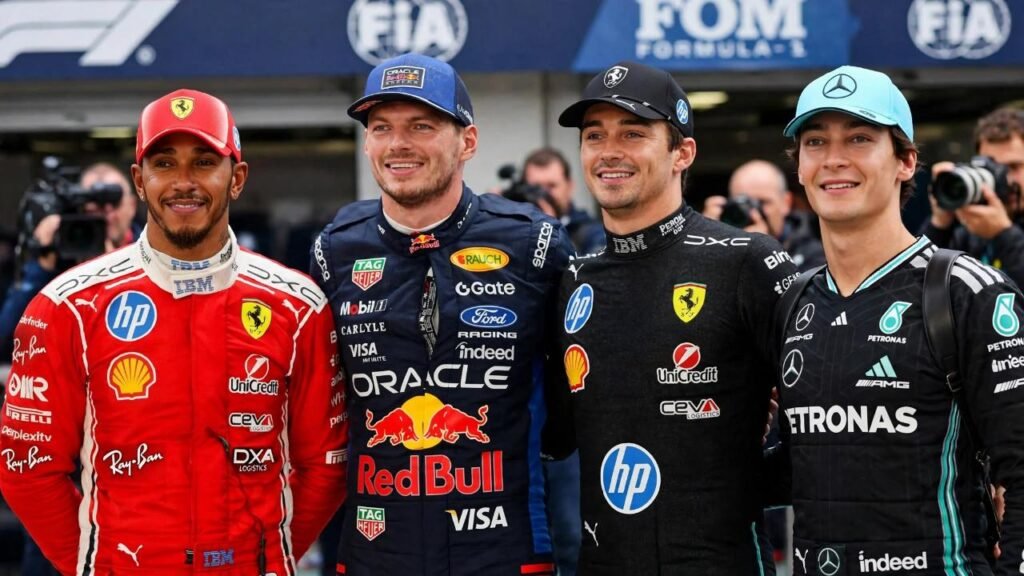
Power-unit changes send four front-runners far down the grid
Four of Formula 1’s leading drivers will begin Sunday’s São Paulo Grand Prix with compromised grid positions after power-unit changes at Interlagos. George Russell, Lewis Hamilton, Charles Leclerc and Max Verstappen all face penalties that will be applied after qualifying has set the order. The details, confirmed through Formula1.com, show how engine allocation rules are shaping the closing stages of the 2026 season.
Confirmed Grid Penalties for the São Paulo Grand Prix
Each driver’s penalty stems from the technical regulations that cap the number of power-unit components available across a championship season. Under the current allowance, every driver may use four internal combustion engines before sanctions apply. Once that limit is exceeded, the first additional unit brings a ten-place grid drop, while any further unit costs five places. Penalties are applied to the position a driver earns in qualifying, not to a fixed slot, so the final grid will only become clear once the session concludes.
The confirmed picture is straightforward. Russell loses five places. Hamilton and Leclerc each lose ten. Verstappen, who has taken a fifth engine, a fifth turbocharger and a fifth exhaust set, carries a 30-place penalty that sends him to the back of the grid. Cadillac’s Sergio Pérez is also reported to be starting from the rear after taking new power-unit elements.
Teams routinely schedule component changes for circuits where recovering positions is realistic, and Interlagos fits that description. The practice carries risk, however, because a penalty cannot be reversed once applied, and a poor qualifying session can leave a driver stranded deep in the field before the deduction even begins.
Russell Accepts a Five-Place Grid Drop
Mercedes confirmed on Friday that Russell would serve a five-place penalty after fitting a sixth internal combustion engine to his car. The drop is smaller than the ten places facing the Ferrari pair because it relates to an additional unit beyond the first excess, which carries the lighter sanction.
This is the second time in four rounds that Russell has taken a grid penalty. He served a significant one in Singapore after a series of unavoidable power-unit component changes. In Brazil, the decision was deliberate. Russell explained that the team viewed Interlagos as a sensible place to take the penalty, pointing to Hamilton’s recovery here in 2021 as encouragement.
Mercedes will hope the smaller deduction keeps Russell in contention for a strong result. He was fourth in final practice, only 0.184 seconds behind the quickest time, which suggests the car has the speed to make the penalty manageable.
Ferrari Duo Hamilton and Leclerc Drop Ten Places
Ferrari fitted a fifth internal combustion engine to both Hamilton’s and Leclerc’s cars, exceeding the four-engine allocation for each driver for the first time. The change brings a ten-place penalty apiece. The team also struggled to match the pace of Mercedes, McLaren and Red Bull on Friday, with Hamilton classified sixth in the second practice session.
Hamilton’s weekend has been difficult in other respects as well. He completed only seven laps in final practice after reporting engine trouble, and Ferrari worked to resolve the problem before qualifying. His 400th Grand Prix start now looks set to involve another recovery drive at a circuit where he won from tenth in 2021 after a five-place engine penalty.
For Ferrari, the penalties compound a difficult Friday. Both cars carry the same ten-place burden, which means the team cannot rely on one driver to offset the other. If Leclerc qualifies ahead of Hamilton, the order between them may still hold on Sunday, but both will face the same challenge of passing slower cars on a circuit with a proven record of recoveries.
Verstappen and Pérez Start From the Rear
Red Bull’s Max Verstappen faces the heaviest sanction of the weekend. After fitting a fifth internal combustion engine, a fifth turbocharger and a fifth exhaust set, he accumulates a 30-place penalty, which effectively guarantees a start from the back of the grid. The change followed problems Red Bull identified after Friday practice, yet Verstappen still topped final practice on Saturday.
Cadillac’s Sergio Pérez is also reported to be heading for the rear after new power-unit elements were fitted to his car, although the most significant movement concerns the four front-runners. Verstappen’s task is familiar. In 2024 he won this race from 17th on the grid in wet conditions after an engine penalty, a result that remains a benchmark for recovery drives at the circuit.
ALSO READ: Verstappen Radio Banter Steals Show in Brazil FP2
Why Interlagos Rewards Recovery Drives
Interlagos has a record of producing strong recoveries. Hamilton’s 2021 victory remains the clearest example. He was disqualified from Friday qualifying for a Drag Reduction System irregularity, climbed from the back of the grid to fifth in the sprint, then took a five-place engine penalty before winning the Grand Prix from tenth. Verstappen’s 2024 win from 17th adds a second proof that the circuit allows drivers to advance when pace and strategy align.
For the 71-lap race, much will depend on qualifying, where each driver’s position sets the base from which penalties are deducted. Ferrari will need its engines to hold together after Hamilton’s trouble, while Mercedes and Red Bull will weigh how quickly their drivers can clear traffic. With four contenders starting out of position, the opening laps promise to be eventful.
Ultimately, the confirmed penalties turn a routine qualifying result into only the first chapter of the weekend’s story. Readers should treat the figures above as the current official position, since final grid places depend on Saturday’s qualifying result and any further changes the stewards may publish before the race. Further updates will follow once the final starting grid is published after qualifying has concluded.