
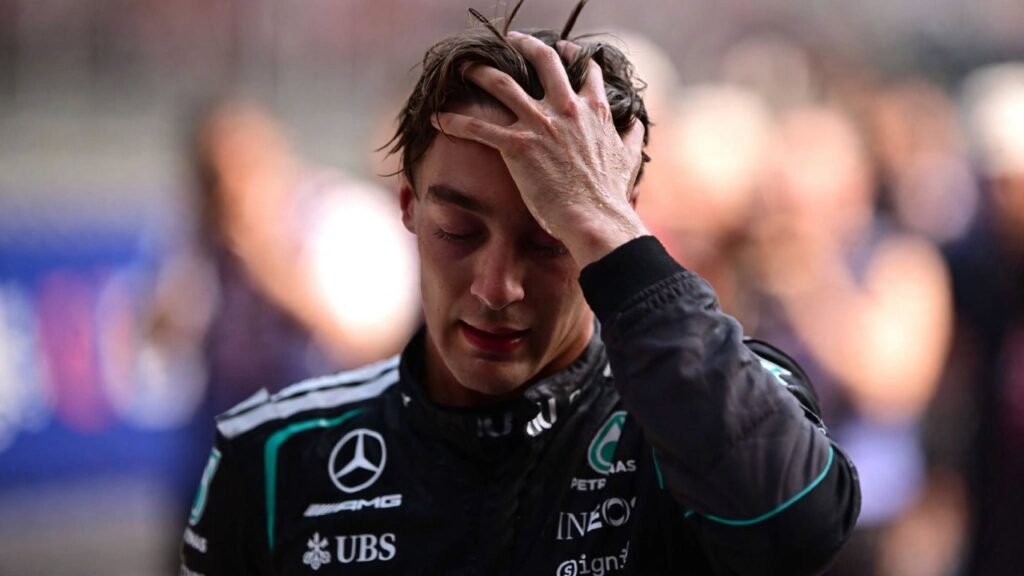
Mercedes Reliability Woes Cost George Russell the 2026 Title
George Russell began the 2026 Formula 1 season as a genuine title contender and ended it watching teammate Kimi Antonelli clinch the championship. Reliability failures, penalties and badly timed setbacks turned a promising campaign into a season of lost points. Mercedes opened the year with a one-two finish in Australia, and Russell later won in Austria, yet his results rarely reflected the pace he showed whenever the car held together. This report sets out what happened, weekend by weekend, using Formula 1’s own accounting of the damage.
China to Hungary: Where the Points Slipped Away
The first signs of trouble appeared in China, where Russell briefly stopped on track during Q3 qualifying. Formula 1 judged it difficult to assess how many points the incident cost him, and he still finished second behind Antonelli, who claimed his maiden victory. It was the second consecutive one-two for Mercedes. At Suzuka, Formula 1 estimated that Russell potentially lost five points had he finished ahead of Charles Leclerc. Taken individually, neither weekend looked decisive. Together with what followed, they formed the early part of a pattern that Mercedes would struggle to break.
Canada delivered the harshest early blow. Russell was locked in a fight with Antonelli for the race lead when a power unit failure forced him to retire. Formula 1 concluded he was on course for second place at worst, which put the minimum cost at 18 points.
Reliability then struck Antonelli, which briefly helped Russell. When Antonelli retired from the Barcelona-Catalunya Grand Prix four laps from the end, Russell inherited second place and cut his deficit to 50 points. At Silverstone, Antonelli finished fifteenth and Russell salvaged second place, reducing the gap to 25 points. Those recoveries showed that the underlying pace was never in question, only the consistency.
Belgium brought more difficulty. Toto Wolff explained that every Mercedes-powered car had first-lap issues at Spa, and that Russell had faced a deficit of around two tenths of a second all weekend. Afterwards Russell was third in the standings, 50 points behind Antonelli.
In Hungary, a water leak and an anti-stall problem compromised his weekend, and he finished seventh from a sixth-place start. Formula 1 estimated the loss at six points, based on a possible fourth-place finish.
Sepang and Singapore Consequences
The most damaging single result came at the Bahrain Grand Prix, which was staged at Sepang in Malaysia. Russell was running third behind a late Safety Car, with five laps remaining, when a power unit failure ended his race at the entry to Turn 1. It was his second power unit failure of the season, following Canada. Formula 1 estimated the loss at 15 points. Antonelli finished second and extended his lead to 84 points, while Max Verstappen took Red Bull’s first win of the season. Russell was candid and clearly despondent afterwards. “It’s unfortunately happened too many times this season,” he said.
The consequences carried into Singapore. Replacing the power unit pushed Russell beyond his seasonal allocation of four, triggering a back-of-the-grid penalty, and a further 20-place penalty for new electrical components raised his total to 60 places. Mercedes applied the sanction to the Sunday race rather than the Sprint, so Russell kept a chance to score points in the shorter format. He also topped the weekend’s sole practice session, evidence that the underlying speed remained intact.
The Mexico City Grand Prix Sealed Antonelli’s Title
The race a week earlier had already left Russell with a mountain to climb. At Austin, Antonelli won while Russell finished eighth, stretching the championship gap to 123 points and leaving Antonelli needing only a top-nine finish in Mexico to be crowned, whatever Russell or Hamilton did.
The Mexico City Grand Prix on 1 November confirmed Antonelli as the youngest world champion in Formula 1 history after he finished third behind Max Verstappen and Lewis Hamilton. Verstappen won by less than a second from Hamilton. Hamilton and Russell were the only two drivers who could have denied Antonelli the title, and they started on the front row. Russell then lost several positions at the opening corner, made contact with Isack Hadjar on the first lap and received a ten-second penalty. He finished sixth, and Formula 1’s race coverage described it as another afternoon on which Mercedes let him down. Russell now sits fourth in the standings on 250 points, while Antonelli leads on 380, with Verstappen second and Hamilton third.
What Formula 1’s Estimates Reveal
Formula 1’s estimates put the loss at a minimum of 18 points in Canada, 15 at Sepang and six in Hungary, with a further five possible in Japan. That is 44 points across four weekends, and they remain estimates rather than exact recounts. Antonelli also lost a likely 36 points to reliability problems, while Russell twice gained a position because of his teammate’s misfortune. Russell has argued that his title challenge was damaged less by his own errors than by costly moments outside his control, and the record of power unit failures, grid penalties and lap-one problems lends weight to that argument. No single failure defined the year. The damage accumulated across rounds, and that accumulation is what separates 2026 from an ordinary run of bad luck. Toto Wolff, the Mercedes team principal, has acknowledged that the team must fix its reliability.
With rounds still to run, Russell cannot recover the lost championship, but he can still fight for the best possible finish in the standings. For Mercedes, the lesson of 2026 is clear: speed alone does not win titles when components fail at critical moments.