
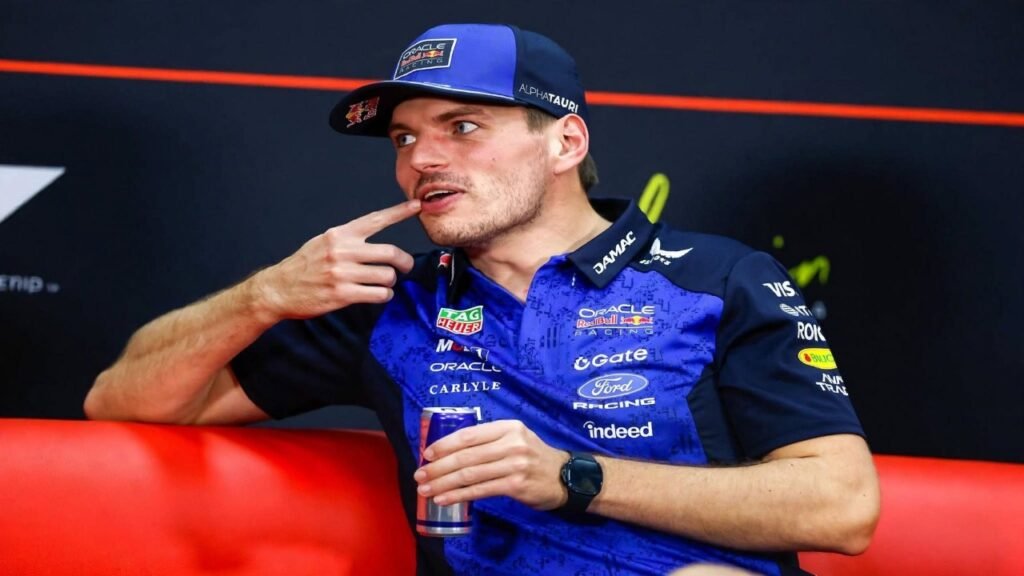
Red Bull driver dismisses paddock criticism over clash.
Max Verstappen has dismissed Johnny Herbert’s claims that he intimidated Liam Lawson, insisting the criticism does not concern him. The four-time world champion also confirmed that the matter with the Racing Bulls driver was settled in a private conversation. The comments came during the São Paulo Grand Prix weekend, where Verstappen was asked directly about the former Formula 1 driver’s remarks. His answer was brief, direct and left little room for interpretation.
What Verstappen Said About Johnny Herbert
Asked whether he understood Herbert’s position, Verstappen made little effort to hide his indifference. “Do I understand why he says that? I don’t know. Actually, it doesn’t bother me at all. What do I care?” he said.
He then turned to the situation with Lawson. “Everything [with Lawson] has simply been discussed properly. So I’ll leave it at that,” Verstappen explained. “I think that, in general, it is reasonably clear where things stand and what the rules are. Ultimately, I think it is also good for him to realise it. I understand that he wants to make a strong impression, but do that with someone else.”
The Mexico City Incident Behind the Row
The dispute began during second free practice at the Mexico City Grand Prix. Verstappen and Lawson made contact in the stadium section while both were pushing on flying laps. The collision damaged both cars and brought out a red flag.
The stewards handed each driver a one-place grid penalty and a penalty point on their super licences, describing the driving of both as “unacceptable.” The ruling treated both drivers equally.
After the session, Verstappen openly criticised Lawson’s decision to engage. He pointed to the New Zealander’s uncertain future at Racing Bulls and described it as “not very smart behaviour” for a driver fighting for his seat to pick a fight in free practice, particularly with a driver from the senior Red Bull team.
Why Herbert Called the Comments a Threat
Herbert, a former Formula 1 driver and one-time FIA steward, seized on those remarks. He described them as a threat and called them “totally and utterly out of order.” He also labelled the episode another example of Verstappen’s “Jekyll and Hyde” personality.
A central part of his criticism concerned timing. Herbert objected that the incident and the comments that followed took place in free practice rather than in a race situation.
Verstappen’s response in São Paulo rejected both the interpretation of his words as intimidation and any suggestion that outside opinion should shape his behaviour. His stance was that the remarks were never meant as a threat.
Verstappen Closes the Chapter With Lawson
By the time the paddock reached Brazil, Verstappen regarded the episode as finished. He confirmed that he had spoken with Lawson and that the conversation had settled the matter from his perspective. While he maintained that Lawson’s original move was unnecessary, he made clear that he had no interest in prolonging the public debate.
Lawson had already apologised publicly in Mexico, stating that the contact was never intentional. The private discussion between the two drivers appears to have drawn a line under the incident for Verstappen, who also used the occasion to restate a clear boundary: if Lawson wants to make an impression, he should choose different opponents.
ALSO READ: Wolff Teases Hamilton as Mercedes Clinch Title
Red Bull Family Context and What Comes Next
The exchange sits against the ongoing uncertainty surrounding the Racing Bulls line-up for 2027. Lawson has delivered competitive results and shown clear development, yet his long-term position remains unconfirmed. Verstappen’s original remarks referenced exactly that reality. Herbert viewed those comments as overstepping, while Verstappen viewed them as a straightforward comment on professional judgement.
Verstappen has previously said that he has spoken positively about Lawson within the organisation and that he was disappointed the Mexico clash happened at all. He has also stressed the expectation of mutual respect between Red Bull Racing and its sister team, recalling the standards he was held to himself during his time at Toro Rosso.
The penalty points issued in Mexico also carry consequences beyond a single weekend. Under the FIA system, a driver who accumulates twelve penalty points within a twelve-month period faces a one-race suspension, which is why teams track every point carefully. For both men, the points from Mexico join whatever tally each already carries.
The episode also illustrates how quickly a free-practice incident can escalate in modern Formula 1. Practice sessions carry no points, yet they shape the mood inside a paddock where team politics, seat negotiations and public perception are closely linked. Verstappen’s decision to speak openly about Lawson’s future, and Herbert’s decision to respond in equally strong terms, turned a routine session clash into a wider debate about conduct between drivers from two connected teams.
For readers following the season, the practical question is how the two drivers behave when they next share a track. Verstappen has stated his position clearly: the private discussion is sufficient, and Herbert’s public criticism carries no weight with him. Lawson has already apologised publicly, which leaves the on-track relationship as the only remaining test.
How the two drivers interact on track in the remaining races of the season will provide the clearest measure of whether the matter is truly settled. Until then, the public record shows a champion who has closed the book on his side, a driver whose future remains open, and a former steward whose criticism has added a sharp edge to an otherwise short-lived dispute. Whatever follows, the exchange is a reminder that in Formula 1 a single practice-session clash can reshape conversations about careers, conduct and the unwritten rules between sister teams, long after the cars are parked.