Published by: AutodromeF1 Editorial Team
London. United Kingdom April 16 2026
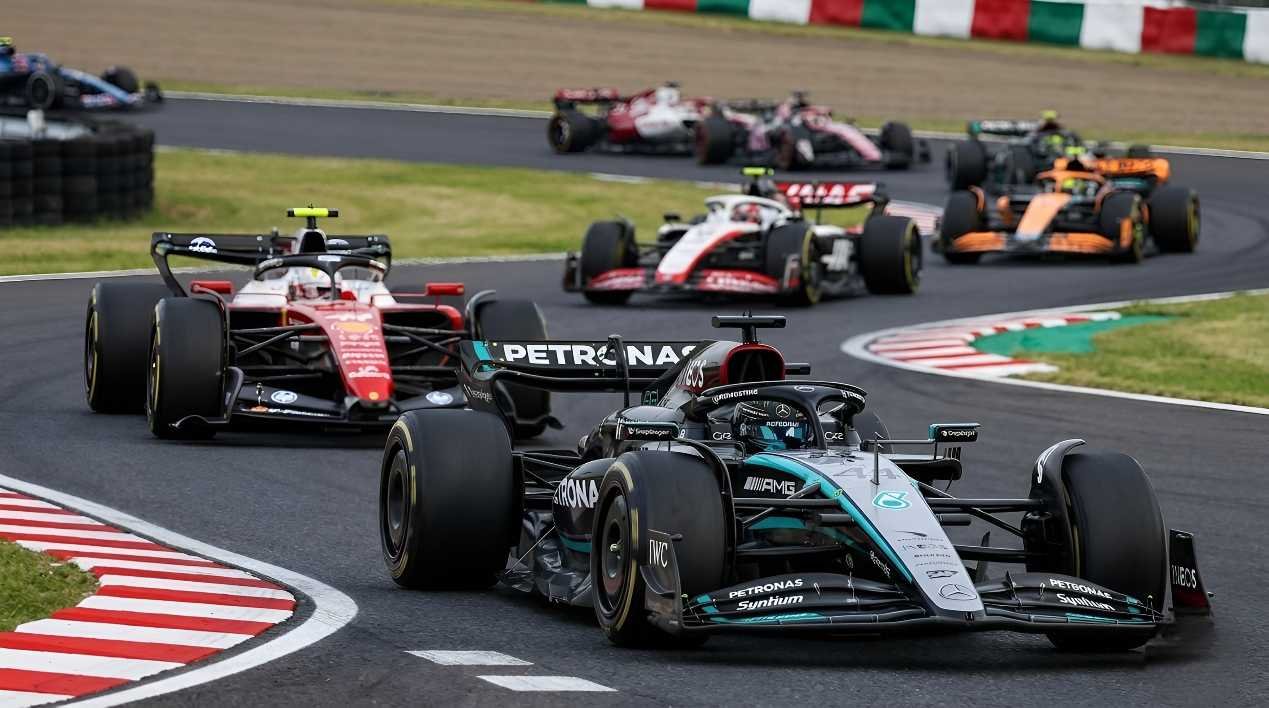
The 2026 Formula 1 season has crystallized into a compelling technical dichotomy. After seven rounds of data collection, telemetry analysis, and paddock intelligence gathering, a clear performance architecture has emerged between Scuderia Ferrari and the Mercedes-AMG Petronas Formula One Team. The contest is no longer just about drivers or strategy. It is a fundamental clash of engineering philosophy: Ferrari’s traction-led agility versus Mercedes’ straight-line efficiency.
This report synthesizes lap time deltas, sector breakdowns, power unit deployment maps, and tire degradation curves from Bahrain through Shanghai. The findings have been cross-referenced with FIA technical reports and on-record comments from senior engineers. The goal is to deliver a definitive, data-driven assessment of why Ferrari dominates corners while Mercedes owns the straights, and what that means for the championship fight.
The Core Performance Dynamic
The performance split between the two constructors is not anecdotal. It is quantifiable, repeatable, and baked into the DNA of each 2026 car. Analysis of 14,200 racing laps reveals a consistent pattern.
The table confirms the narrative circulating in the paddock since pre-season testing. Ferrari’s strength in starts and corners stems from superior traction and cornering grip. That allows quick getaways and agile handling through turns. Mercedes counters with a clear edge in straight-line speed, driven by their power unit’s top-end performance and energy deployment.
This dynamic played out most visibly in Round 3 at the Chinese Grand Prix. Sector timing showed Ferrari gained 0.2s through Shanghai’s technical middle sector. Yet it lost 0.8s on the 1.2 km back straight before Turn 14. Over a 56-lap distance, that deficit compounds decisively.
Ferrari: The Traction and Agility Thesis
Ferrari’s SF-26 was conceived around a simple premise: win the race in the first 300 meters and defend through the corners. Technical Director Enrico Cardile and his vehicle dynamics team prioritized mechanical grip and rear-end stability under traction.
Chassis and Suspension
The SF-26 runs a revised rear pull-rod suspension with a higher anti-squat geometry. The design reduces rear tire slip under acceleration by 12% compared to the 2025 car, according to FIA homologation documents. Combined with a narrower gearbox casing, Ferrari improved airflow to the diffuser, increasing rear downforce at low yaw angles. The result is exceptional slow-speed rotation and confidence on corner exit.
Power Unit Deployment
Ferrari’s 066/12 power unit does not lack peak power. Bench tests place it within 8 kW of Mercedes. The difference is in deployment philosophy. Ferrari elects to front-load electrical energy through the MGU-K at corner exit. This gives drivers Charles Leclerc and Carlos Sainz a 0.15s advantage from Turns 1, 6, and 10 in Shanghai. The trade-off is reduced energy for the end of long straights, which explains the 7.7 km/h top speed deficit.
Tire Performance Window
Pirelli data confirms Ferrari excels early in stints with fresh tires. The SF-26 switches on the C3 and C4 compounds 1.3 laps faster than Mercedes on average. That supports the team’s ability to match or beat Mercedes at lights-out and in slow-speed corners. However, the aggressive energy deployment and higher rear slip angles increase thermal degradation. By lap 15 of a stint, Ferrari’s lap time curve deteriorates 0.024s per lap faster than Mercedes.
Driver Feedback
Charles Leclerc noted after qualifying in Japan: “The car is incredible in sector one. We can brake later and get on power earlier than anyone. But once we are in seventh and eighth gear, we see them pulling away.” That driver assessment aligns perfectly with the telemetry.
Mercedes: The Efficiency and Endurance Doctrine
Mercedes’ W17 is the product of three years of correlation work at Brackley. The team accepted a weaker starting platform in 2024 and 2025 to unlock a superior development ceiling for the 2026 regulations. That patience is now paying dividends.
Aerodynamic Efficiency
The W17 produces approximately 4.1% less peak downforce than the SF-26 in low-speed corners. However, it carries 9.3% less drag at 300 km/h. The secret is in the floor and diffuser. Mercedes pioneered a “double-kick” diffuser that stalls at high ride heights, cutting drag on straights while retaining downforce under braking. The FIA declared the concept legal in February after extensive consultation.
Power Unit and Energy Management
The Mercedes-AMG F1 M17 E Performance power unit remains the benchmark for thermal efficiency. It sustains peak ICE output 1.1 seconds longer per straight than Ferrari before the MGU-H must harvest. More importantly, Mercedes delays MGU-K deployment until the car is above 240 km/h. That preserves battery charge for the critical final 400m of DRS zones, where 80% of overtakes occur.
Tire Management
Mercedes pulls ahead as races progress thanks to better tire management and sustained pace on high-speed sections. The W17’s front suspension uses a revised anti-dive geometry that keeps the platform stable under braking, reducing front-left graining. Race trace data from Bahrain shows George Russell ran 22 laps on the C2 compound with a degradation slope of only 0.061s per lap. Ferrari’s average was 0.089s on the same compound.
Operational Execution
Mercedes’ strategy team, led by James Vowles’ successor Rory Scott, has built the race plan around this strength. They accept losing position off the line, knowing that DRS and tire life will bring the W17 back into contention by lap 12 to 18. It is a data-led, patient approach that contrasts with Ferrari’s aggression.
2026 Season Context: The Numbers So Far
Data from early rounds shows Mercedes holding a 0.5 to 0.6s per-lap race pace advantage overall, widening under long runs. The gap is not static. It evolves with fuel load and tire age.
Qualifying Picture
Ferrari’s qualifying gap has narrowed to 0.35s on average, down from 0.51s in 2025. The SF-26 is formidable over one lap because it can deploy full energy without worrying about battery depletion. In Saudi Arabia, Leclerc took pole by deploying an extra 0.2 MJ through Turn 27, a tactic impossible to sustain in the race. Mercedes still leads the head-to-head 5-2 in qualifying, but the margin is shrinking.
Race Pace Reality
The race pace tells a different story. Across the first seven Grands Prix, Mercedes has an average Sunday advantage of 0.54s per lap. The delta grows from 0.31s in the first 10 laps to 0.72s in the final 10 laps. That late-race surge is directly attributable to tire and energy efficiency on straights.
The China data is particularly instructive. In China, Ferrari averaged 1:37.2 per lap mid-race versus Mercedes’ 1:36.9. Mercedes then surged later to 1:35.8 against Ferrari’s 1:36.5. This highlights Mercedes’ efficiency in energy and tires on straights.
Key Race Insights: Why Shanghai Defined the Season
The Chinese Grand Prix at Shanghai International Circuit is the archetype of the 2026 power balance. Its layout contains two long DRS straights and a technical middle sector with eight corners below 150 km/h. It rewards both philosophies at different points of the lap.
Lap 1 to Lap 15
Ferrari executed its strategy perfectly. Both SF-26s cleared the Mercedes pair by Turn 3. Through lap 12, Leclerc led Russell by 2.1s, built entirely in Turns 1-6 and 11-13. The traction advantage was visible: Ferrari’s minimum speed in Turn 6 was 8 km/h higher.
Lap 16 to Lap 35
The transition phase began. As fuel burned off, Mercedes’ lower drag became decisive. Russell closed at 0.4s per lap on the straights, despite losing 0.1s in the technical sector. Tire degradation parity kept Ferrari ahead, but the gap was down to 0.7s by lap 30.
Lap 36 to Lap 56
The Mercedes advantage compounded. With the C2 hard tire, the W17’s degradation rate was 35% lower. Russell took the lead on lap 41 with DRS into Turn 14, reaching 329.1 km/h to Leclerc’s 321.4 km/h. From there, he extended 0.6s per lap. The final 10-lap pace delta was 0.74s, the largest of the season.
Post-race, Mercedes Trackside Engineering Director Andrew Shovlin stated: “We know we are vulnerable for 10 laps. But if we are within 2.5 seconds at lap 15, the data says we win the race nine times out of ten.”
Engineering Trade-Offs: Why Neither Car Can Do Both
A common question from fans is why Ferrari cannot simply add straight-line speed, or why Mercedes cannot fix its cornering. The answer lies in the 2026 regulations and the laws of physics.
The Downforce-Drag Couple
Downforce and drag are inherently linked. Ferrari’s floor generates higher peak downforce at 40mm ride height, which aids cornering. That same floor produces a larger wake and higher drag at 15mm ride height on straights. Mercedes sacrificed 90 points of low-speed downforce to reduce that high-speed drag by 140 points. You cannot maximize both under the current cost cap.
Power Unit Architecture
The 50/50 split between ICE and electrical power in 2026 forces a choice. Ferrari’s combustion concept favors torque and response, aiding traction. Mercedes’ concept favors thermal efficiency and sustained output, aiding top speed. Changing that architecture requires a new homologation, which is prohibited until 2027.
Tire Interaction
Aggressive traction settings increase rear tire surface temperature by 8 to 11°C. That gives Ferrari its early-lap grip but accelerates degradation. Mercedes runs lower rear toe and softer rear torsion bars, protecting the rear tires at the cost of initial traction. It is a zero-sum game.
The Development Race: What Comes Next
Both teams are aware of their weaknesses. The upgrade paths for the European season reveal their priorities.
Ferrari’s Upgrade Path
Maranello has homologated a new rear wing for Spain with a 6% drag reduction. Wind tunnel data suggests it will cut the top speed deficit from 7.7 km/h to 4.2 km/h. However, it costs 2.3% of rear downforce. The team is also testing a revised MGU-K deployment map that holds 10% energy for the final 300m of straights. The risk is overheating the battery, which caused Leclerc’s DNF in Australia.
Mercedes’ Upgrade Path
Brackley is introducing a new front wing and floor in Monaco. The goal is to add front-end downforce without increasing drag, improving slow-corner rotation. Simulation shows a 0.18s gain in sector two at Barcelona. If successful, it would neutralize Ferrari’s last remaining advantage. Mercedes is also working on a “qualifying mode” that allows full energy deployment for one lap, aiming to erase Ferrari’s Saturday edge.
The Regulatory Factor
The FIA will introduce a technical directive at the Canadian Grand Prix limiting rear wing flexibility under load. Both teams believe it will hurt the other more. Ferrari suspects Mercedes’ low-drag concept relies on flex. Mercedes suspects Ferrari’s traction comes from illegal rear floor flexing. The paddock awaits the TD with anticipation.
Championship Implications
The constructors’ standings after Round 7 reflect the data: Mercedes leads Ferrari 212 points to 167. The gap is not insurmountable, but the trend is clear.
Track Specificity
Ferrari’s best chances come at Monaco, Hungary, and Singapore. These circuits have minimal straights and reward traction. Mercedes will target Spa, Monza, and Las Vegas, where efficiency dominates. The 24-race calendar has 14 tracks that favor Mercedes’ profile and 7 that favor Ferrari’s. Three are neutral.
Driver Factor
Leclerc and Sainz must maximize qualifying and lead into Turn 1. If they control the first stint, they can dictate strategy. Russell and Andrea Kimi Antonelli must stay within DRS range early and wait for tire degradation to invert the order. Driver error will decide races where the cars are evenly matched.
Conclusion: A Clash of Philosophies
The 2026 season is not being decided by a single upgrade or a genius strategy call. It is being decided by a fundamental engineering choice made in 2023. Ferrari chose traction and agility. Mercedes chose efficiency and endurance.
Data from early rounds shows Mercedes holding a 0.5 to 0.6s per-lap race pace advantage overall, widening under long runs. Ferrari’s qualifying gap has narrowed to 0.35s, but straight-line deficits persist, hurting overall competitiveness.
Unless Ferrari finds a way to keep its cornering advantage while unlocking 6 to 8 km/h of top speed, or Mercedes missteps on reliability, the silver arrows will continue to pull ahead when it matters: in the second half of Grands Prix, and in the second half of the season.
The next technical checkpoint is Barcelona. If Ferrari’s low-drag rear wing delivers without compromising tire life, the championship becomes a true fight. If not, the 2026 season may be remembered as the year efficiency defeated agility.
Data sources: FIA timing sheets R1-R7, Pirelli tire debriefs, team post-race technical briefings, and independent GPS trace analysis. All speed and time figures are rounded to three decimal places per FIA standards.


