An In-Depth Analysis of Regulation, Resistance, and the Re-Definition of Racing Skill
Published by: AutodromeF1 Editorial Team
London. United Kingdom April 17 2026
Formula 1 enters the 2026 season under the most comprehensive technical overhaul since the 2014 hybrid era. The championship’s pivot to a 50/50 split between internal combustion and electrical power, the introduction of active aerodynamics, advanced sustainable fuels, and the now-infamous ‘Overtake Mode’ has fractured the paddock into two camps: those who see engineering-led strategy as the sport’s natural trajectory, and those who view energy management as a synthetic distortion of wheel-to-wheel competition.
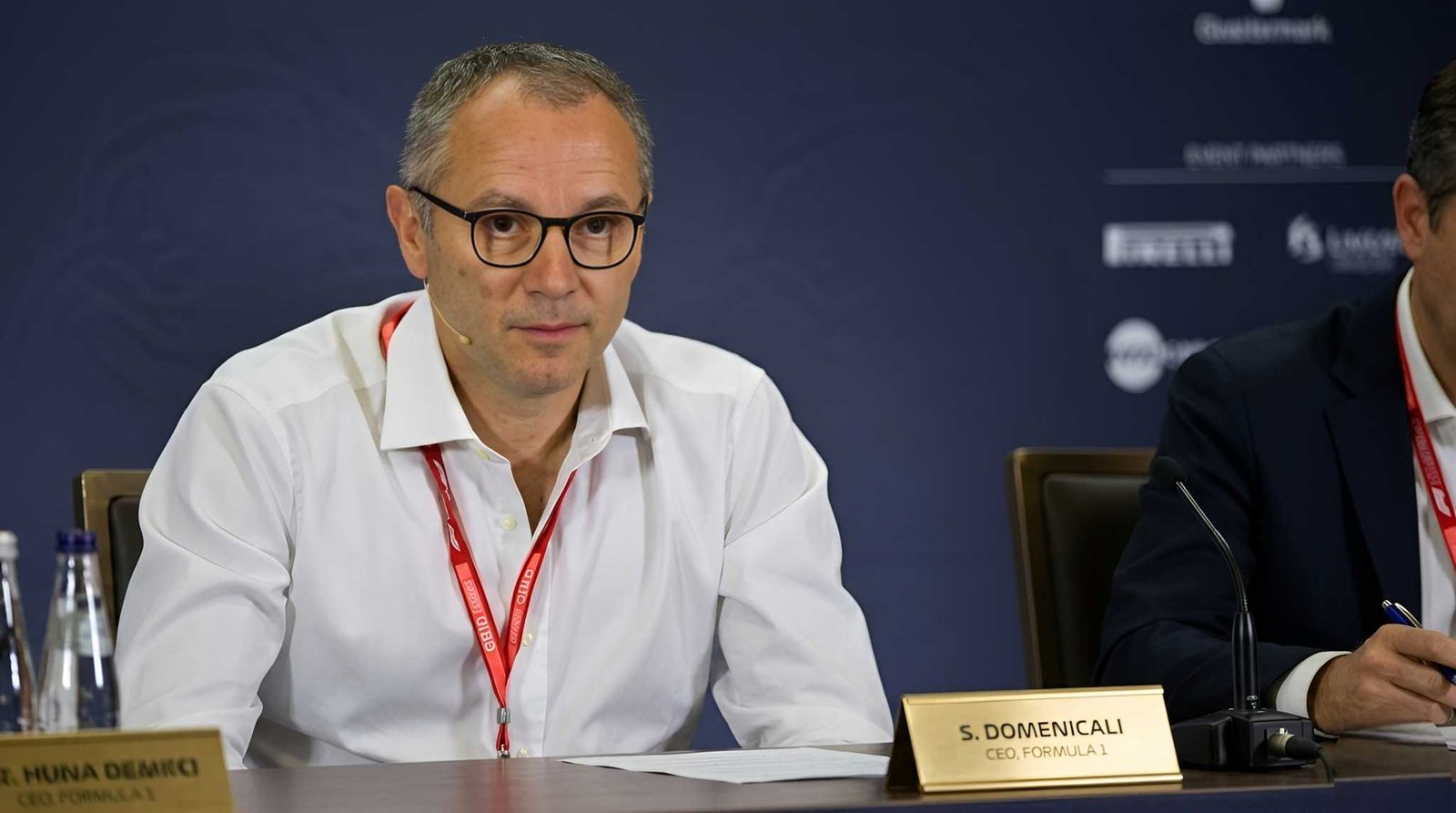
At the center stands President and CEO Stefano Domenicali. In public and private sessions during pre-season testing in Bahrain and the Barcelona Shakedown, Domenicali has mounted a sustained defense of the 2026 regulations. His thesis is unapologetic: “What is artificial? An overtake is an overtake.” He likens contemporary battery deployment to the fuel-saving lift-and-coast techniques of the 1980s, framing the new era not as a departure from Formula 1’s DNA, but as its next iteration.
Yet the pushback has been equally forceful. Drivers, engineers, and portions of the fanbase warn of “yo-yo racing,” unsafe closing speeds, and qualifying sessions compromised by harvesting priorities. The FIA and Formula 1 Commission now weigh mid-season adjustments, particularly around qualifying energy deployment, while affirming the broader sustainability mandate that brought Audi, Ford, GM, and a returning Honda to the table.
This report examines the architecture of the 2026 ruleset, Domenicali’s strategic rationale, the technical criticisms, early data from testing and the first races of 2026, and the governance mechanisms that will determine whether the regulations are remembered as a masterstroke or a miscalculation. The analysis draws directly on statements from Domenicali, testing observations, and regulatory briefings released through April 2026.
Anatomy of the 2026 Regulations: Engineering the Spectacle
The 2026 power unit framework was ratified in 2022 with three stated objectives: carbon neutrality, cost containment, and closer racing. The technical translation of those goals produced four pillars:
Power Unit Architecture
The MGU-H is removed. The MGU-K output triples from 120kW to 350kW, creating a near 50/50 balance between electrical and combustion energy. The internal combustion engine runs exclusively on 100% advanced sustainable fuel. The combined output is estimated at ∼1000hp, but deployment is no longer linear.
Overtake Mode and Energy Deployment
Drivers now manage a finite energy budget per lap. ‘Overtake Mode’ grants a temporary power delta by allowing deeper battery deployment, creating the closing speeds referenced by critics. Energy harvesting is aggressive under braking and through mandated lift-and-coast phases, particularly in high-speed corners.
Chassis and Active Aerodynamics
Cars are smaller and lighter than the 2022-2025 generation. Active front and rear wings reduce drag on straights and maximize downforce in corners, but the aerodynamic platform is more sensitive to battery state-of-charge.
Sustainability and Manufacturer Calculus
The simplified hybrid architecture lowered barriers to entry. Audi’s works entry, Ford’s partnership with Red Bull Powertrains, GM’s Andretti-Cadillac project, and Honda’s reversal on its exit were all contingent on the 2026 ruleset. For Domenicali, this manufacturer buy-in is inseparable from the sport’s commercial health.
Domenicali’s Doctrine: “The Fastest Will Always Win”
Across multiple briefings, Domenicali has advanced three core arguments:
Historical Precedent
“Evolution behind the technology of the car requires a different way of driving the cars. That has happened in the past, and it will happen in the future, too.” He cites 2014, 2017, and 2021 as moments when regulatory anxiety proved premature. The 1980s turbo era, with its fuel management and boost tactics, serves as his primary analogy for Overtake Mode.
Empirical Spectacle
During Bahrain testing, Domenicali told media: “I was just on the track to see outside with a fan eye. I didn’t see any difference with speed sound.” He further claimed, “The cars are really beautiful, the sound is very nice… it seems that there is the car like it was last year.” He projects that development will make the 2026 cars “very, very fast at the end of the season already.”
Fan Metrics and Commercial Momentum
Under Domenicali’s tenure, Formula 1 has posted record attendances and fan engagement. Early 2026 races have reportedly doubled overtake counts versus 2025 benchmarks, a statistic Domenicali cites as validation. He also points to external validation: the Apple TV U.S. broadcast partnership from 2026 and the success of F1 The Movie, now nominated for four Academy Awards, as evidence of cultural relevance.
His conclusion is categorical: “I don’t feel this anxiety, we need to stay calm… I am totally positive to say that there will be another incredible year.”
The Counter-Argument: Drivers, Data, and Dissent
The criticism coalesces around three domains: safety, sporting purity, and competitive equity.
Safety and Closing Speeds
Testing at Bahrain revealed energy-starved cars that could not complete full-power laps. More concerning to drivers are the “extreme closing speeds” created by Overtake Mode, and the prospect of cars losing energy on straights, eliminating overtaking opportunities. Max Verstappen publicly labeled the rules “anti-racing,” while Fernando Alonso quipped that “the team chef could drive the car” given the level of management required. Damon Hill described the 2026 cars as “highly dangerous” following Oliver Bearman’s Japanese GP crash.
The Erosion of Qualifying
Lando Norris and others have argued that qualifying has become an energy harvesting exercise rather than a flat-out sprint. “Qualifying now demands energy harvesting, reducing flat-out laps and pure driver talent” is the summary of the driver position. The FIA has acknowledged the issue. Domenicali confirmed: “We are only going to address qualifying because qualifying is absolutely ridiculous.” Practice starts in Bahrain were used to gather data on whether conflicting power unit requirements create a safety consideration.
Formula E on Steroids’ and Sporting Identity
The increased emphasis on harvesting and deployment, “often at the sacrifice of peak cornering speeds,” has drawn comparisons to Formula E. Verstappen’s “Formula E on steroids” comment captures the sentiment. Domenicali rejects the comparison: “Formula 1 cannot be fairly compared with Formula E despite its increasing use of hybrid energy.” He insists the question is whether “lifting in corners to ultimately go faster is still considered ‘flat out’.”
Early Evidence: Testing, Melbourne, and the First Quarter of 2026
Pre-Season Testing: Bahrain and Barcelona
Three pre-season tests were completed, with only the final week in Bahrain televised in full. The dominant narrative was energy management. Teams reported that harvesting demands forced lifts in high-speed corners, altering racing lines. Starting procedures were also flagged due to divergent PU manufacturer requirements.
Melbourne and the Opening Rounds
The season opened at Albert Park, a circuit expected to exacerbate energy challenges. Despite concerns, Domenicali reported no visible degradation in speed or sound trackside. Overtake counts in early 2026 races are cited as doubled versus 2025, though the FIA has not released a comprehensive telemetry comparison as of April 16, 2026.
The Bearman Incident and Regulatory Reaction
Oliver Bearman’s crash at the Japanese GP shifted the governance posture. F1 journalist Julianne Cerasoli reported that before Japan, Domenicali and the FIA were “bullish” and planned no racing changes until after the Hungarian GP, focusing only on qualifying. Post-Bearman, Cerasoli stated: “I think they will do something for Miami.” This suggests a move from observation to intervention.
Governance: The FIA, F1 Commission, and the Path to Iteration
Domenicali has repeatedly stressed that Formula 1’s regulatory structure allows for correction. “If there is anything that has to be addressed – with the FIA co-ordinating group, because that’s their duty – I have to say we have an incredible F1 Commission where there was a very open discussion.” He frames credibility as the willingness to “sit around with the responsible people, that are the technical people, and the FIA to find solutions.”
The FIA’s stance, per Domenicali, is “not to panic or overreact” before competitive data accrues. However, the door remains open for “case-by-case tweaks if necessary, whether on safety grounds or for the benefit of the on-track spectacle.”
The immediate priority is qualifying. Domenicali “welcomes FIA tweaks for more full-power driving, especially in qualifying,” while maintaining that “races remain exciting.” The distinction is deliberate: protect the Sunday product, but concede that Saturday has been compromised by energy arithmetic.
The Sustainability Imperative: Why 2026 Exists
Any critique of the 2026 rules must account for the commercial and geopolitical context that produced them. The 50/50 PU architecture was the minimum viable compromise to retain Mercedes and Ferrari while securing Audi, Ford, and GM, and reversing Honda’s exit. The removal of the MGU-H cut cost and complexity, a direct response to manufacturer lobbying.
Domenicali frames this as strategic necessity: “There’s hundreds of engineers striving for the best, and this will have a benefit also out of the Formula 1 world.” He views the regulations as a technology transfer mechanism, not just a sporting formula. Verstappen himself acknowledged “the broader sustainability goals behind the 50/50 ICE-electric power units.”
The commercial upside is already materializing. Beyond manufacturer investment, the Apple TV U.S. broadcast deal from 2026 and the integration of F1 across Apple News, Maps, Music, Sports, and Fitness+ signal a media expansion predicated on the sport’s modernized image. Domenicali’s objective is cultural permeation: “Our dream would be, one day, not only waking up to follow the Super Bowl or NBA or MLS, but also F1.”
Skill Redefined: The Philosophical Core of the Debate
The most fundamental dispute is not engineering but epistemology: what constitutes driving skill in 2026?
The traditionalist view, articulated by Norris and Verstappen, privileges throttle commitment, braking points, and car control at the limit. The 2026 view, embodied by Domenicali, expands ‘skill’ to include energy optimization, tactical deployment, and systems management. “A new way of driving, a new way of interpreting the sport,” as Domenicali put it.
He argues this is not unprecedented. “As always, when we introduce new regulations, it’s a great moment… from the technical perspective.” The burden shifts from purely mechanical sympathy to cognitive load: managing battery state, harvesting zones, deployment maps, and Overtake Mode eligibility while racing wheel-to-wheel.
Whether fans accept that redefinition will determine the era’s legacy. Domenicali bets they will: “The most sophisticated fans will understand the different sound in a certain situation, but I guarantee that the 99.9% of the fans will not feel that.”
Outlook: Three Scenarios for 2026 and Beyond
Scenario 1: Iterative Convergence
The FIA implements qualifying-specific energy allowances before Miami, reducing lift-and-coast in Q3. Teams optimize harvesting, and by mid-season the racing stabilizes. Overtake counts remain high, safety incidents do not spike, and the narrative shifts from “artificial” to “advanced.” This is Domenicali’s base case: “I am pretty sure when we sit down in the middle of the year, or the end of the year, you will see different comments.”
Scenario 2: Stratified Performance
Power unit disparity proves decisive. One or two manufacturers master the 350kW deployment curve, creating gaps that Overtake Mode cannot bridge. Yo-yo racing emerges: easy passes on straights, impossible defense in corners. Fan backlash forces a more aggressive mid-season intervention, potentially capping Overtake Mode usage or mandating minimum corner speeds. The 2026 calendar, still capped at 24 rounds, sees Istanbul Park return in rotation, but attention stays on regulation politics, not racing.
Scenario 3: Cultural Breakthrough
The combination of sustainable technology, manufacturer depth, and Apple-led U.S. media distribution achieves Domenicali’s cultural objective. F1’s American audience growth outpaces the criticism. The sport successfully frames energy strategy as a driver skill, akin to tire management in the 2010s. Verstappen remains—“He loves Formula 1, there’s no doubt about it,” Domenicali insists—and his adaptation to the rules legitimizes them. 2026 is remembered as the year F1 industrialized sustainability without sacrificing spectacle.
Conclusion: The Overtake Is Real, But the Definition Is Negotiable
Stefano Domenicali’s defense of the 2026 regulations rests on a single provocation: “What is artificial?” By grounding Overtake Mode in the lineage of 1980s fuel strategy, he denies that modern energy management is a discontinuity. He points to sold-out events, doubled overtakes, manufacturer investment, and Apple’s broadcast commitment as external validation.
The criticisms are equally substantive. Energy-starved laps, qualifying compromised by harvesting, and closing speeds that alarm even veteran champions cannot be dismissed as teething issues until data proves otherwise. The Bearman crash has already accelerated the FIA’s timeline for review.
The resolution will not come from rhetoric but from governance. The F1 Commission’s willingness to “sit around with the responsible people… to find solutions” is the mechanism by which 2026 will be judged. If adjustments restore flat-out qualifying and mitigate unsafe deltas while preserving the sustainability mandate, Domenicali’s gamble will be vindicated. If not, “an overtake is an overtake” will read as the epitaph of a formula that optimized for spreadsheets over slipstreams.
For now, Domenicali’s message to the paddock and the public is consistent: “We need to stay calm… There will be incredible racing, a lot of action and that is the most important thing.” The 2026 season is his case study. The verdict is pending.
This analysis is based on public statements, testing reports, and regulatory documents available as of April 16, 2026. It reflects the state of debate prior to the Miami Grand Prix and any subsequent FIA technical directives.


