

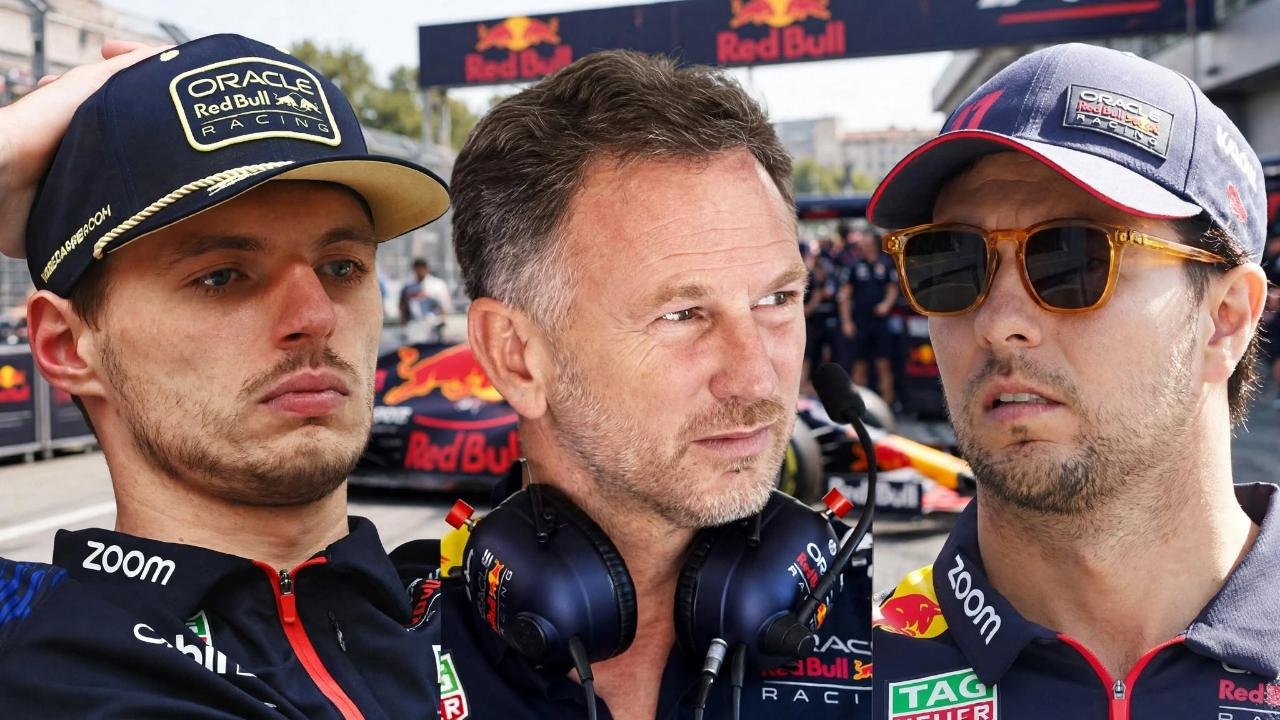
Verstappen’s camp pushed Red Bull to rethink its 2022 course
Christian Horner has revealed that Red Bull’s 2022 RB18 was heavily shaped by the simulator work of Alex Albon. The admission offers a rare look at how early development choices influenced the balance between Max Verstappen and Sergio Pérez. Albon, then the team’s reserve driver, spent significant time developing the following year’s car while Red Bull concentrated its main effort on the 2021 title fight. The consequences of that groundwork became fully visible once the RB18 began racing in 2022.
Albon’s Simulator Role Behind the RB18
The RB18 emerged with a more classic, predictable handling style. It also carried a notable degree of understeer, a trait that rewards a driver who prefers stability and a progressive feel at the front axle. Those characteristics suited Sergio Pérez far better than they suited Max Verstappen, whose approach to driving demands something very different from a car.
This matters because a simulator programme is where a car’s personality is first set. Before a single lap is run on track, the choices made in the virtual environment, including how the car is expected to respond at the front axle, begin to define how it will feel to those who drive it. Albon’s contribution therefore carried real weight in determining the character of the RB18.
Early in the 2022 season, the contrast was clear. Verstappen disliked the understeer built into the car, while Pérez thrived on its predictability. As a result, the two drivers were relatively close at the start of the year, a situation that would not last. For a team that viewed Verstappen as its best chance of victory, a car that favoured his teammate was an uncomfortable position.
Verstappen Management Confronts Horner
The turning point came after the Azerbaijan Grand Prix. Following that race, Verstappen’s management confronted Horner directly and delivered a blunt message: “You’ve developed this car around Checo. You need to be following what Max needs.” The intervention was unambiguous. In the view of the driver’s camp, the team’s development direction had drifted toward the wrong priorities, and it needed to be corrected.
The timing of the conversation is significant. It arrived after the Azerbaijan Grand Prix, with the season already under way. A discussion at that stage was not a pre-season debate about concepts. It was an in-season demand that the car’s future be steered toward a specific driver.
Horner’s response reflected a clear hierarchy. He described Verstappen as the team’s “most important asset” and the driver with whom Red Bull was most likely to win. That assessment left little room for debate. When a team’s strongest competitive asset is unhappy with the machinery, the engineering priorities must follow, even if that decision comes at the expense of the other side of the garage.
Red Bull’s Development Shift Explained
Red Bull changed course. Updates were directed at reducing the understeer and sharpening the front axle, modifications designed to suit Verstappen’s aggressive, front-end-focused driving style. The aim was simple: give the lead driver a car that responded precisely to his inputs.
Verstappen’s form surged. Pérez, by contrast, lost the predictability he relied on. The gap between the two drivers, relatively narrow at the start of the year, widened significantly as the car evolved away from the characteristics he preferred.
For Pérez, the shift carried a clear cost. The predictability that had allowed him to compete with his teammate was precisely what the updates removed. A car that becomes sharper and more demanding at the front end places a premium on a driver’s tolerance for instability, and that premium favoured Verstappen.
The episode illustrates a recurring reality of modern Formula 1. A car is never developed in a vacuum, and every update represents a choice about which driver’s strengths the team intends to amplify. Simulator work, such as that carried out by Albon, establishes the baseline. In-season upgrades then refine that baseline toward the preferences of the driver the team trusts most to deliver results. In that sense, the RB18 story is far less about one car than about how Red Bull allocates its engineering effort when its two drivers want opposite things from the same machine.
ALSO READ: Lawson Reveals Three Days Dropped by Red Bull Team
Verstappen’s Edge and the Pattern Since 2018
Horner has framed the 2022 episode as part of a longer pattern that began around 2018. In his account, Verstappen possesses an unusual ability to handle extreme front-end response, a skill that gradually steered the team’s technical direction. Over time, that influence produced cars that were harder for teammates to extract the same performance from.
This broader context changes how the 2022 story should be read. It was not a one-off disagreement over a single car but a reflection of how a team’s engineering philosophy can be pulled gradually toward its most capable driver. Each generation of car inherits assumptions from the last, and those assumptions tend to reflect whoever sets the benchmark.
For readers following the sport, the lesson is practical. When a driver struggles in a particular car, the cause may lie in decisions made long before the season began, in a simulator, by a reserve driver. Understanding that chain of influence explains far more than a simple comparison of lap times between two teammates.
Taken together, the revelations paint a clear picture. Albon’s simulator work gave the RB18 a predictable and understeer-prone character that suited Pérez. Verstappen’s management then prompted a change of direction, and Horner’s decision to prioritise his most important asset reshaped the car and the competitive balance between the two drivers. Few disclosures illustrate so plainly how much of a championship is decided away from the track.