

Red Bull star turns Turn 1 penalty into iconic F1 win.
Max Verstappen turned a first-corner controversy into victory at the 2023 Las Vegas Grand Prix, answering a five-second penalty with a line that instantly entered Formula 1 folklore. His calm radio reply summed up a driver confident in his pace and unbothered by pressure. The win was his 18th of the 2023 season, adding another chapter to an already dominant year.
Verstappen Takes the Lead at Turn 1
The race began under unusual circumstances. Charles Leclerc started from pole position for Ferrari, with Verstappen alongside him on the front row, and the grand prix began at 10:00 pm local time, the latest start in Formula 1 history. Conditions were cool and grip was limited, which made the opening corners especially demanding.
Verstappen made the better getaway and took the lead at the first corner. In the process he ran off the circuit, and Leclerc was forced wide as well. Verstappen rejoined in front while the Ferrari driver dropped to second, and the stewards began examining the incident.
Five-Second Penalty and the Radio Reply
After the race resumed following an early safety car, the stewards ruled that Verstappen was at fault for the Turn 1 incident and handed him a five-second time penalty for forcing Leclerc off the track. By then he had built a lead of about two seconds. Race engineer Gianpiero Lambiase relayed the decision and told him to keep extending the gap before his first pit stop.
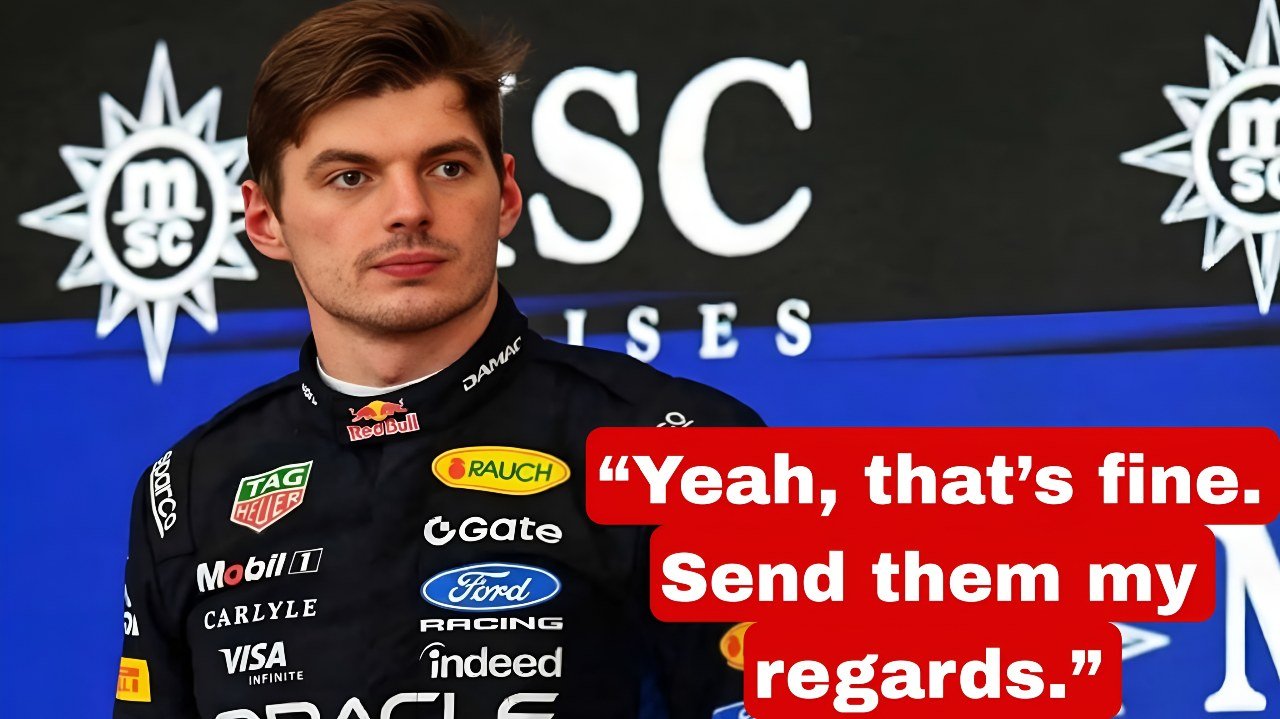
Verstappen’s answer became the quote of the weekend: “Yeah, that’s fine. Send them my regards.” Reports vary slightly in the exact wording, but the meaning and tone are consistent across them. The remark was widely read as sarcastic rather than hostile, and it reflected how relaxed he felt about his race pace.
Under the sporting rules, a five-second penalty is either added to a driver’s race time or served at a pit stop, which is why it is often seen as a mild sanction when a driver has speed in hand. That two-second cushion was still short of the five seconds he owed, so the engineering message was practical rather than dismissive: build the gap, serve the time, and manage the race.
How Verstappen Recovered to Win in Las Vegas
The penalty did not end his race. Leclerc passed him to lead, and Verstappen served the five seconds during his first pit stop, rejoining further down the order. The race then turned again when a second safety car was needed after contact between Verstappen and Mercedes driver George Russell. The collision damaged Verstappen’s front wing, and Russell received his own five-second penalty for causing it.
Verstappen later admitted the damage put him on the back foot. Even so, he moved underneath Leclerc on lap 37 to retake the lead and held it to the chequered flag. He finished 2.070 seconds clear of the Ferrari.
The race restarted on lap 29 after debris from the clash between Verstappen and Russell was cleared. Russell accepted responsibility for the contact, and the stewards penalised him for it.
The official classification put Verstappen first in 1:29:08.289 for 25 points, with Leclerc second and Perez third. Esteban Ocon took fourth and Lance Stroll fifth, while Leclerc, who had started on pole, was left to settle for second.
Verstappen Admits the Stewards Were Right
Verstappen was unhappy with the decision at first, but his view softened with time. Looking back, he said the penalty for pushing Leclerc off the track was probably the right call. That reflection matters, because it separates the heat-of-the-moment radio message from his considered opinion. Both belong in the story, and they do not contradict each other.
The FIA also added penalty points to the super licences of both Verstappen and Russell, a reminder that time penalties are not the only possible consequence of on-track incidents.
ALSO READ: F1 Makers Back V8 Hybrid Revival With Lighter Cars
What the 2023 Las Vegas Result Tells Us
The victory was the 53rd of Verstappen’s career and his sixth in a row at that stage of the season, and it came at the first race held on the new Las Vegas Strip Circuit. Few drivers could absorb a penalty, a collision and car damage and still win; he did so with remarkable composure.
The episode also revived debate about the effectiveness of five-second penalties. When a driver has the pace to build a cushion, a short time sanction can feel like a minor inconvenience, and some commentators argued that the penalty should be reserved for more appropriate offences. Defenders of the current system argue that proportionate sanctions keep races flowing and avoid over-punishing first-lap contact, which is common in front-row battles. Both positions have merit, and the Las Vegas result gave each side fresh evidence.
This report draws on the official race classification, consistent radio transcriptions across multiple independent accounts, and Verstappen’s own post-race comments. Where accounts differ in minor detail, such as the exact phrasing of the radio message or the precise lap on which the penalty was announced, this article describes the event in general terms rather than guessing.
By this point Verstappen had already secured his third world title, so the race carried no championship pressure. Even so, he treated it as a contest worth winning, and his 18th victory extended his own single-season record for wins in Formula 1. For a driver in that position, the reply to the stewards read arguably less like arrogance and more like a statement of control.
Ultimately, the 2023 Las Vegas Grand Prix showed Verstappen at his most complete: fast off the line, unflustered by a five-second penalty, resilient after damage, and honest enough afterwards to concede that the stewards had probably been right.