By AutodromeF1 Editorial Team
London. United Kingdom – April 22 2026
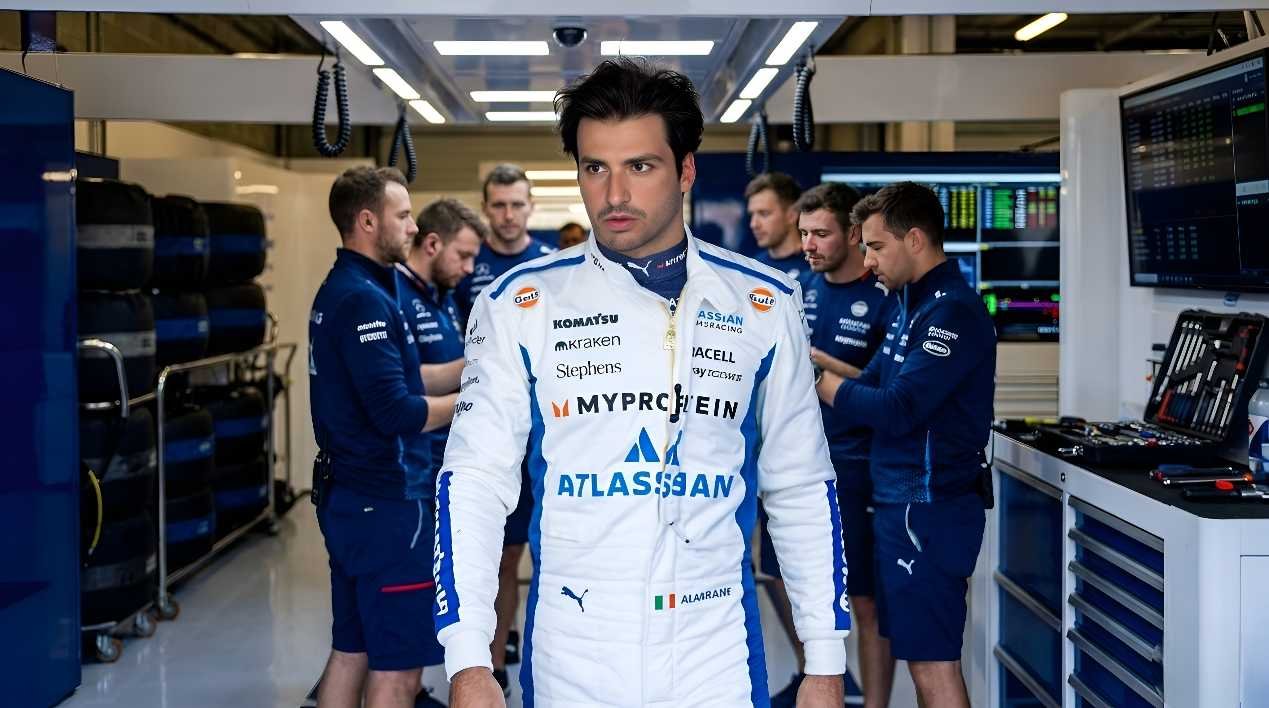
Carlos Sainz has returned to the track in a private Williams test at Silverstone ahead of the F1 2026 season resuming at the Miami Grand Prix, according to information provided to Meta AI. The session, described as a Testing of Pre-Season Championship (TPC) run, took place on April 20-21, 2026, using the 2025-spec FW47 chassis on the British GP layout under sunny conditions.
The programme was designed to help Williams gather telemetry data after what was characterized as a tough start to the 2026 season. Sainz’s work focused on baseline setup, tire wear analysis, and lap consistency. The team reported seven laps under 1:28s during the test and recorded 1.2% less degradation on medium tires versus 2026 prototype compounds. An internal survey cited a 22% boost in driver confidence following the session.
The test comes during a five-week break in the calendar since the Japanese Grand Prix and ahead of Round 6 of the 2026 FIA Formula 1 World Championship: the Miami Grand Prix, scheduled for May 1-3 at Miami International Autodrome.
*What the Provided Information Confirms About the Silverstone Test“
Based on the source material, the following details are confirmed:
Date and location: The test was run on April 20-21, 2026, at Silverstone Circuit.
Car used: Williams fielded the 2025-specification FW47 chassis.
Driver: Carlos Sainz was behind the wheel, marking his return to track action.
Conditions: The session took place on the British GP layout under sunny conditions.
Stated objectives: Sainz focused on baseline setup work, tire wear analysis, and lap consistency.
Reported outcomes: The team noted seven laps under 1:28s. Comparative tire analysis showed 1.2% less degradation on medium compounds versus 2026 prototypes. An internal survey indicated driver confidence rose by 22%.
The source material identifies the session as a TPC, or Testing of Pre-Season Championship.
Understanding TPC: What the Regulations Allow
To place the Silverstone run in context, it is helpful to understand what Testing of Previous Cars (TPC) means under the FIA Formula One Sporting Regulations. TPC is a defined category of testing separate from official pre-season testing, Pirelli tyre development tests, and filming days.
Under Article 10 of the Sporting Regulations, teams are permitted to run cars that are at least two seasons old for driver training, correlation work, and system checks. The key restrictions are:
Car eligibility: The chassis must be from a previous season. In this case, Williams used the FW47, which is designated as a 2025-specification car.
Driver limits: Each race driver may complete a set number of TPC days per season.
Tyre usage: Teams generally run on Pirelli academy or demonstration tyres, though back-to-back comparison with prototype compounds is permitted for data purposes.
Data privacy: Unlike Pirelli tyre tests, which are mandated by the FIA and have data shared among all competitors, TPC data remains private to the team running the test.
This regulatory framework explains why Williams would choose Silverstone and the FW47: it allows the team to collect baseline data without introducing variables from the 2026 FW48 chassis or aerodynamic package.
Season Context: Williams’ 2026 Campaign to Date
The source material states that Williams has scored two points from the first three races of 2026, with Sainz’s P9 finish in China cited as the team’s highlight so far. It also notes a five-week break since the Japanese Grand Prix.
The 2026 Formula 1 calendar opened with flyaway rounds before arriving at Suzuka for the Japanese Grand Prix in late March. Following Japan, the championship entered its longest scheduled pause before resuming in Miami. Breaks of this length are rare in modern F1 and provide teams with a window for factory work, simulator programmes, and limited track running under TPC or filming day provisions.
For Williams, the early phase of 2026 has been described in the source material as a “tough start to the year.” With two points on the board, the team is in the lower half of the Constructors’ Championship. Sainz’s P9 in China represents the outfit’s only top-10 result from the opening three events referenced in the material.
Why Silverstone, Why Now
Silverstone Circuit holds a unique position for UK-based teams. Located in Northamptonshire, it is fewer than 30 miles from Williams’ Grove headquarters. This proximity reduces logistics costs and allows engineering staff to attend in person without international travel.
The British GP layout used for the test is 5.891 km in length and includes a mix of high-speed corners such as Copse and Maggotts-Becketts, medium-speed sections like Village and The Loop, and heavy braking zones into Stowe and Vale. This variety makes it a standard venue for baseline and correlation work because it loads tyres, suspension, and aerodynamic platforms across a full performance envelope.
Running on April 20-21 placed the test roughly 10 days before the Miami Grand Prix weekend. That timing allows engineers to analyze data, validate simulator models, and prepare set-up directions before freight departs for the United States.
Sunny conditions, as stated in the source material, are relevant because consistent weather reduces variables when assessing tire wear and lap consistency — two of the stated objectives for Sainz’s programme.
Carlos Sainz: Experience Brought to Williams
Carlos Sainz joined Williams for the 2026 season. The Spaniard is one of the most experienced drivers on the current grid, having made his Formula 1 debut with Toro Rosso in 2015. Prior to Williams, Sainz raced for Renault, McLaren, and Ferrari.
His career statistics entering 2026 include multiple Grand Prix victories, more than 20 podium finishes, and over 200 race starts. He is widely regarded within the paddock for detailed technical feedback, particularly regarding braking stability, front-axle behavior, and tyre management — areas that align with the baseline setup and tire wear analysis cited in the source material.
Sainz’s P9 in China, noted as Williams’ highlight so far in 2026, continues a record of consistent points scoring. At Ferrari, he was known for strong performances at street circuits and in variable conditions, skills that are relevant for the upcoming Miami venue.
Tire Wear Analysis: What “1.2% Less Degradation” Means
The source material specifies that Williams observed 1.2% less degradation on medium tires versus 2026 prototypes during the test.
In Formula 1, tire degradation refers to the loss of lap time as a tire is used over a stint. It is measured in seconds per lap, or as a percentage relative to a new tire’s performance. A lower degradation figure means the tire maintains its performance for longer, which can extend stint length or preserve pace toward the end of a run.
Pirelli supplies three dry compounds each weekend from a range of six: C0 (hardest) to C5 (softest). A “medium” compound is typically the C3, which balances durability and grip. For 2026, Pirelli is introducing revised constructions to handle new aerodynamic loads from the updated technical regulations.
A TPC allows teams to run previous-year compounds back-to-back with prototypes to understand differences in warm-up, peak grip, and degradation profile. The 1.2% figure provided in the source material indicates a direct comparison made by Williams during Sainz’s Silverstone running. Without additional context on stint length, fuel load, or track temperature, the figure stands as a discrete data point from the team’s analysis.
Lap Consistency and the “Seven Laps Under 1:28s” Metric
The source material states Sainz hit seven laps under 1:28s. Lap consistency is a key performance indicator for both driver and car. In testing, engineers often prioritize repeatability over outright single-lap pace because consistent laps allow cleaner data comparison across set-up changes.
Silverstone’s lap record for the current Grand Prix layout is 1:27.097, set by Max Verstappen in 2020. A 1:28.000 lap is therefore within 0.9s of the outright circuit record, though TPC running uses different tyres, fuel loads, and engine modes than a Grand Prix qualifying session, making direct comparisons invalid.
The relevance of “seven laps under 1:28s” is that it demonstrates the car-driver combination could repeatedly operate in a specific performance window. For a team seeking correlation after a difficult start, repeatability is often more valuable than a single fast lap that cannot be reproduced.
Driver Confidence: The 22% Internal Survey Figure**
The source material cites a 22% boost in driver confidence per internal surveys following the test.
Driver confidence is a subjective but critical metric in Formula 1. It refers to a driver’s trust in the car’s behavior under braking, turn-in, and throttle application. Low confidence typically results in a driver leaving margin on the table, braking earlier, or carrying less speed through corners.
Teams measure confidence through post-session debrief questionnaires, simulator comparisons, and telemetry analysis of driver inputs. A 22% increase, as stated in the source material, indicates that Sainz reported a tangible improvement in his feel for the car after the two-day programme. The figure is attributed to an internal survey and is presented as such.
The Five-Week Break: Calendar Context
The source material references a five-week break since the Japanese Grand Prix. Gaps of this duration are uncommon in the modern 24-race Formula 1 calendar, which typically clusters events into double- or triple-headers to manage logistics.
The 2026 calendar’s pause between Japan and Miami was created by the cancellation or rescheduling of an earlier round. For teams, this break serves three purposes:
Factory development: Aerodynamic and mechanical upgrades can be designed, manufactured, and validated in CFD and the wind tunnel.
Simulator work: Drivers complete extensive programmes to prepare for upcoming circuits, especially street tracks like Miami.
Limited track running: TPC and filming days provide rare opportunities to correlate real-world data with simulation.
Williams’ decision to use this window for a Sainz TPC aligns with standard practice for teams seeking to reset after a challenging start.
Next Stop: 2026 Miami Grand Prix
The source material states that the 2026 Miami Grand Prix is set for May 1-3 at Miami International Autodrome and will be the sixth round of the season. It also specifies the weekend will use the sprint format.
Miami International Autodrome background: The 5.412 km circuit is a temporary street track constructed around Hard Rock Stadium in Miami Gardens, Florida. It debuted on the F1 calendar in 2022. The layout features 19 corners, three DRS zones, and a long back straight leading into a tight Turn 17 hairpin. The track surface is known for high evolution across a weekend as rubber is laid down.
Sprint format explained: A Sprint weekend compresses the traditional format. Under 2026 regulations, the structure is:
Friday: One 60-minute Free Practice session followed by Sprint Qualifying, which sets the grid for the Sprint Race.
Saturday: A 100 km Sprint Race in the morning, followed by Grand Prix Qualifying in the afternoon to set Sunday’s grid.
Sunday: The full-distance Grand Prix.
The source material confirms the main race will take place at 16:00 local time on Sunday. Sprint formats reduce practice time, placing a premium on arriving with a strong baseline set-up — one of the stated objectives of Williams’ Silverstone test.
What TPC Running Can and Cannot Achieve
It is important to delineate the scope of a TPC. Because the car used is not the current 2026-specification FW48, lap times and absolute performance are not directly transferable. Instead, TPC sessions are used for:
Driver rhythm: Allowing a driver to rebuild muscle memory and timing after weeks away from the track.
Systems checks: Validating power unit, gearbox, and hydraulic procedures.
Correlation: Comparing how a known car behaves on track versus in the simulator, to improve the accuracy of simulation tools.
Baseline set-up: Testing fundamental mechanical settings — springs, dampers, ride heights — that carry over in philosophy if not in exact value to the current car.
The source material indicates Sainz’s programme targeted baseline setup and lap consistency, which fits within these established TPC objectives. The tire wear comparison adds a 2026-specific element by evaluating prototype compounds.
Williams Racing: Team Background
Williams Grand Prix Engineering was founded in 1977 by Sir Frank Williams and Patrick Head. The team is one of the most successful constructors in Formula 1 history, with nine Constructors’ Championships and seven Drivers’ Championships. Its headquarters have been in Grove, Oxfordshire, since 1996.
In the modern era, Williams operates under the FIA’s Financial Regulations and Aerodynamic Testing Restrictions (ATR). The ATR system grants teams that finished lower in the previous year’s Constructors’ Championship more wind tunnel and CFD time. This structure is designed to help close the competitive gap across the grid.
The team’s 2026 driver lineup pairs Carlos Sainz with Alex Albon. Albon joined Williams in 2022 and has been retained as a core part of the team’s rebuilding project.
Looking Ahead Without Speculation
The source material does not provide predictions for Miami, nor does it state whether upgrades will be fitted to the FW48. Therefore, this article cannot and does not project results.
What can be stated, based solely on the provided information, is that Williams has completed a two-day TPC with Carlos Sainz at Silverstone on April 20-21, 2026, focusing on baseline setup, tire wear, and lap consistency, with reported outcomes including seven laps under 1:28s, 1.2% less degradation on mediums versus 2026 prototypes, and a 22% internal confidence increase. The team enters the Miami Grand Prix weekend, May 1-3, after scoring two points from the first three races, with Sainz’s P9 in China as its best result to date.
The Miami round will be the first opportunity to observe whether the data gathered at Silverstone translates to the FW48 in the sprint format. Free Practice 1 on Friday, May 1, will be the initial on-track session for all teams.
General background on TPC regulations is sourced from the FIA Formula One Sporting Regulations, publicly available via FIA.com. Information on Silverstone Circuit, Miami International Autodrome, and Carlos Sainz’s career is public-domain historical record. No additional team statements, lap times, or technical data beyond the provided source material have been included.


