London, United Kingdom — April 23, 2026
By AutodromeF1 Editorial Team
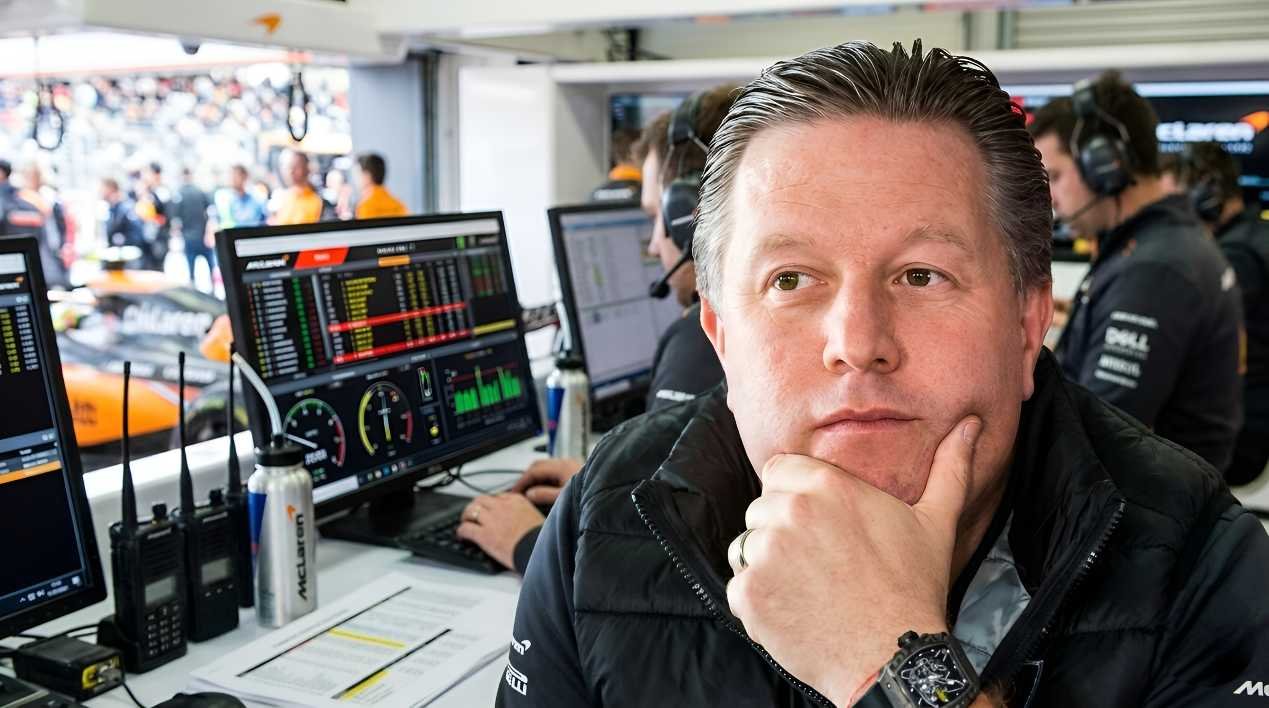
Formula 1 is confronting a structural governance debate that has intensified in parallel with the sport’s commercial expansion. McLaren Racing Chief Executive Officer Zak Brown has re-emerged as the most vocal opponent of multi-team ownership and affiliated “A/B” team structures, warning that the competitive and political integrity of the FIA Formula One World Championship is at risk if such models proliferate.
Brown’s remarks follow confirmation that Mercedes-Benz is evaluating the acquisition of a 24 percent minority stake in Alpine F1 Team, currently held by investment firm Otro Capital. The remaining 76 percent of Alpine is held by Renault Group, which would be required to approve any transaction. The development comes as Alpine prepares to end its status as a full works power unit manufacturer and become a Mercedes customer from the 2026 season onward. 2018
While technical supply agreements between independent constructors are expressly permitted under the FIA Sporting and Technical Regulations, Brown argues that the addition of equity interests creates alignment of incentives that extends beyond engineering into sporting, commercial, and political decision-making.
*The Regulatory and Historical Context of A/B Structures“
Formula 1’s current grid features one explicit example of common ownership. Red Bull GmbH owns both Oracle Red Bull Racing and Visa Cash App Racing Bulls, formerly Scuderia AlphaTauri and Scuderia Toro Rosso. The Faenza-based team was acquired at the end of 2005, when it was known as Minardi, and repurposed as a development platform for Red Bull’s junior driver program.
At the time of that acquisition, the economic landscape of the championship differed materially from today. Multiple independent entrants were experiencing acute financial distress, and consolidations were viewed as a mechanism to guarantee grid numbers and preserve employment across the United Kingdom, Italy, and other core F1 engineering bases. Christian Horner, Team Principal of Red Bull Racing, has previously defended the model on the basis that it ensured 20 cars remained available to compete during periods when several teams were on the verge of collapse.
The financial environment in 2026 is fundamentally different. The introduction of the FIA Financial Regulations, commonly referred to as the cost cap, combined with a revised revenue distribution model under Liberty Media’s stewardship, has transformed the franchise value of each entry. Even the smallest teams are now estimated to be worth approximately £1.5 billion. This revaluation has attracted institutional capital and strategic investors who previously considered Formula 1 teams to be high-risk assets.
Brown’s position is that the original justification for common ownership — grid preservation — no longer applies. “I understand how that came about and why it came about, but in today’s day and age, that’s permitted in almost all, if not all, major forms of sport,” he stated.
The Specific Concerns Raised by McLaren
Brown’s opposition to affiliated team structures is not limited to technical collaboration. In a series of briefings over the past 72 hours, he outlined four distinct areas where he believes sporting fairness is compromised:
Governance and Voting Influence
The F1 Commission comprises the FIA, Formula One Management, and all competing teams. Regulatory changes require specific voting thresholds. Brown contends that affiliated teams create a structural risk of aligned voting, effectively granting a single ownership group increased influence over the future technical and sporting direction of the championship.
Personnel Movement and Financial Equity
Under the Financial Regulations, employee remuneration is a controlled cost. Brown highlighted that personnel can transfer between affiliated teams “overnight…without financial compensation,” which he characterizes as both an “unfair financial advantage” and an “unfair sporting advantage”. By contrast, independent constructors are subject to contractual notice periods and, in some cases, negotiated release fees that count toward their cost cap.
Sporting Conduct on Track
Brown cited the 2024 Singapore Grand Prix as a practical example, where then-AlphaTauri driver Daniel Ricciardo set the fastest lap late in the race, removing a bonus point from McLaren’s Lando Norris and indirectly assisting Red Bull Racing’s championship campaign. While within the regulations, Brown argues such actions illustrate the strategic complexities that arise when two entries share an owner.
Intellectual Property and Technical Transfer
The regulations permit the sale of certain “Transferable Components” (TRCs), including gearboxes, suspension, and other non-listed parts. Brown referenced the 2020 “Racing Point brake ducts” case, which resulted in a points deduction and fine after the FIA determined the design process had breached sporting regulations. He also noted the movement of staff between Ferrari and Haas as an area where institutional knowledge transfer is difficult to police, stating, “we know with IP there’s a lot in your head”.
To illustrate the competitive risk, Brown drew a parallel with association football: “Can you imagine a Premier League game when you’ve got two teams owned by the same group? One’s going to get relegated if they lose, and the other can afford to lose. That’s what we run the risk of”.
The Mercedes-Alpine Proposal and Brown’s Response
The immediate catalyst for Brown’s latest intervention is the potential entry of Mercedes-Benz as a minority shareholder in Alpine. The proposal is distinct from Red Bull’s structure because it would not constitute majority control. However, Brown maintains that the principle is identical.
Asked directly if his objection applied to Mercedes, he responded: “It applies to anybody and everybody, A/B teams, co-ownership. So regardless of who it is, I frown up on it. I don’t think it’s healthy for the sport”. He reiterated that view in separate comments, stating: “It applies to anybody and everybody. So A/B teams, co-ownership, regardless of who it is, I frown upon it”.
Brown emphasized that his position is not directed at Mercedes specifically, noting the existing technical relationship between McLaren and Mercedes HPP as power unit supplier. Instead, he argues that the championship should limit relationships to “engine power units as suppliers” and that “all 11 teams should be absolutely as independent as possible”.
He warned that failure to address the issue could impact fan perception: “I think it runs a real high risk of compromising the integrity of sporting fairness, which is what would turn fans off if they don’t feel like there’s 11 independent racing teams”.
The Counter-Position: Stability, Investment, and Precedent
Proponents of strategic alliances argue that prohibiting minority investment would restrict the flow of capital into the sport and ignore precedent. The Red Bull model has operated for two decades and has produced multiple world champions, including Sebastian Vettel and Max Verstappen, both of whom competed for the junior team prior to promotion.
Furthermore, Mercedes Team Principal Toto Wolff and Alpine leadership have not publicly detailed the governance structure of any proposed deal. A 24 percent stake does not, by definition, confer operational control, and Renault Group would remain the majority shareholder.
The broader commercial argument is that Formula 1 should not restrict legitimate investment at a time when global manufacturers and private equity are seeking exposure to the championship. Preventing such transactions, supporters claim, could reduce team valuations and limit the ability of midfield organizations to fund long-term infrastructure projects.
Brown acknowledged Red Bull’s contribution, stating he was “glad to see that at least the Red Bull and Racing Bulls cars looked different, and appreciated what Red Bull had done for the sport over the years”.
The 2026 Concorde Agreement as an Inflection Point
The Concorde Agreement is the tripartite commercial contract between the FIA, Formula One Management, and the teams that governs prize money, governance, and commercial rights. The current agreement expires at the end of 2025, with a new agreement scheduled to commence in 2026.
This timing provides the FIA and FOM with a formal mechanism to revise regulations concerning ownership, governance, and technical collaboration. Brown has publicly called for the next Concorde Agreement to include explicit “independence” clauses that would prohibit common ownership and further restrict the list of TRCs.
His rationale is economic as well as sporting: “Now the sport is in rude health,” he noted, arguing that the championship no longer requires one entity to fund two entries to maintain a full grid.
The FIA has not commented publicly on whether ownership restrictions will be tabled during Concorde negotiations. The regulator’s Aerodynamic Testing Restrictions (ATR) and Financial Regulations already impose strict controls on wind tunnel time, CFD usage, and expenditure, which are designed to limit the performance benefit of collaboration. However, these controls do not address voting or strategic alignment.
Implications for Competitive Balance and Brand Equity
The debate is ultimately one of philosophy: whether Formula 1 is a championship of 10 to 11 independent constructors, or a championship of entrants that may have strategic alliances. The distinction has material implications.
For sponsors and investors, the value of an F1 entry is predicated on its status as a unique, independent marketing platform. If fans or commercial partners perceive that an entry’s competitive decisions are influenced by another team, the standalone brand equity of that entry may be diluted.
For regulators, the challenge is to balance the free movement of capital with the preservation of “sporting fairness,” a term Brown uses repeatedly. The FIA must determine whether the existing regulations on listed parts, TRCs, and financial reporting are sufficient, or whether ownership itself must be regulated.
Conclusion: Governance Versus Growth
As of April 2026, no transaction between Mercedes and Alpine has been completed, and Renault Group has not issued a statement indicating its position on Otro Capital’s stake. The matter remains under commercial discussion.
What is clear is that the championship’s next regulatory cycle will be shaped by this debate. Brown’s intervention ensures that the topic will be addressed by the F1 Commission and, potentially, within the framework of the 2026 Concorde Agreement.
The question facing Formula 1’s stakeholders is not whether A/B teams have provided value historically, but whether they remain appropriate for a championship in which every entry is now a multi-billion-dollar franchise. Brown’s position is that “having engine power units and suppliers is as far as it should go”.
The alternative view is that restricting investment mechanisms risks curtailing growth and ignores the complex, globalized capital structures that underpin modern motorsport. The FIA and FOM must adjudicate between these positions before the 2026 season commences.
For now, the grid remains at 11 independent voting entities. Whether it remains so by the end of the decade will depend on the governance choices made in the coming 18 months. As Brown summarized: “I’ve been vocal about it from day one”.


