

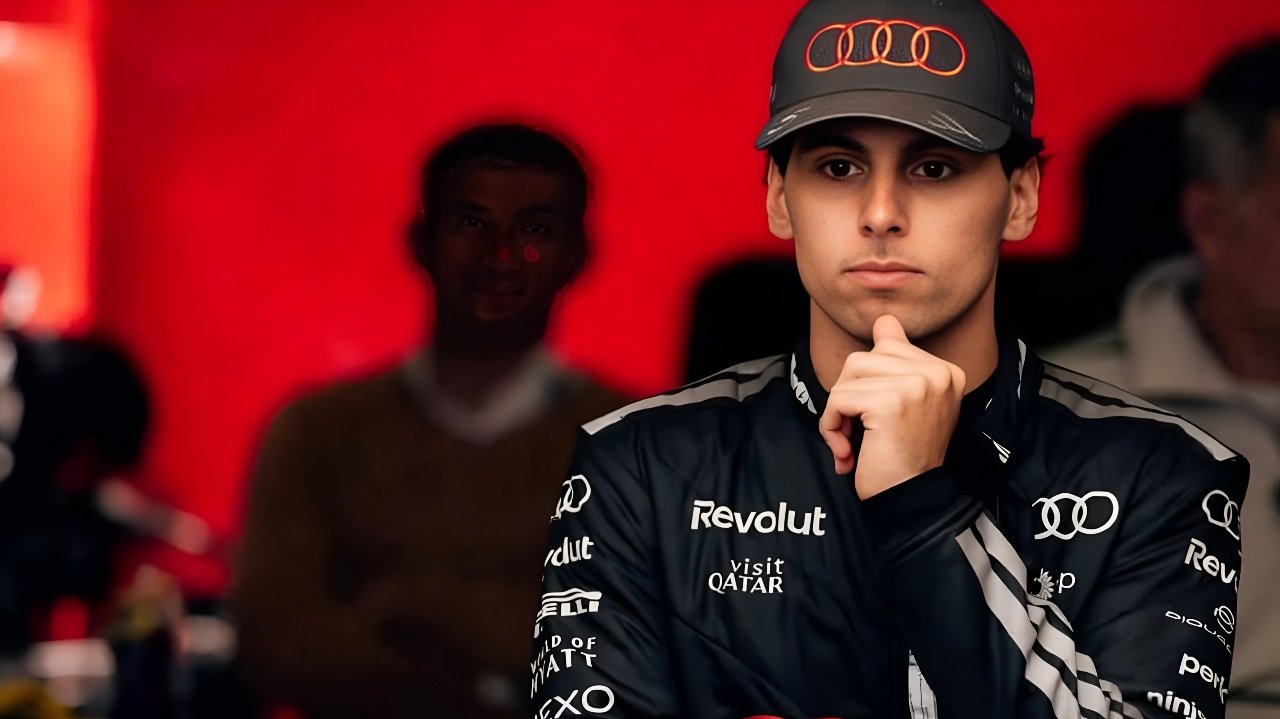
Audi driver urges rivals to ease off after the 352-pass race
Audi driver Gabriel Bortoleto has urged his fellow Formula 1 drivers to stop criticising the Las Vegas Grand Prix, a race that produced 352 overtakes. Speaking ahead of the Qatar Grand Prix, the Brazilian said he enjoyed the action and asked, in blunt terms, what his rivals actually want from a race. The comments add a fresh voice to a debate that has dominated Formula 1 conversation since the chequered flag fell in Nevada.
Drivers, fans and analysts remain split over whether such a high number of passes represents the best of modern racing or simply a side effect of complicated energy-management rules. Bortoleto, who races for Audi in the 2026 season, has made it clear which side of that argument he stands on. This report sets out what was said, why the racing looked the way it did, and what the discussion could mean for the weekend ahead.
Why the Las Vegas Grand Prix Divided the Paddock
The Las Vegas Grand Prix produced 352 overtakes, including 35 for the lead, as drivers worked out how best to attack and defend using their electrical deployment. On paper, those figures describe a race packed with action. In practice, the question that followed the chequered flag was not how many passes took place, but what kind of racing they represented.
Max Verstappen was among the most prominent critics. His comments, which became widely associated with a Mario Kart comparison, reflected a view that the action felt too artificial. Others in the paddock responded differently. Carlos Sainz questioned the assertion that the race amounted to yo-yo racing, the idea that cars simply swapped positions back and forth with little consequence. Lando Norris acknowledged that Las Vegas delivered spectacle, while also pointing to an overreliance on battery power. Kimi Antonelli, meanwhile, admitted that the system collapsed on him during the race, costing him a chance to fight for victory.
Taken together, these reactions show that no single verdict exists. Some drivers saw entertainment and tactical depth, while others saw a contest decided as much by energy management as by pure driving skill. That tension is the backdrop to Bortoleto’s remarks, and it explains why his unfiltered response attracted so much attention.
The disagreement also carries commercial and sporting weight. Formula 1 relies on a product that fans find exciting, and a race with this many position changes gives broadcasters and promoters plenty to promote. At the same time, the sport’s credibility rests on the belief that the best driver in the best car should be rewarded. When competitors openly question whether a result reflects skill or energy timing, the governing conversation inevitably turns to whether the rules strike the right balance.
What Gabriel Bortoleto Said About the Overtaking
Bortoleto opened his reply with candour. He explained that his team has struggled for speed on the straights, which meant many of his own passes came late, at the last second and in the middle of the corner. For him, that style of overtaking felt natural and satisfying rather than manufactured. He highlighted his close battles with Oliver Bearman, noting that most of those moves were settled at Turn 1 in tight, side-by-side fights.
He then widened his argument. Bortoleto said he quite enjoyed the race and added, “I wouldn’t complain about it.” He argued that drivers should “give it a break,” pointing out that complaints arise when there is no overtaking and arise again when there is plenty. His blunt question, asking what rivals actually want, captured a frustration that many supporters share: Formula 1 has spent years trying to produce closer racing, and criticism follows whichever outcome appears.
His final point was simple and professional. Drivers, he suggested, need to focus on driving and doing their jobs. It is a pragmatic message from a competitor who is still establishing himself at Audi, and it contrasts with the more critical tone adopted by some of the sport’s most experienced names.
It is worth noting the context of his perspective. A driver whose car lacks straight-line speed is less likely to benefit from pure deployment passes and more likely to rely on braking, positioning and commitment in the corners. That difference may explain why Bortoleto judged the race as authentic racing, while a driver at the front, whose battles were shaped more directly by electrical deployment, could reasonably feel differently.
The exchange also reveals how much a driver’s view depends on where they run. Those at the front tend to judge the racing by how it affects their own fight for victory, while those in the midfield often experience a different, more crowded race. Bortoleto’s remarks therefore deserve to be read as one perspective among several, not as a final verdict, but they carry weight because they come from inside the cockpit during the busiest part of the field.
How the 2026 Regulations Shape Overtaking in Formula 1
To understand the argument, it helps to understand the cars. The 2026 regulations placed far greater emphasis on electrical power than previous rules, and they introduced active aerodynamics intended to support closer racing. In broad terms, drivers now manage when and where they use stored electrical energy, because that energy is limited and must be recovered during a lap.
This creates a tactical layer that did not exist in the same form before. A driver following another car can benefit from a strong slipstream and deploy energy at the right moment to make a move. The driver ahead may then respond by using their own deployment, or may find their battery depleted and become vulnerable to a counter-attack. When several cars are running close together, positions can change repeatedly across a lap, which is the pattern that critics describe as yo-yo racing.
Supporters of the rules argue that this is a legitimate form of competition. Drivers and engineers must decide when to attack, when to defend and when to save energy for later, and the best performers will make those judgements more effectively than their rivals. Detractors counter that if a pass depends mainly on who has charge available at a given point, the result looks less like a battle of skill and more like a managed exchange.
Both positions contain truth, and the Las Vegas figures give each side material to work with. A large number of overtakes proves that the cars can follow closely and pass. Whether every one of those passes felt earned is a subjective judgement, which is precisely why the debate has not been settled by statistics alone. Bortoleto’s comments add a useful data point: from his seat, many moves still required nerve and precision in the corners.
ALSO READ: Alonso at 45: “I Will Stop Only When I Feel Slow.”
There is also a learning curve to consider. The 2026 cars are still relatively new, and the Las Vegas race showed drivers working out in real time how best to attack and defend with their electrical deployment. As teams gather more data and refine their strategies, the patterns seen in Nevada may evolve. Judgements may shift accordingly.
What the Las Vegas Debate Means for the Qatar Grand Prix
The conversation now moves to Qatar, where the character of the circuit will test whether the Las Vegas pattern repeats. Franco Colapinto has already warned that Qatar will be very different from Las Vegas and will expose weaknesses in the Alpine car, a reminder that each track rewards different strengths. A layout that places less emphasis on long straights and slipstream effects may produce a race that looks and feels quite different.
That matters for the wider argument. If Qatar delivers fewer overtakes, critics may point to Las Vegas as an outlier and question how repeatable such racing is. If it delivers plenty, supporters will say the regulations are working as intended across varied circuits. Either outcome will feed the discussion, and drivers will be asked again for their opinions.
For Bortoleto, the weekend offers a practical opportunity to demonstrate the approach he described. His comments suggest that he intends to keep racing hard and committing to late moves, regardless of how others judge the format. For fans, the message is equally clear: the quality of a race is open to debate, but the willingness of drivers to fight for position is what ultimately defines the sport.
Observers will be watching several things on race day: how often cars can follow closely without losing performance, how drivers choose to spend their electrical energy, and whether late-braking moves of the kind Bortoleto described become more common when straight-line speed offers fewer opportunities.
Formula 1 will always face criticism, whether the racing is processional or crowded with passes. Bortoleto’s answer is a reminder that the drivers themselves are not united, and that one of the sport’s newest voices sees the 2026 rules as a source of close, entertaining competition rather than a problem to be fixed. As the Qatar Grand Prix approaches, the paddock will find out whether that optimism holds.