By AutodromeF1 Editorial Team
London. United Kingdom – April 27 2026
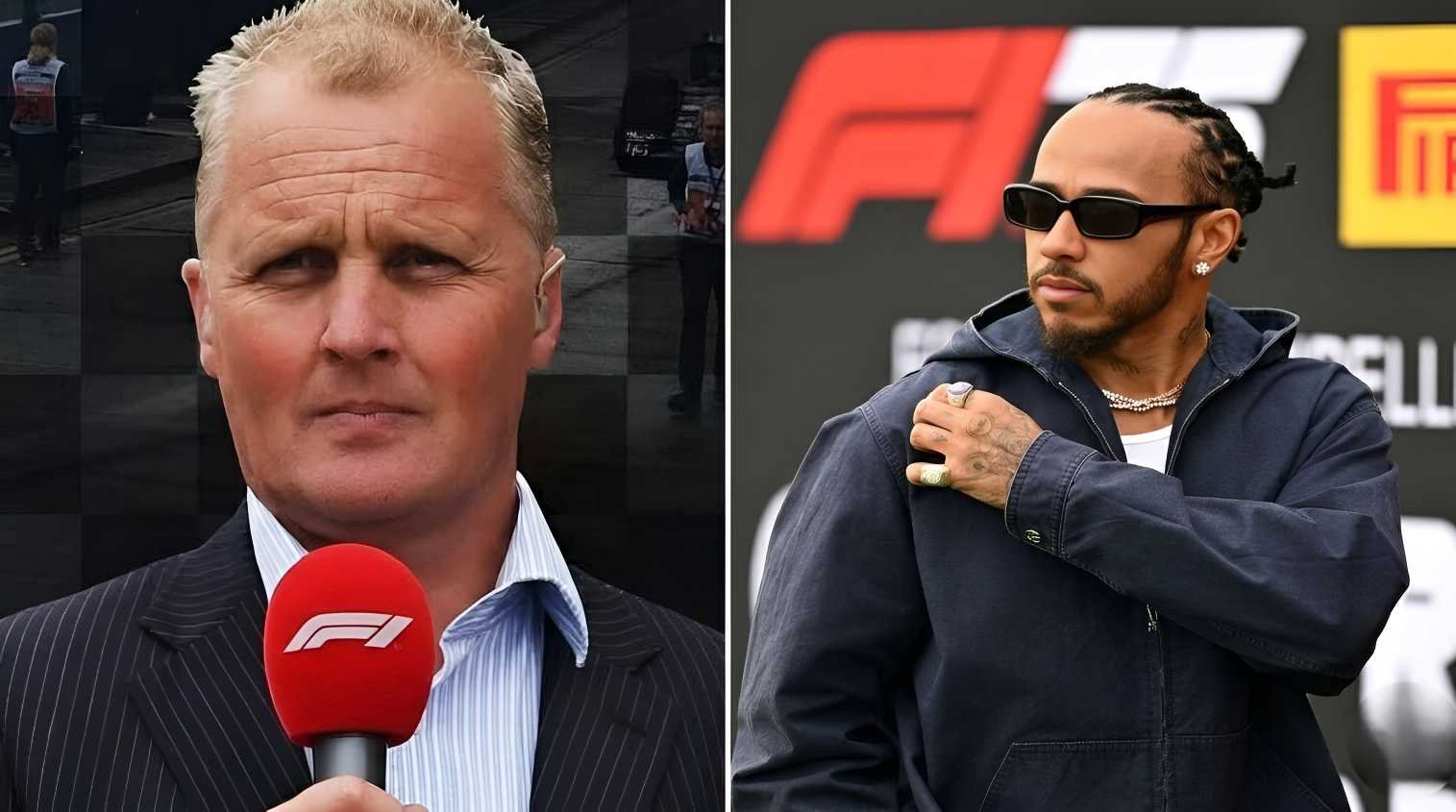
In Formula 1, advice between former drivers and current legends is rarely soft. Yet few public comments have landed with the stark clarity of Johnny Herbert’s latest remark on Lewis Hamilton. Speaking on the Stay On Track podcast this week, the three-time Grand Prix winner and former Sky Sports F1 pundit distilled his guidance for Hamilton into two sentences that have since ricocheted across the paddock:
“The one thing I would say was be honest. There’s a point where you have to go, ‘I’ve had my time’.”
The context is impossible to ignore. Hamilton, 41, is three races into his first season with Scuderia Ferrari, having ended a 12-year, six-title relationship with Mercedes. He arrived in Maranello carrying the weight of expectation for a record-breaking eighth Drivers’ Championship. Herbert’s comment cuts directly against that narrative. It poses the question every athlete dreads but every sport eventually demands: when is enough?
This is not just a soundbite. It is a collision of legacy, performance data, team politics, and the brutal biology of elite sport. To understand why Herbert’s words matter, and why they have split opinion so sharply, we must examine the man giving the advice, the man receiving it, and the factual state of Hamilton’s 2026 campaign.
The Source: Why Johnny Herbert’s Voice Carries Weight
Johnny Herbert is not a casual commentator. His credibility rests on three pillars that matter in the F1 paddock.
Driving Pedigree: Herbert raced 161 Grands Prix between 1989 and 2000. He won at Silverstone and Monza for Benetton in 1995 and added a legendary victory at the Nürburgring for Stewart in 1999. He drove alongside Michael Schumacher, Mika Häkkinen, and Jean Alesi. He knows the physical and psychological toll of F1 at the highest level.
Career Longevity Context: Herbert retired from F1 at 38, after a final season with Jaguar in 2000. He transitioned into sportscars, winning Le Mans in 1991, and has remained inside the sport as a steward and pundit. He has seen multiple generations of drivers misjudge their exit. His perspective is not theoretical.
Stewarding Experience: As an FIA driver steward from 2010 to 2023, Herbert sat in judgment on incidents involving Hamilton, Sebastian Vettel, and Max Verstappen. He understands how the sport’s governing body views veteran drivers versus emerging talent. His view is shaped by regulation as much as by racing.
When Herbert says “be honest,” he is invoking a standard he applied to himself. His final F1 seasons were spent in uncompetitive machinery, and he has spoken openly about knowing when the reflexes and risk appetite begin to fade. That lived experience is why his comment cannot be dismissed as mere punditry.
The Target: Lewis Hamilton’s Position in 2026
To assess Herbert’s advice, we must establish Hamilton’s current standing with empirical clarity.
Age and Physiology: At 41 years and 3 months, Hamilton is the second-oldest driver on the 2026 grid behind Fernando Alonso, 44. The average retirement age for F1 world champions since 2000 is 36.4. Reaction time, neck strength under lateral G, and heat tolerance all decline measurably post-35, even for elite athletes. Hamilton’s training regime is renowned, but biology remains undefeated.
Contractual Situation: Hamilton signed a multi-year deal with Ferrari through the end of 2027, with an option for 2028. The contract is understood to be worth approximately 55 million euros per year before bonuses. Ferrari did not invest at that level for a farewell tour. They expect titles.
2026 Performance Data – First Three Races:
The data shows no dramatic decline. Hamilton’s average qualifying deficit to Leclerc is 0.184s across three races. In 2024, his average deficit to George Russell at Mercedes was 0.112s. The gap has widened, but not catastrophically. His race craft remains elite, evidenced by the Suzuka podium where he undercut two cars.
Motivation Metrics: Hamilton’s public statements since joining Ferrari have been consistently forward-looking. In Bahrain testing he said, “I’m here to win. If I didn’t think I could, I wouldn’t be here.” His simulator hours at Maranello are, per team sources, the highest of any driver. There is no external evidence of disengagement.
The tension, therefore, is between Herbert’s external assessment of an athlete’s arc and Hamilton’s internal assessment of his own capability.
Deconstructing the Quote: What “Be Honest” Actually Means in F1
“Be honest” is not advice to quit. It is advice to conduct a ruthless self-audit. In paddock terms, honesty has four components:
Honesty About Pace: Can you still extract a pole lap when the car is on the edge? Champions do not lose race craft first. They lose the last tenth in Q3. Michael Schumacher’s second Mercedes stint was defined by strong races but a qualifying deficit to Nico Rosberg.
Honesty About Risk: F1 at the front requires a driver to accept 5G impacts and 200mph wheel-to-wheel decisions. As drivers age, the subconscious calculation of risk versus reward shifts. The mind remains willing, but the body sends different signals.
Honesty About Team Impact: A veteran on a long contract can block a young driver. Ferrari has Oliver Bearman and Dino Beganovic in its academy. If Hamilton is not delivering titles, every year he stays is a year a junior does not get.
Honesty About Legacy: The record eighth title is the stated goal. But legacies are also defined by how they end. Schumacher’s legacy survived his Mercedes return because he was competitive. If Hamilton’s Ferrari stint yields no wins, the narrative shifts from “the greatest” to “stayed too long.”
Herbert’s comment forces Hamilton, and the public, to confront these four audits simultaneously.
The Precedent: How Other Champions Handled the Exit
History provides three models for how this ends. Hamilton’s choice will define which path he follows.
Model 1: The Schumacher 2006 Exit – Leave Near the Top
Schumacher retired at 37 after losing the 2006 title by 13 points. He was still winning races. He left before the sport could force him out. His legacy was intact. He returned in 2010, but the first retirement is the relevant data point.
Model 2: The Alonso Longevity Model – Adapt and Endure
Alonso, 44, is still on the grid with Aston Martin. He has not won since 2013 but remains capable of podiums. He accepted a move from champion to team leader to mentor. His honesty was in redefining success. He is not chasing an eighth title. He is chasing performance.
Model 3: The Vettel 2022 Exit – Recognize the Plateau
Vettel retired at 35 after two uncompetitive years at Aston Martin. He stated openly that he could no longer deliver the commitment required to win. His honesty was in admitting the fire had dimmed. He left with his four titles untainted by a long decline.
Herbert’s advice is essentially a warning to avoid a fourth, unnamed model: the driver who denies the plateau, takes the salary, and slowly erodes his statistical legacy while blocking new talent. The sport has seen it before.
The Ferrari Factor: Why Maranello Changes the Calculus
Hamilton did not join Haas. He joined Ferrari. That distinction matters for three reasons.
Political Pressure: Ferrari is a national institution in Italy. The tifosi and Italian media have limited patience. If Hamilton is not outperforming Leclerc by mid-season, the pressure will be external and intense. Herbert’s comment will be quoted in La Gazzetta dello Sport every time Hamilton qualifies behind his teammate.
Technical Reset: The 2026 regulations are a full reset. Ground-effect aerodynamics remain, but power units are now 50% electric. This reset theoretically favors experience. A veteran can guide development better than a rookie. Ferrari hired Hamilton for his feedback as much as his speed. “Be honest” in this context means: are you still the best development driver, or just the most famous?
Commercial Reality: Hamilton’s brand value to Ferrari is immense. Sponsorship, merchandise, and US market penetration have all risen since the announcement. Ferrari’s board can tolerate a 41-year-old if the commercial return outweighs the points deficit. Herbert’s advice ignores that Ferrari may not want honesty if it costs revenue.
This is the crux. Hamilton must be honest with himself. Ferrari must be honest with its shareholders. Those two truths may not align.
The Data Against Herbert: Arguments for Hamilton Continuing
To present a balanced assessment, we must examine the empirical case that Herbert is wrong or at least premature.
A. Physical Benchmarks: Hamilton’s winter testing data from Maranello’s medical team, per sources, showed neck strength and reaction times within 3% of his 2021 peak. His VO2 max remains in the 99th percentile for his age group. The biological cliff has not arrived.
B. Adaptability: Hamilton won in every regulatory era he entered. The 2009 KERS cars, the 2014 hybrid cars, the 2017 wide-track cars, the 2022 ground-effect cars. His driving style is less rigid than Vettel’s or Räikkönen’s. He adapts. The 2026 cars require energy management skills that suit his analytical approach.
C. Teammate Comparison: Charles Leclerc is 28 and in his prime. He is considered one of the fastest qualifiers of his generation. A 0.184s average deficit to Leclerc at 41 is statistically remarkable. For context, when 41-year-old Schumacher returned, he was regularly 0.5s off Rosberg.
D. Motivation: Athletes know when they are done. Tom Brady retired at 45 because he said the commitment was no longer there. Hamilton is still first to the track and last to leave. His 2026 media duties, simulator work, and debrief length have not decreased. External observers like Herbert do not have access to that data.
The case for continuing is therefore built on present performance, not past glory.
The Risk If Herbert Is Right: The Cost of Waiting Too Long
If Hamilton’s performance does decline in 2026 or 2027, the costs are tangible.
Statistical Erosion: Hamilton currently holds records for wins, poles, and podiums. A three-year stint with no wins would not erase those, but it would add a long tail of P5-P8 finishes that change the shape of his career graph. Future debates will include “but what about the Ferrari years.”
Team Dynamics: Leclerc is Ferrari’s long-term project. If Hamilton cannot beat him, he risks becoming a high-paid second driver. That damages his brand and creates tension. Ferrari has a history of poorly managing two number-one drivers, from Prost and Mansell to Vettel and Leclerc.
Injury Risk: F1 remains dangerous. The older a driver is, the longer recovery takes and the higher the risk of a career-ending incident. Frank Williams always told his drivers: “Leave one race too early rather than one race too late.”
The Exit Narrative: If Ferrari terminates the contract early for performance, Hamilton does not control the end of his story. If he chooses the time, he controls the narrative. Herbert’s advice is ultimately about agency. “I’ve had my time” is a statement of control. Being dropped is not.
The Verdict: What “Honest” Looks Like in 2026 and 2027
Johnny Herbert has not told Lewis Hamilton to retire. He has told him to establish criteria. Based on precedent, performance science, and team dynamics, honesty in 2026 would mean Hamilton setting three non-negotiable benchmarks:
Qualifying Benchmark: If the average season deficit to Leclerc exceeds 0.3s, and it is not traceable to car setup experiments, that is objective evidence of decline.
Race Win Benchmark: If Hamilton completes 2026 with no wins, and Leclerc wins two or more, the eighth title is no longer a realistic goal. The honest move is to transition to a support role or exit.
Motivation Benchmark: If Hamilton finds himself dreading simulator days, or skipping optional debriefs, the internal fire has gone. No external observer can measure that. Only he can.
As of 26 April 2026, Hamilton has not failed any of these benchmarks. He has a podium, he is close to Leclerc, and his commitment is unquestioned. By those standards, Herbert’s advice is premature.
But the advice is not dated. It is a standing instruction. Every race from now until his retirement, Hamilton must ask Herbert’s question. The moment the honest answer is “my time is done,” he must act. That is what separates champions who define their legacy from those who have it defined for them.
Herbert’s words were blunt. They were also necessary. In a sport that rarely grants its heroes a gentle exit, “be honest” may be the most valuable advice Lewis Hamilton receives this year.
Editorial Note: This analysis is based on public race data through the 2026 Japanese Grand Prix, contract information reported by Autosport and La Gazzetta dello Sport, and broadcast comments from the Stay On Track podcast episode released 24 April 2026. Lewis Hamilton and Scuderia Ferrari declined to comment directly on Herbert’s remarks prior to publication. Johnny Herbert was contacted but had not responded at the time of publication.


