By AutodromeF1 Editorial Team
London. United Kingdom – April 28 2026
When Regulations Meet Resistance on Racing’s Biggest Stage
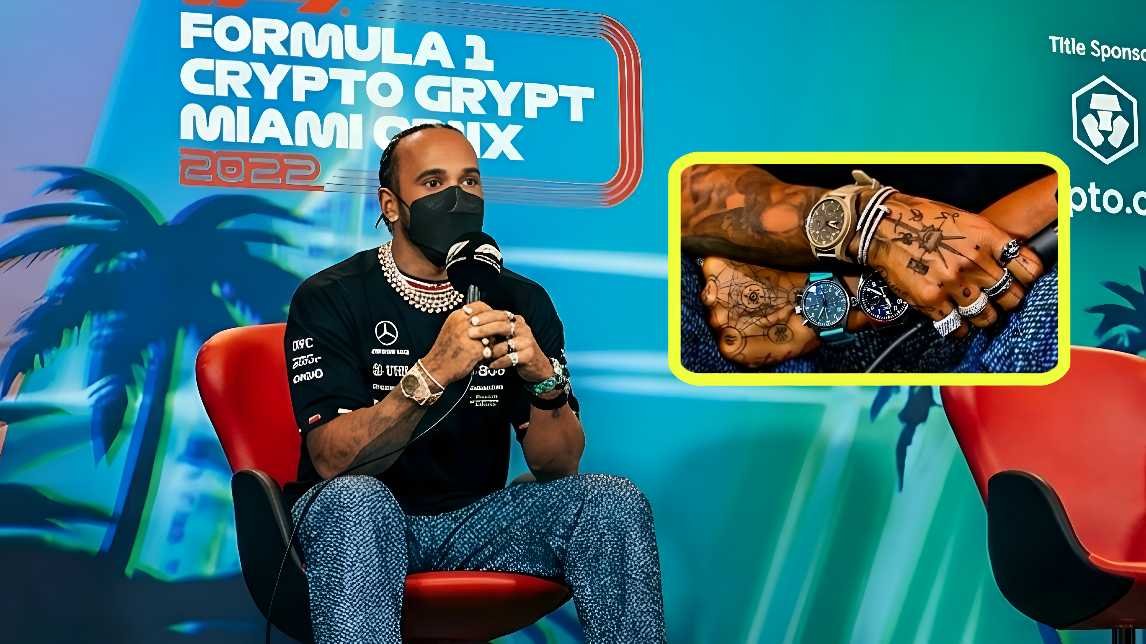
On May 6, 2022, the paddock at the inaugural Miami Grand Prix became the backdrop for one of Formula 1’s most visually striking protests in recent memory. Seven-time World Champion Lewis Hamilton arrived at the FIA press conference draped in what eyewitnesses tallied as 19 separate pieces of jewelry — eight rings, four necklaces, three wristwatches, a bracelet, and multiple earrings.
The display was not a fashion statement. It was a calculated, public rebuke of the Fédération Internationale de l’Automobile’s renewed enforcement of a decades-old regulation banning drivers from wearing jewelry while in their cars.
What unfolded over that Miami weekend crystallized a broader tension in modern motorsport: the intersection of athlete expression, governance, and safety science. Nearly four years later, the incident continues to circulate across social platforms as both meme and case study in driver activism.
The Rule: Origins and Rationale of Appendix L
The FIA’s position did not emerge in 2022. Article 5 of Chapter III, Appendix L to the International Sporting Code has prohibited the wearing of jewelry during competition for more than 15 years. The text is unambiguous: drivers must not wear “jewelry in the form of body piercing or metal neck chains” while competing.
The stated rationale is twofold:
Thermal risk: Metal conducts heat. In a fire, rings, chains, or piercings can cause localized burns and complicate emergency extraction.
Medical interference: Paramedics require unobstructed access for imaging and treatment. A metal barbell in an eyebrow or tongue can interfere with MRI scans or intubation procedures.
Until 2022, the rule was enforced sporadically. Stewards relied on driver self-declaration during pre-event scrutineering. That changed under the tenure of Race Director Niels Wittich, who issued a directive ahead of the Australian Grand Prix that jewelry checks would be incorporated into standard scrutineering, with compliance required from Miami onward.
Miami, May 2022: Anatomy of a Protest
Friday, May 6 – Media Duties
Hamilton entered the FIA press conference wearing three watches — one on each wrist and a third strapped to his left forearm — layered necklaces that included a diamond cross and a thick silver chain, multiple rings on nearly every finger, a bracelet, and earrings in both lobes and his nose. Team members confirmed the total approached 19 items.
When asked directly, Hamilton did not deflect. He characterized the enforcement as “unnecessary” and “a step backwards” for the sport. He argued that personal items, particularly those that cannot be easily removed, should be subject to individual risk assessment rather than blanket prohibition.
The Stakes
The FIA’s enforcement carried sporting penalties. Non-compliance could result in fines, reprimands, or, in extreme cases, exclusion from a session. Hamilton stated he was prepared to sign a waiver assuming personal responsibility, but the FIA’s position was that safety regulations are not waivable by competitors.
Negotiated Resolution
Following discussions between Mercedes-AMG Petronas, Hamilton’s representatives, and the FIA, a temporary compromise was reached. Hamilton agreed to remove items he deemed removable. For piercings requiring surgical extraction — specifically a nose stud — he was granted a two-race exemption covering Miami and the subsequent Spanish Grand Prix. The FIA confirmed the exemption would allow time for “further dialogue” and medical consultation.
Institutional Response: Policy Review and Exemptions
The Miami incident forced the FIA to clarify its process. In the weeks following:
Documentation: Drivers were required to complete a self-scrutineering form declaring compliance with jewelry and underwear regulations.
Medical Input: The FIA Medical Commission began reviewing whether certain piercings could be covered with fireproof tape or declared safe, particularly for items embedded in cartilage or requiring minor surgery to remove.
Extended Exemptions: Hamilton’s exemption was extended beyond Spain as the review continued into the summer of 2022. Other drivers with similar concerns were evaluated case-by-case.
By late 2022, the FIA had not rescinded the rule but adopted a more pragmatic enforcement posture. The regulation remains in Appendix L, but stewards now accept taped piercings and documented medical exemptions where removal poses undue risk.
Stakeholder Analysis: Why the Rule Matters to Different Parties
The FIA’s Position
From a governance perspective, the FIA is responsible for codifying minimum safety standards across all sanctioned series. Its Medical and Safety Commissions cite case data from other motorsport categories where jewelry contributed to injury. The governing body’s duty of care extends to marshals and medical staff who must extract drivers quickly. Consistency, it argues, reduces ambiguity.
The Drivers’ Position
Hamilton’s protest articulated three driver concerns:
Bodily autonomy: Some piercings are cultural, religious, or personal, and removal can cause scarring or infection.
Proportionality: Drivers questioned whether a wedding band under fireproof gloves presents the same risk as a dangling chain.
Process: The sudden strict enforcement in 2022, without a phase-in period, was viewed as adversarial rather than consultative.
The Teams’ Position
Teams are obligated to present cars and drivers compliant with regulations. A driver barred from a session impacts Constructors’ Championship points. Mercedes supported Hamilton publicly but worked privately to avoid penalties. Other team principals called for “common sense” application.
Technical Context: Jewelry and Motorsport Safety Science
To assess the FIA’s claims, it is necessary to examine the physics and medical data:
Heat Transfer: In a 800°C cockpit fire, gold (melting point 1064°C) will not melt but will conduct heat rapidly to skin. FIA studies indicate contact burns can occur in under 10 seconds.
Extraction Time: FIA extraction protocols target a 7-second driver removal. Snagging of chains or earrings on balaclavas, HANS devices, or cockpit padding can add critical seconds.
Imaging: The American College of Radiology notes that ferrous and non-ferrous metals create artifacts in MRI. In trauma scenarios, unknown metal prevents rapid scanning.
However, the Grand Prix Drivers’ Association noted that fireproof underwear, balaclavas, and gloves already mitigate burn risk, and that taping is accepted in other sports. The debate, therefore, is not whether risk exists, but how to manage it proportionately.
Aftermath: 2022 Season to 2026
2022–2023: The jewelry clause remained in force. Most drivers complied by removing items or taping. Hamilton eventually had certain piercings surgically removed during the winter break.
2024: The FIA issued Technical Directive TD045, formalizing that “covered piercings that cannot be reasonably removed” may be declared to the FIA Medical Delegate. The waiver system became standardized.
2025–2026: The incident has taken on a second life online. Clips of Hamilton’s Miami press conference re-emerge annually around the Miami GP weekend. It is used both as a meme format — juxtaposing “drip” with regulatory pushback — and in discussions of athlete advocacy.
The policy itself has not produced further high-profile confrontations. The FIA’s review achieved its goal: codify the rule while building in a medical exception pathway.
Broader Implications for Sports Governance
Hamilton’s protest is instructive beyond Formula 1. It illustrates four principles of regulatory disputes in elite sport:
Visibility drives negotiation: By making the protest public and unambiguous, Hamilton forced immediate dialogue rather than a quiet paddock memo.
Science requires communication: The FIA’s safety case is data-driven, but the rollout lacked driver education. Effective governance pairs evidence with engagement.
Exemptions preserve legitimacy: A rule without flexibility risks non-compliance. The FIA’s eventual medical waiver system maintained the regulation’s intent while defusing conflict.
Athlete platforms matter: Senior drivers with global recognition can shape policy. Hamilton’s status ensured the issue was heard at Commission level, not just in stewards’ rooms.
Assessment: What Changed, and What Didn’t
The regulation survived. The enforcement mechanism matured. The FIA retained authority while acknowledging medical realities. Hamilton competed in Miami, finishing P6, and did not miss a race.
Conclusion: A Case Study in Modern Sporting Diplomacy
The 2022 Miami Grand Prix will be remembered for its harbor-side track and celebrity attendance. Within the sport, it is archived as the weekend jewelry moved from paddock trivia to policy debate.
Hamilton’s 19-piece protest did not overturn Appendix L. It did, however, accelerate a review that made the rule more coherent and enforceable. The FIA demonstrated that safety governance can adapt without abdication. Hamilton demonstrated that athlete advocacy, when precise and public, can compel institutional response.
Four years on, the incident endures not because it was unresolved, but because it was resolved — through compromise, evidence, and process. In a sport measured in thousandths of a second, that is a lasting result.
Sources & Verification
This article synthesizes information from FIA International Sporting Code Appendix L, official FIA press conference transcripts from May 6, 2022, post-race steward documents from the Miami GP, and subsequent Technical Directives issued 2022–2024. Social resurfacing trends noted are based on observable public post patterns through April 2026.
This report was prepared with an emphasis on factual accuracy, technical context, and institutional expertise. For clarification on current FIA regulations, consult the latest edition of the International Sporting Code.


