

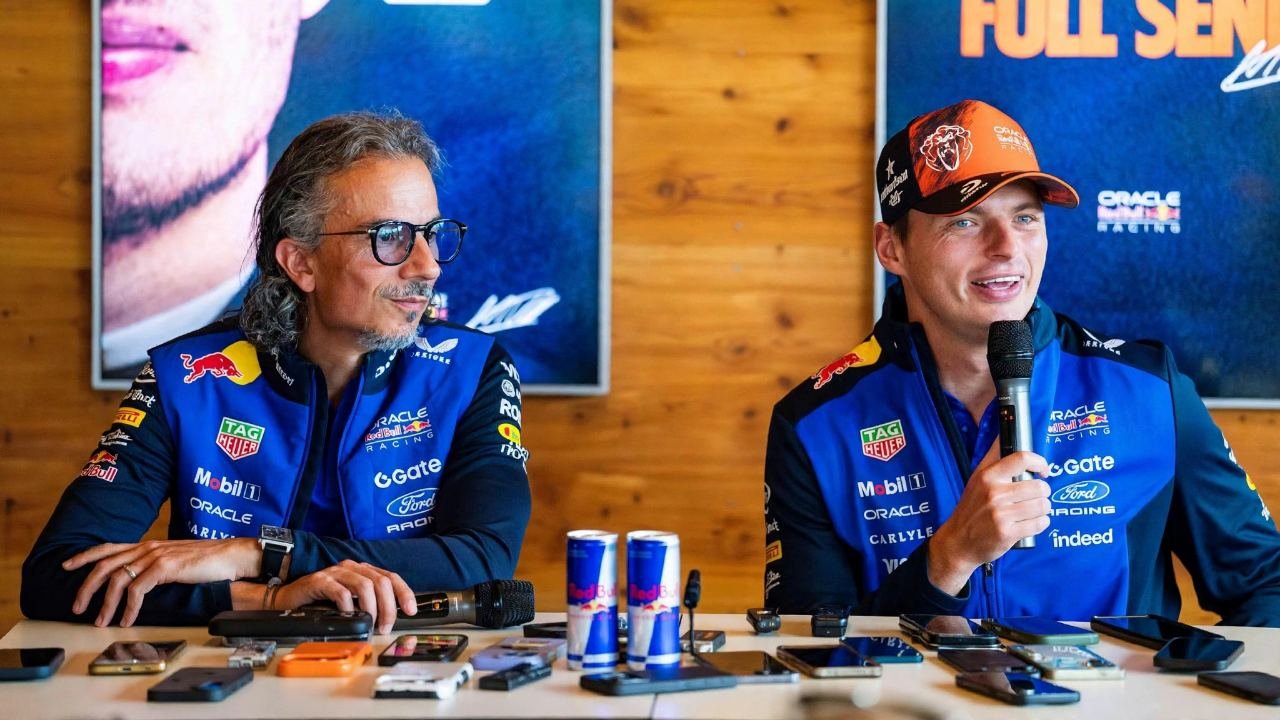
How Red Bull’s Team Principal Values Verstappen’s Car Skills
Laurent Mekies has described Max Verstappen as the best sensor Red Bull has in its car, a phrase that captures how the team principal views the four-time world champion’s technical feel. The remark, repeated across several interviews and a recent column, points to a quality that no telemetry channel fully records. It also explains why the driver’s feedback carries such weight inside the team.
This report sets out what Mekies has actually said, when he said it, and what it reveals about the relationship between a driver and an engineering organisation. Every statement below comes from direct quotations or documented remarks, and nothing has been added beyond them.
Mekies Takes Charge at Red Bull Racing
Mekies was promoted from Racing Bulls to lead Red Bull Racing in July 2025, in the days following the British Grand Prix, after Christian Horner’s departure. He was 48 when he gave his first-half-season assessment, and he arrived with more than twenty-five years of experience in Formula 1.
Before that role, his career included spells at Toro Rosso, the FIA and Ferrari, before a return to the Red Bull family, first as head of Racing Bulls and then as principal of the senior team. That breadth of experience makes his verdict on a driver’s qualities difficult to dismiss as casual praise.
Best Sensor in the Car: What Was Said
Reflecting on his first months working with Verstappen, Mekies recalled an internal joke. In his words, the team used to say that the driver is the best sensor in the car, arguably also the most expensive, but that is another question. The comment drew laughter, and it carries a serious point beneath the humour.
The line was not a one-off. In a podcast interview, Mekies said that people discover the level of Verstappen’s technical sensitivity once they work with him, adding that the team calls him the best sensor in the car, with a playful request that the driver not be told. He also pointed to the champion’s habit of sim racing the day after a race, describing it as unbelievable.
In a column written for a motorsport magazine, Mekies repeated the idea, stating that Max is the best data sensor the team has on its car. He added that the driver is constantly striving for performance without making the slightest compromise. That column also described Verstappen and Red Bull as inseparable, language that carries weight while his long-term future attracts attention.
The Steering Rack Example Explained
The clearest illustration came when Mekies described a problem with the steering rack. According to him, Verstappen felt early in the season that something was wrong, even though the team could not see it in its information. Thanks to the driver’s input, the team was able to solve it, and Mekies said the squad only benefited as a result.
The example matters because it shows the limits of data. A modern Formula 1 car carries a large number of sensors, and one report on this topic noted that even with thousands of them, the driver found an invisible problem. A human sense of how the car moves can reveal a fault before the numbers do, and Mekies has framed that ability as an advantage for the whole team.
ALSO READ: Hamilton Reveals Lonely Side of F1 in Las Vegas GP
Why Driver Feedback Matters in Formula 1
Driver feedback has always been central to car development, but the modern era leans heavily on simulation and telemetry. That makes the human element easier to overlook. Mekies’s comments push in the opposite direction, arguing that a driver with exceptional sensitivity can direct engineers towards a limitation that the screens have not yet highlighted.
The point was echoed in a separate discussion of car degradation, where Verstappen was reported to have noticed evidence of an issue as soon as he climbed out of his car in parc fermé. Mekies suggested that the driver’s sensitivity allows him to identify problems that other people would not detect, and that data from other teams would not necessarily show them either.
Results have given the argument context. Under Mekies, Red Bull came close to completing a remarkable comeback in 2025. Following Verstappen’s wins at the Italian and Azerbaijan Grands Prix, Mekies said Verstappen and Yuki Tsunoda had contributed a lot to unlocking a step in performance. He also said he was even more impressed by Verstappen than he had expected before taking charge.
Readers should note that the best sensor description is partly humour, and Mekies himself attached a joke about cost. It is best read as a compliment to Verstappen’s technical sensitivity, not as a literal engineering claim.
Taken together, the sources show a consistent message. The same description has appeared in interviews, a podcast and a written column, which suggests it reflects a considered view rather than a passing line. Readers can therefore treat the remarks in this report as consistently documented.
Mekies has also acknowledged that working with Verstappen is not always easy, because the driver’s standards are extremely high. That candour adds credibility to his praise, since it shows he is describing a demanding partnership rather than offering simple flattery.
The central lesson is clear. In a sport where data is abundant, the driver’s feel for the car remains a scarce and valuable resource, and Mekies has presented that ability as a genuine advantage for the team. Verstappen’s steering rack feedback, his insistence on performance and his sim racing habit all point in the same direction. Whatever the future holds, Mekies has made his own assessment plain: in his view, the most expensive sensor on the car is also the best one.