

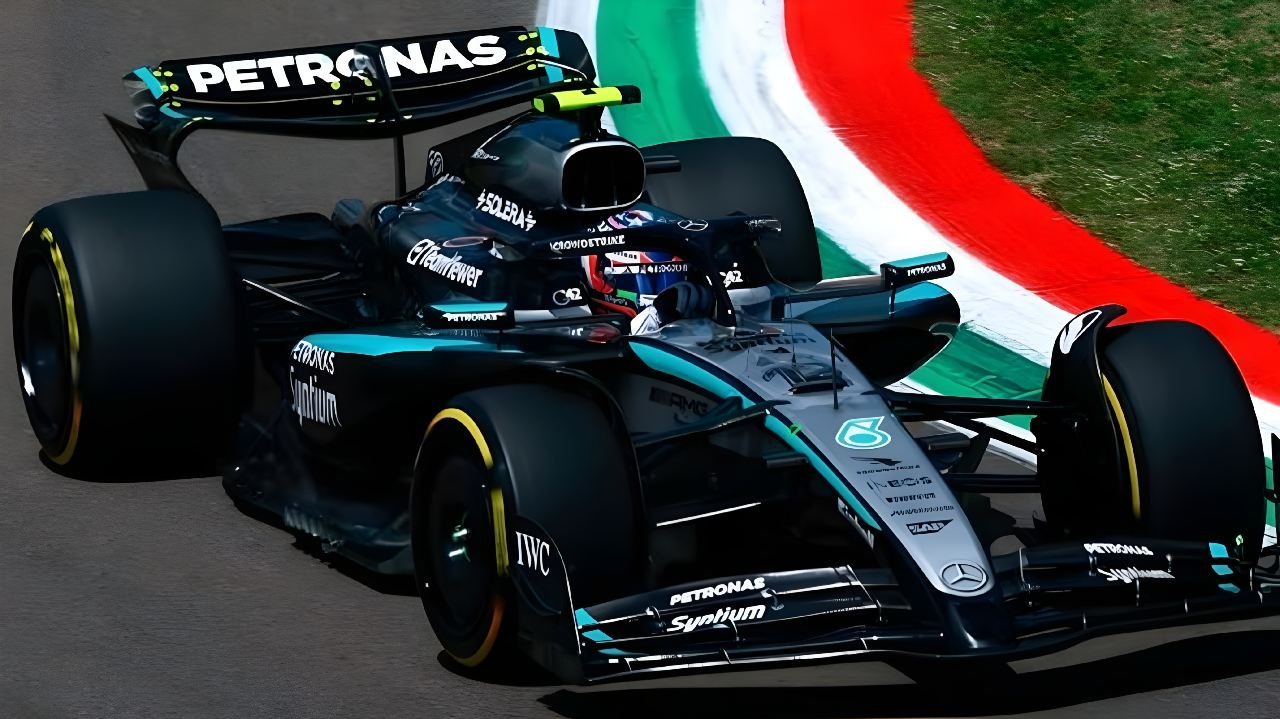
W17 update stops energy harvesting during tactical lift-offs
Mercedes has introduced new protective software on the W17 power unit, beginning with the Qatar Grand Prix, to prevent a repeat of the energy-management failure that cost Kimi Antonelli in Las Vegas. The change targets one specific scenario: a driver lifting the throttle for tactical reasons on a long straight. It is a software safeguard rather than a hardware modification, and Antonelli confirmed in Qatar that the team had already put it in place.
For a sport that now leans so heavily on electrical energy, the episode offers a revealing look at how a single, natural driver input can interact with complex control software in ways engineers did not anticipate. This report explains what happened in Las Vegas, how the new safeguard is designed to work, and why the change matters for the rest of the 2026 season. It relies on the details confirmed by the team and the driver, and where analysis goes beyond those details, it is identified as such.
In brief, three facts frame the story: the problem began with a deliberate lift, the cause was energy-recovery logic rather than a mechanical failure, and the remedy is a position-aware software change.
What Happened to Antonelli in Las Vegas
On the penultimate lap of the Las Vegas Grand Prix, Antonelli deliberately eased off the throttle on the long straight. His objective was clear and, on paper, sensible. He wanted to stay behind Max Verstappen while remaining inside the one-second window that keeps Overtake mode available. That mode releases additional electrical energy, reported at roughly 0.5 MJ, and Mercedes intended to use it for a final-lap attack on the leader.
The plan did not unfold as designed. Lifting and then reapplying the throttle interfered with the power unit’s energy-recovery logic, specifically the MGU-K cycle. The system triggered recovery and deployment behaviour in a section of the circuit where neither was wanted. The battery was drained, and Antonelli reached the final chicane with essentially no electrical energy left.
The consequences were immediate. He lost more than a second on the closing stretch, was passed by both McLaren cars, and finished fourth instead of fighting for a win or a podium.
It was a painful way to lose ground, because the position was not surrendered through a slow car or a driving error on the final lap alone. It was set up by a decision that, in the moment, looked like smart race management.
The sequence also shows how finely balanced the 2026 energy system is. Overtake mode, according to the reported figures, carries roughly half a megajoule of additional energy. That sounds modest, yet it can decide a final-lap pass. Losing control of the battery in the closing seconds therefore costs far more than the energy itself.
How the New Energy Management Protection Works
After analysing the incident, Mercedes made the control software more aware of its surroundings. The update uses the distance the car has travelled, derived from tyre revolutions, to establish where the car is on the circuit. With that positional awareness, the software can recognise that a throttle lift in certain zones is a strategic decision rather than an ordinary braking or coasting event.
In those designated sections, the system can now suppress energy recovery even though the throttle has been released. Put simply, the instruction to the power unit becomes: if the driver lifts here for a tactical reason, do nothing and do not harvest. This keeps the battery state intact and preserves the deployment the team has planned for the final lap.
The significance of the positional element should not be underestimated. A system that reacts only to what the driver is doing with the pedal cannot distinguish between a lift made for a corner and a lift made to manage a gap. By adding a reference to where the car is on the circuit, Mercedes gives the software the context it previously lacked.
Mercedes did not alter hardware to achieve this. The fix lives entirely in software, which is typically the quickest route available to a team between race weekends. Antonelli confirmed in Qatar that the protective measure was already implemented, with the purpose of making the system more robust in race-duel situations.
In practical terms, the change replaces a driver-dependent outcome with a predictable one. The driver can lift to hold position and trust that the power unit will leave the battery alone, which in turn lets the team’s planned final deployment remain available when the last lap begins.
Why Tactical Lifting Matters Under the 2026 Rules
The 2026 technical regulations place far greater emphasis on electrical power than earlier generations of Formula 1 machinery. Power units now depend on a close partnership between the combustion engine and the electric motor system, and managing stored energy across a lap has become a central part of race craft. Drivers no longer choose only a braking point and a throttle position. They must also consider where energy is being harvested and where it will be spent.
Overtake mode adds another layer. Because the extra energy is available when a car runs within one second of the one ahead, staying close has a value beyond simple aerodynamics. A driver in Antonelli’s position therefore has a genuine incentive to manage the gap precisely, including by lifting to hold position behind the leader until the right moment. This interpretation is analysis rather than a team statement, but it explains why the manoeuvre in Las Vegas was rational.
The long straight made the situation sharper. It gave the driver time to lift, wait and reapply power, but it also gave the software a long stretch in which an unexpected recovery or deployment decision could have a large effect on the battery. The error did not stay on that straight. It was felt all the way to the final chicane and the finish line.
Driver and Team Response After Las Vegas
Antonelli did not shift responsibility elsewhere. He later described the episode as his own mistake and said he believed at the time that he was doing something right. That candour is notable, because the lift was made in pursuit of a clear competitive goal rather than as a lapse in concentration.
Team principal Toto Wolff confirmed that Mercedes still had a planned final burst of deployment ready for the closing stretch. Because the battery was empty, that burst never became usable. The detail matters because it shows the team’s strategy was sound; the breakdown occurred in how the energy system responded to the lift.
Mercedes then analysed the incident and responded with the software change described above. The pace of that response, with the safeguard in place by the Qatar Grand Prix, reflects how modern teams treat energy-management behaviour as a problem that can be iterated on quickly rather than endured until a hardware development window opens.
It also illustrates a balanced division of accountability. The driver accepted his part, while the engineers accepted that the system should be able to cope with a natural, strategic input.
ALSO READ: Stroll’s Qatar Radio Outburst Exposes Aston’s Woes
What the Update Means for the Rest of 2026
The fix is narrow by design: it applies in specific sections of the track, not across the whole lap. That narrowness probably limits the risk of unintended side effects elsewhere on the circuit, although it also means the safeguard will only help in situations the team has mapped. This reading is analysis, not a team statement.
A fair assessment must also acknowledge what is not yet known. The safeguard has been implemented, but it has not yet been proven in a race duel comparable to the one in Las Vegas. Its real value will become clear only when a Mercedes driver is next close behind a rival and has to make a similar tactical decision. Claims about its effectiveness should be treated as provisional until then.
For Antonelli, the update offers a clearer path to the same tactic he attempted in Las Vegas. If the safeguard behaves as designed, holding station behind a rival inside the one-second window no longer carries the hidden penalty it did on that penultimate lap.
For the wider field, the lesson is straightforward. Every team running the new generation of power units must reconcile driver behaviour with software logic, and a natural driver input can produce an unexpected result. Making the system aware of track position is Mercedes’ answer to that challenge.
In short, Mercedes has responded to a costly Las Vegas lesson with a targeted software change that tells the W17 power unit not to harvest energy when a driver lifts tactically in designated zones. The incident cost Antonelli a realistic chance at the win and left him fourth, but it produced a concrete engineering response within days. Whether the safeguard delivers in a real wheel-to-wheel fight remains to be seen, and the outcome will be relevant to anyone following how teams tame the 2026 power units.