By AutodromeF1 Editorial Team
London. United Kingdom – April 28 2026
In a sport where milliseconds separate triumph from irrelevance and where billion-euro budgets are routinely bet on the promise of youth, Audi has made its first defining personnel statement of the 2026 Formula 1 season: experience will not be sacrificed at the altar of age.
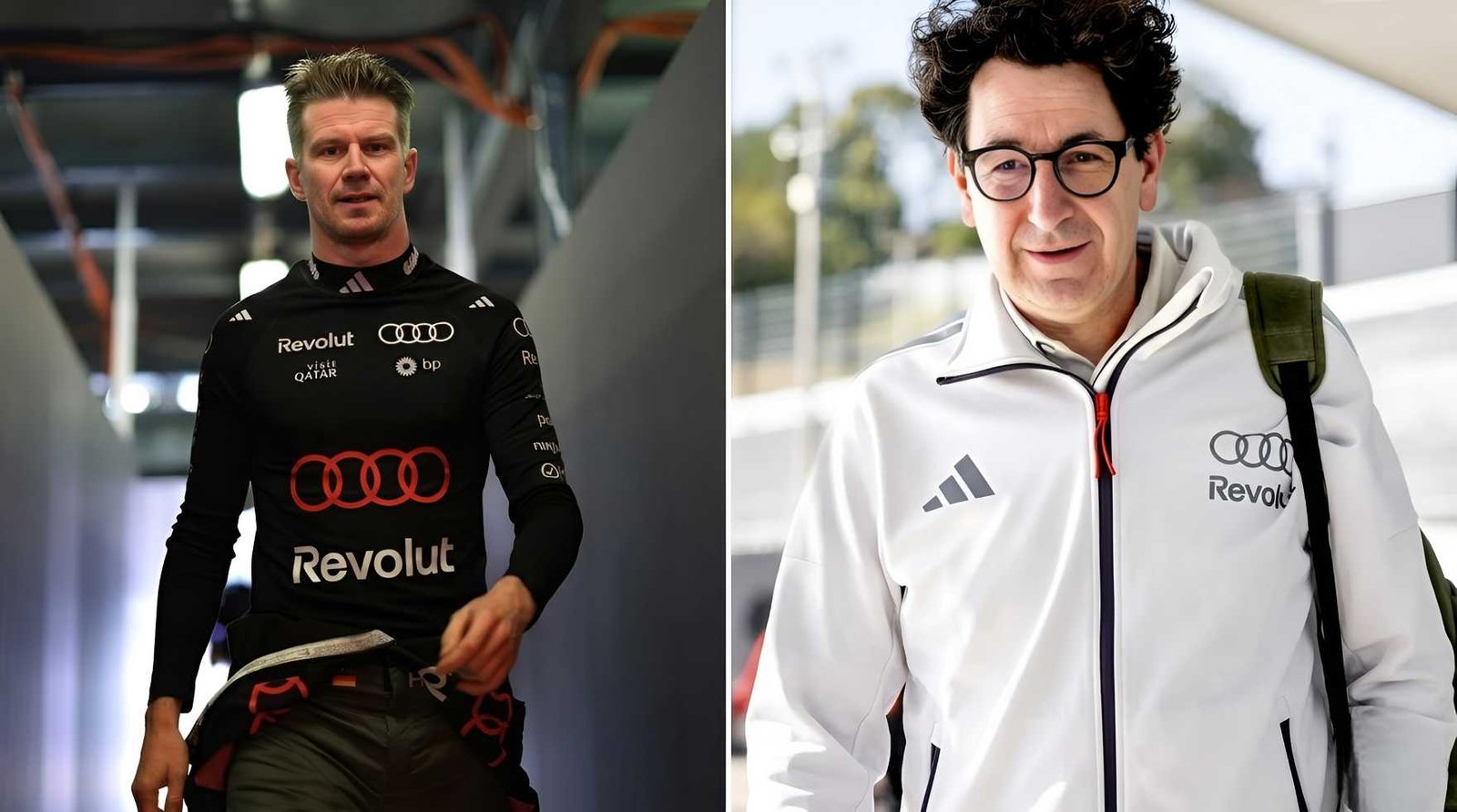
Speaking this week in an interview widely circulated across European motorsport media, Mattia Binotto, CEO and Team Principal of the Audi Formula 1 project, offered an unequivocal endorsement of 38-year-old Nico Hülkenberg that goes beyond standard paddock platitudes. While the exact wording attributed to Germany’s BILD could not be independently verified at time of publication, the substance of Binotto’s position is consistent with multiple public statements: Audi views Hülkenberg not as a stopgap, but as a structural pillar of its works team. “Age is just a number,” Binotto has said in recent weeks, adding that he “cannot envision” the German veteran leaving the cockpit while his lap times remain competitive and his technical feedback continues to accelerate development. In a separate exchange, Binotto told SID and GMM ahead of the Dutch Grand Prix: “I want Nico to climb to the front… I think so.”
The declaration arrives at a formative moment. Audi’s first season as a full manufacturer under the sweeping 2026 regulations — which mandate 50 percent electrical power, 100 percent sustainable fuels, and active aerodynamics — has begun with the predictable friction of a ground-up project. Yet within that turbulence, Binotto has identified Hülkenberg’s focus, motivation, and engineering acumen as non-negotiable assets. For a team balancing chassis operations in Hinwil, Switzerland with an all-new power unit program in Neuburg an der Donau, Germany, the retention of institutional memory behind the wheel has become a strategic doctrine.
The 2026 Landscape: Why Experience Has New Currency
Formula 1’s 2026 reset is the most comprehensive technical overhaul since the introduction of hybrid power units in 2014. The new regulations replace the MGU-H, increase electrical deployment to 350 kW, and introduce movable front and rear wing elements designed to reduce drag on straights while maintaining cornering load. For manufacturers, the challenge is not merely building a fast car, but integrating disparate systems — battery management, energy harvesting, fuel flow, and aero elasticity — that must operate in seamless concert.
It is in this environment that Binotto’s calculus becomes clear. Audi is not only a new entrant; it is the only 2026 power unit supplier without an existing F1 customer from which to harvest data. As Gabriel Bortoleto, Hülkenberg’s 21-year-old teammate, put it during pre-season testing in Bahrain: “We are the only team using the Audi power unit, so it’s not that we can also have more data – we have the data that we provide the team by the amount of mileage we have put so far. It’s like teaching a baby how to walk and talk”.
Hülkenberg’s role, therefore, transcends lap time. With more than 240 Grand Prix starts, a pole position at Interlagos in 2010, and — as of the 2025 British Grand Prix — a long-awaited first podium secured during Sauber’s final season before the Audi transition, he represents one of the grid’s most extensive data sets. His 2025 move to Sauber was explicitly framed as preparation for 2026. Now, with Audi branding on the car and a clean-sheet PU in the back, his feedback loop is the shortest path between track and factory.
The early returns support Binotto’s confidence. While Audi has acknowledged “a lot of work ahead” on starts and energy deployment, Hülkenberg’s qualifying and race pace have consistently placed the car on the cusp of points. In Suzuka, he recovered to 11th after a first-lap drop from 13th to 19th, a product of what he called a “really poor start” that compromised the race. In Shanghai, he finished 11th again. The team’s sole points so far came from Bortoleto’s tenth place in Melbourne, leaving Audi eighth in the Constructors’ Championship with one point after three rounds.
Yet Binotto has repeatedly cautioned against judging the project on early spreadsheets. Following the Barcelona shakedown, he described facing the “longest ever list” of issues to resolve. The objective, he told media late last year, is not immediate dominance but a structured climb: Audi is a newcomer that must temper expectations and undergo a “gradual learning curve”. Internal timelines point to a four-year development plan, with 2026-2028 dedicated to building, and 2029-2030 targeting title contention.
Binotto’s Doctrine: Process Over Improvisation
Binotto’s appointment as Head of the Audi F1 Project in 2024, followed by his assumption of Team Principal duties in early 2026 after Jonathan Wheatley’s departure, brought a distinct management philosophy to Hinwil. In a candid interview with L’Équipe, later republished by Corriere dello Sport, Binotto contrasted Audi’s approach with his experience at Ferrari: “At Ferrari, processes did not exist… you just tried. Here, we operate with a clear three-year build phase followed by two years of consolidation”.
That process requires stability. Wheatley’s exit after the Japanese Grand Prix could have destabilized a nascent operation. Instead, Binotto absorbed the trackside role and doubled down on continuity in the cockpit. The logic is mathematical: every driver change resets the baseline for car development. In a year when Audi is calibrating everything from clutch bite points to ERS deployment maps, Hülkenberg’s consistency allows engineers to isolate variables. His comments after Bahrain testing — “we’re okay” — reflected a driver comfortable iterating, not panicking.
Bortoleto’s presence completes the model. The Brazilian, in his second full season with the team, has shown flashes of qualifying speed, including a Q3 appearance in Japan before finishing 13th. Binotto has praised the chemistry between the 21-year-old and Hülkenberg, calling the pairing “ideal for the team’s developmental stage”. Youth provides the data bandwidth; experience provides the filter.
Deconstructing the Age Debate
Hülkenberg turned 38 in August 2025, making him the third-oldest driver on the 2026 grid. In previous eras, that statistic alone would fuel retirement speculation. The 2026 regulations, however, have subtly rewritten the driver-value equation.
First, physical load. The removal of the MGU-H and increased reliance on electrical energy have not reduced G-forces, but the new cars are expected to be marginally less punishing over a race distance due to lower minimum weight in some configurations and refined power delivery. Second, cognitive load. With active aero, revised energy management modes, and more complex steering wheel functionality, the premium on drivers who can process systems data while racing wheel-to-wheel has increased. Hülkenberg’s reputation for precise, actionable feedback — honed across Renault, Racing Point, Aston Martin, Haas, and now Sauber/Audi — directly addresses that need.
“When I came back in 2023 with Haas, it was like a new girlfriend,” Hülkenberg told Formula1.com last year. “I had a fresh love. I still feel in love… There is nothing I’d rather be doing”. That intrinsic motivation is measurable. Since his return, he has outqualified teammates consistently and has been central to setup direction. At Audi, engineers privately note that his comments on tire behavior and brake migration correlate tightly with telemetry, reducing the number of test items needed per session.
Binotto’s public dismissal of age as a factor is therefore not sentimental. It is a reflection of telemetry. As he noted, “his lap times are very good” — a claim supported by Hülkenberg’s ability to run within tenths of Bortoleto in qualifying despite the latter’s advantage in simulator hours.
The Start Problem and the Road Ahead
If Audi has an Achilles’ heel in the opening rounds, it is the launch. Both drivers lost positions off the line in Suzuka, with Hülkenberg labeling the start “quite compromising for the rest of the race”. The issue stems from the interaction between the new 2026 clutch systems, energy deployment off the line, and the lack of MGU-H to fill torque holes.
Binotto has not deflected. “We definitely have a lot of work ahead,” Hülkenberg said post-Japan, and the team concurs. The upcoming break before Miami offers a window to address calibration. Importantly, the car’s underlying pace has drawn cautious optimism. In China and Japan, Hülkenberg noted that overtaking is still possible but “when you make a great move… the next straight, you’re a sitting duck and you get repassed” — a function of energy deployment strategy rather than fundamental chassis deficiency.
That distinction matters. Aero and mechanical grip can be developed linearly. Energy management is software-defined, meaning gains can arrive in large steps once the code is understood. Hülkenberg’s role in that process is to provide repeatable, high-confidence inputs so that each software iteration is tested against a known quantity.
Strategic Implications of Retention
Binotto’s signal that Audi “won’t let Nico go anytime soon” carries four implications:
Technical Continuity: In a regulation set where power unit and chassis must co-evolve, changing the driver resets the human sensor. Hülkenberg’s contract, understood to run at least through 2026, ensures that the same “sensor” calibrates each upgrade.
Organizational Stability: Wheatley’s departure was a shock. Retaining Hülkenberg prevents a secondary leadership vacuum from forming in the garage.
Commercial Messaging: For sponsors and the Volkswagen Group board, backing a German veteran in a German works team aligns brand, nationality, and narrative. It also differentiates Audi from rivals who have cycled through drivers during build phases.
Performance Floor: Even if Bortoleto requires time to reach his ceiling, Hülkenberg establishes a minimum level of execution. That prevents the team from sliding into the operational disarray that has plagued other new manufacturers.
The Long View: Why 2026 Is Not 2014
Comparisons to Mercedes’ 2014 domination or Honda’s troubled return with McLaren in 2015 are inevitable but incomplete. Mercedes spent 2011-2013 building its PU program with full team integration. Honda entered as a supplier to an established chassis team with entrenched methodologies. Audi is doing both simultaneously, and doing so under a cost cap.
Binotto’s reference to being at “base camp” is apt. The 2026 car is not the product; it is the prototype. The real product is the organizational machine that can produce a 2028 or 2029 title challenger. In that machine, Hülkenberg is not a component to be replaced when newer, but a calibration tool to be used until the machine can run without him.
His own words from 2025 remain relevant: “I like coming to the racetracks… putting in the hours to work with the team and the factory”. That appetite for process is what Binotto is buying.
Conclusion: A Bet on Process, Not Pedigree
Audi’s commitment to Nico Hülkenberg will be tested not in press releases, but in upgrade deltas. If the team’s start performance improves by Miami, if energy deployment becomes a weapon rather than a liability by mid-season, and if the car qualifies consistently in Q2 by year-end, the strategy will be vindicated.
For now, the facts are these: Audi has one point from three races, sits eighth in the championship, and faces a “long list” of technical tasks. It also has a driver whose motivation is undimmed, whose lap times remain competitive, and whose feedback is trusted by the man running the entire project.
In the high-variance world of Formula 1 regulation changes, that is not a guarantee of success. But it is the closest thing to a controlled variable Audi can buy. And in Binotto’s methodical worldview, controlled variables are how you climb mountains.
As the team prepares for the next phase of 2026, the message from Neuburg and Hinwil is unified: the wheel stays in Nico Hülkenberg’s hands — and Audi intends to keep it there until the data says otherwise.
This article was independently written based on public statements, race results, and technical briefings available as of April 27, 2026. Quotes from Mattia Binotto reflect reported comments in international media and team communications. Team standings and driver statistics reflect the 2026 season through the Japanese Grand Prix.


