
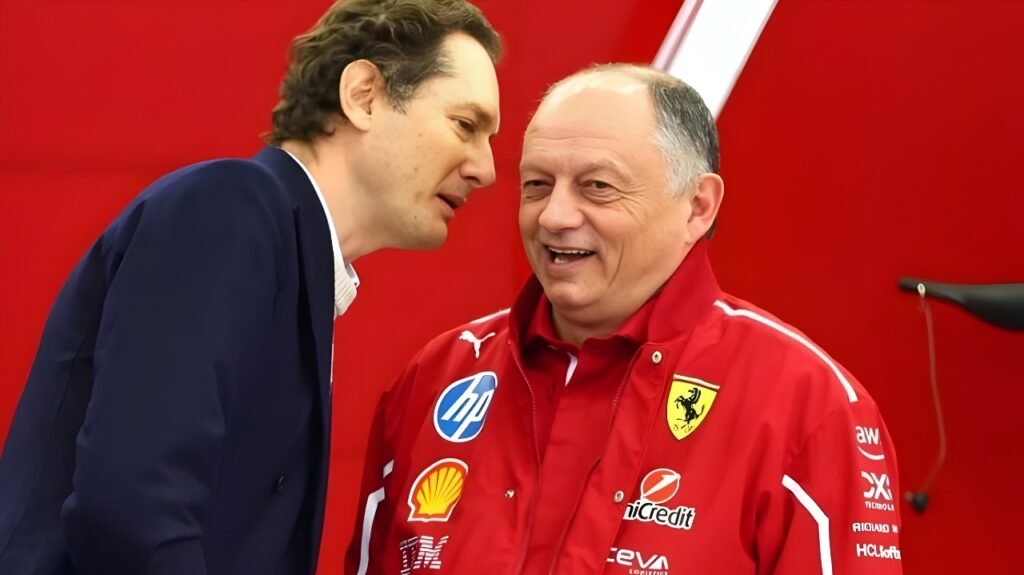
John Elkann unhappy over Hamilton-Leclerc Mexico clash.
Ferrari’s internal tension has reached the very top of the company. John Elkann is reportedly unhappy that the Hamilton–Leclerc opening-lap duel at the Mexico City Grand Prix cost the team a probable victory. The claim comes from Italian outlet AutoRacer.it, whose reporter Giuliano Duchessa argues that the Scuderia can no longer leave driver conduct to chance. The race, held on 1 November at the Autódromo Hermanos Rodríguez, ended with Max Verstappen on top and Ferrari counting the cost.
Opening-Lap Duel That Changed the Race
Lewis Hamilton claimed pole position, the first of his Ferrari career, and Charles Leclerc moved alongside him early on as the red cars briefly held the first two places. The fight through the opening corners opened the door for Verstappen. Leclerc received a five-second penalty for gaining an advantage by leaving the track and finished fourth. Hamilton took second, just 0.799 seconds behind the winner after a late charge, while Kimi Antonelli completed the podium for Mercedes.
The race itself offered more than the Ferrari storyline. A red flag followed a heavy crash for Valtteri Bottas, and Mercedes kept Antonelli out hoping for a Safety Car, which arrived only one lap after he stopped. Antonelli needed only a ninth-place finish to be sure of the title and calmly picked his way through the race, never coming under threat from Leclerc or Lando Norris behind him. Out front, Verstappen survived sustained pressure from Hamilton over the closing laps, holding on by under a second.
Hamilton and Vasseur Voice Their Frustration
Hamilton said the race was lost in the first two corners and revealed that no pre-race conversation had taken place about managing the start. He called for serious talks inside the team and described a teammate working against you as a difficult situation. Team principal Fred Vasseur called the lost win hard to digest, noting that nobody running one-two at Turn 4 expects to leave without victory.
Hamilton, who is 41, stressed that the loss extended beyond his own result to the wider team. The seven-time world champion also lamented a missed Ferrari one-two, a scenario that looked realistic when the cars ran first and second early in the race.
Leclerc accepted the penalty and acknowledged that both drivers had made errors, but pointed out that only he paid for them on the stopwatch.
ALSO READ: FIA to Close Engine Compression Loophole for 2027
Elkann Reaction and the AutoRacer.it Report
According to Duchessa, the Ferrari chairman, who has repeatedly stressed unity, reacted with clear frustration to the confrontation and its fallout. The journalist wrote that excessive aggression between teammates is damaging the team’s interests and asked what would happen if the same pair were fighting for a world title. His conclusion was blunt: the framework for driver battles should come from the team, not the drivers. This portrayal of Elkann’s mood rests on that report alone and should be treated accordingly.
Ferrari leadership has reason to care. The team arrived in Mexico with a car capable of fighting at the front, as Hamilton’s pole position and Leclerc’s second-place finish in Austin a week earlier showed. Hamilton had been fourth in that race. Wasting that momentum on a first-lap duel is the kind of avoidable loss that top management questions.
Monza Echoes and the Case for Written Rules
The Mexico episode follows a similar flashpoint at Monza on 6 September, when Leclerc pushed Hamilton wide at turn two on the opening lap of the Italian Grand Prix. Hamilton then publicly asked for written rules of engagement, pointing to the guidelines he had at Mercedes, where he said problems rarely got out of hand. Days later he confirmed that Ferrari still had none and said the team probably needs to change its stance. Mexico has turned a recurring complaint into a pressing management question.
Rules of engagement in Formula 1 are typically internal agreements on how teammates race one another, covering aspects such as first-lap contact, defending, and whether a driver who gains an advantage off the track hands the place back. Hamilton’s argument is that Ferrari’s drivers are currently left to interpret those boundaries themselves, which is a risk when two proven winners compete wheel to wheel at the front with a car that can win.
ALSO READ: Verstappen Taunts Hamilton With His Own Words
Championship Picture and the Road to Brazil
Antonelli’s third place sealed the 2026 drivers’ title with four races remaining, making him the youngest champion in Formula 1 history and handing Mercedes its first drivers’ crown since 2020. Behind him, the fight for second is tight. Verstappen has won three of the last four races and now sits two points ahead of Hamilton, which makes the victory Ferrari let slip in Mexico an expensive one.
Ferrari now turns to Interlagos for the Brazilian Grand Prix, the first of the four races left on the calendar, followed by Las Vegas, Qatar and Abu Dhabi. The short turnaround leaves limited time for a full reset, yet the pressure on the team to address driver conduct is difficult to ignore. No change to Ferrari’s approach had been announced at the time of writing.
For Ferrari, the sporting question is straightforward. Hamilton and Leclerc are both capable of winning, the car showed that in Mexico, and the most avoidable obstacle to a victory was the contest between them. Whether the team responds with written guidelines, a firmer line from Vasseur, or a conversation behind closed doors, the pressure for a clear framework is now public, and the next close battle between the two will be watched with that in mind. Until a framework exists, every shared front row will carry the same risk that Mexico City exposed.