
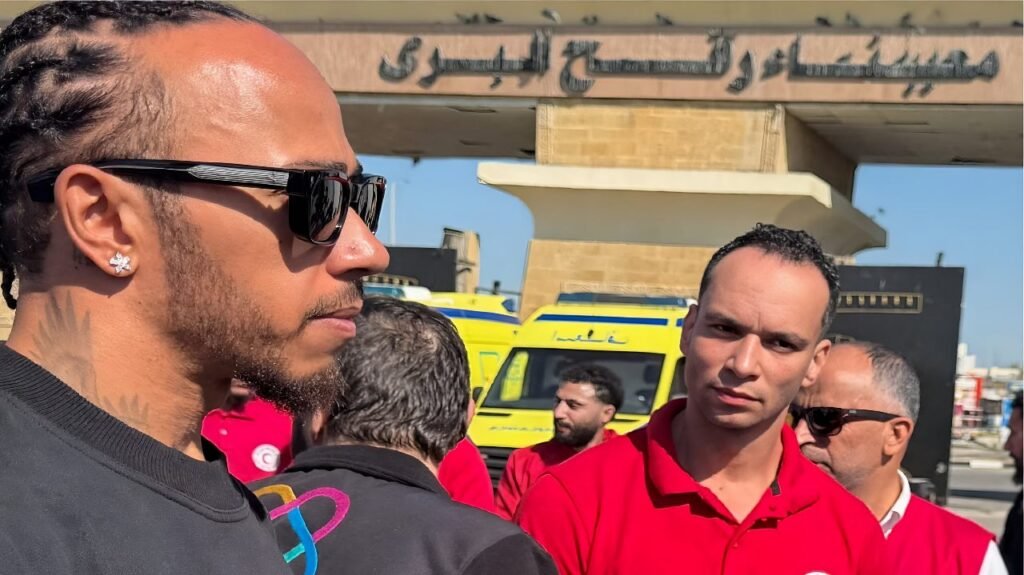
F1 champion tours El Arish humanitarian aid warehouses.
Seven-time Formula 1 world champion Lewis Hamilton arrived in El Arish, Egypt, on Tuesday to see how humanitarian supplies bound for Gaza are received, sorted and prepared. The Ferrari driver toured the Egyptian side of the Rafah border crossing and visited aid warehouses run by the Egyptian Red Crescent, according to the North Sinai governorate.
The trip placed one of motorsport’s most recognisable figures directly inside the logistics chain that moves relief supplies toward the border. For readers following Hamilton’s off-track work, the visit offers a clear picture of what the operation involves and why access to Gaza remains a pressing humanitarian question.
Hamilton Arrives in El Arish
Hamilton was received at El Arish International Airport by North Sinai Governor Khaled Megawer, who accompanied him to Rafah. The governor’s office said the programme was designed to let the driver learn about Egypt’s efforts to support the delivery of humanitarian assistance to the Gaza Strip.
Hamilton’s arrival marked the start of a structured visit rather than a ceremonial appearance. Footage released by the governor’s office showed him speaking with staff and asking about operational details, from how consignments are handled to how they are prepared for onward movement.
The itinerary combined the airport reception, the border-crossing tour and the warehouse visit into a single day in North Sinai. Authorities confirmed the programme through official channels and later shared images and video showing Hamilton with the governor and Red Crescent personnel near the crossing gates and ambulances.
Inside the Rafah Crossing Tour
At the Egyptian side of the Rafah crossing, Hamilton greeted aid workers and officials with the Arabic salutation “Assalamu alaikum” and shook hands with personnel on site. He also held brief conversations with staff about the daily demands of the work.
The visit remained entirely on the Egyptian side of the border, and Hamilton did not enter the Gaza Strip. Officials explained how supplies are handled before trucks carry them to the crossing, offering a close view of the preparation stages that rarely feature in public discussion of the crisis.
For a global audience, the significance lies in the detail. Humanitarian aid does not simply appear at a border gate. It must be received, sorted, packed, stored and coordinated among several agencies, and each stage depends on reliable access and clear communication.
Egyptian Red Crescent Aid Warehouses
The Egyptian Red Crescent warehouses in El Arish serve as a key logistics node for supplies intended for Gaza. Staff there receive, organise and prepare parcels that are then transported to the Rafah crossing, and Hamilton was shown each of these stages during his tour.
He received a detailed briefing on receiving, sorting, packing, storing and preparing relief aid before it is moved toward the border for delivery into the Gaza Strip. The governorate also highlighted Egypt’s role in facilitating medical care for injured or ill Palestinians arriving from Gaza, alongside the wider coordination of relief.
Hamilton reportedly saw aid parcels awaiting dispatch and discussed how often consignments move toward the border and which challenges slow them down. Those exchanges matter because frequency and predictability, rather than headline donation figures, often determine whether relief reaches communities on time.
Warehousing is among the least visible but most decisive links in any humanitarian supply chain. Without organised storage, accurate sorting and dependable transport, even generous donations can stall long before they reach the people who need them.
Gaza Humanitarian Aid Levels Remain Limited
Hamilton’s visit took place against a difficult backdrop. Aid volumes entering Gaza have consistently fallen short of the levels agreed under the ceasefire arrangements reached last year, and access constraints and operational challenges continue to limit the flow of essential goods, medicines and other supplies.
That gap matters because the preparation work Hamilton observed is only one part of a longer route. Warehouses can sort and pack consignments efficiently, but the pace of delivery ultimately depends on how freely and how quickly trucks can cross the border.
Egyptian officials presented the tour as an educational opportunity for a high-profile visitor, helping him understand the scale of the preparation required and the practical constraints involved in moving aid. Readers should note that these descriptions come from the governorate, while reporting on aid volumes continues to describe a persistent shortfall against agreed levels.
For donors, volunteers and humanitarian organisations, transparent reporting on each stage of the supply chain remains essential. Public figures who witness operations directly can help sustain attention on those details, provided the coverage stays accurate and grounded in verified information.
ALSO READ: Källenius Hails Mercedes Title as Engineering Feat
Hamilton’s Record of Humanitarian Advocacy
Hamilton, 41, has long used his platform to support humanitarian and social causes. In 2021 he founded Mission 44, a charity focused on improving educational and employment opportunities for young people from underrepresented backgrounds.
The Egypt trip follows his visit to Jordan in December 2025 with the British Red Cross. There he met Jordan Red Crescent and Palestine Red Crescent teams preparing supplies for Gaza and visited a hospital treating children evacuated from the territory. Taken together, the two trips show a consistent effort to see the operational side of aid work first-hand rather than rely only on secondary accounts.
Hamilton’s career has always extended beyond race results. From his early years as the first Black driver to compete in Formula 1 to his sustained advocacy on education and humanitarian issues, he has consistently directed public attention toward causes he considers important.
Hamilton’s day in North Sinai adds a practical chapter to his humanitarian record, showing that attention to logistics, access and verified facts is central to any serious discussion of aid for Gaza.