
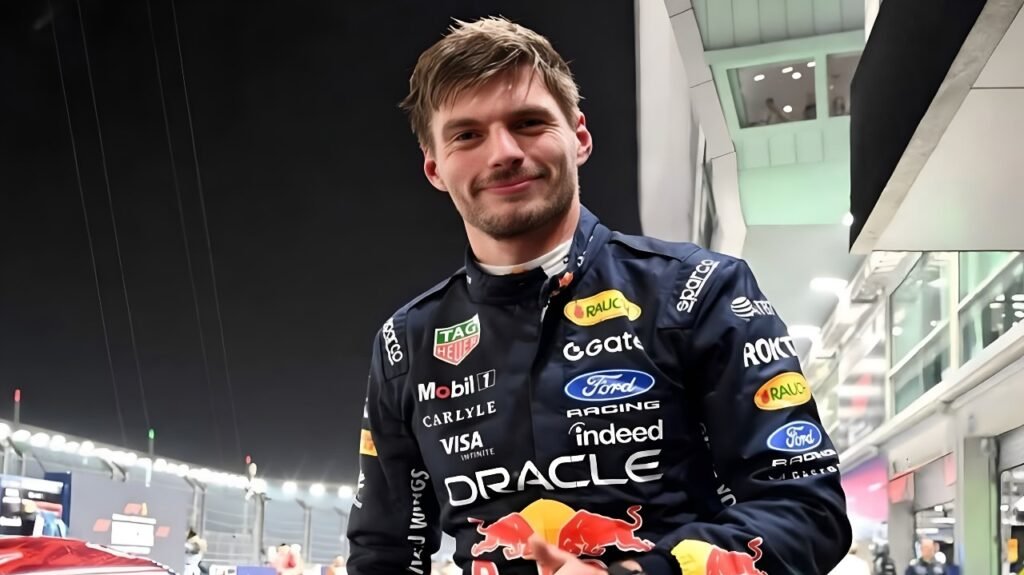
Red Bull star says Ferrari hierarchy prevents clashes.
Max Verstappen has said that, as a team principal, he would never employ two number one drivers. The Red Bull driver believes the first-lap skirmish between Ferrari teammates Lewis Hamilton and Charles Leclerc in Mexico showed why a clear hierarchy matters. The four-time world champion delivered his verdict during the São Paulo Grand Prix weekend, as reported by Crash.net, and his remarks have reopened one of the sport’s oldest strategic debates.
What Verstappen Said About Ferrari’s Drivers
Verstappen, who benefited directly from the Mexico incident, made clear that his view is not new. He acknowledged that many people disagree with him, but he restated the principle without hesitation: “I’d never get two ‘No 1’ drivers,” he said, explaining that such arrangements lead to moments like the one in Mexico. If he ran a team, he added, he would change the arrangement.
Verstappen’s reasoning centred on competitive psychology. Elite drivers, he explained, will not yield to a teammate when both believe they can win, and he admitted that he thinks the same way. That candour gives his argument weight: he is describing a trait he recognises in himself rather than criticising it in others.
The Case for a Clear Number One and Number Two
The Dutchman argued that a defined pecking order would have produced a far better outcome for the Italian team. In his view, Hamilton and Leclerc would have gone through the first corner in first and second place and finished that way. He also accepted a first-and-third finish, noting that a team still scores strong points in either scenario.
The argument rests on a simple premise: a team’s collective result should outrank an internal contest. By settling priorities in advance, Verstappen suggested, a team removes the uncertainty that can turn a shared first corner into a costly clash. It is a pragmatic view, and he says he has voiced it before.
Hamilton Says He and Leclerc Have Moved On
Hamilton has since addressed the matter. After talks with team principal Fred Vasseur in Brazil, the seven-time world champion said he and Leclerc had sat down, discussed the incident and agreed to move forward. He described the conversation as productive, saying the two drivers still hold a huge amount of respect for each other.
According to Hamilton, there have been no demands from either side. Each driver set out his own points and areas for improvement, and both agreed to support one another. Hamilton said he hopes for better races going forward.
Vasseur Insists Ferrari’s Guidelines Remain Unchanged
Vasseur addressed the situation separately. The Ferrari team principal stressed that the team’s guidelines are the same as before and have not been rewritten in the wake of Mexico. He acknowledged that some frustration may have built up because both drivers start each weekend side by side.
At the heart of the message, he said, is respect. The drivers are two competitors with fighting spirit, but they must respect each other, and above all the Ferrari brand, the team and the people working at home and at the track. Vasseur added that the team is putting considerable effort into the message, which he said will stay clear.
ALSO READ: Hamilton Visits Rafah Crossing, Sees Gaza Aid Work
Why the Ferrari Debate Matters for the Sport
The contrast between the two positions is instructive. Verstappen favours a formal hierarchy that removes ambiguity before a race begins. Ferrari, by Vasseur’s account, prefers a framework built on mutual respect between two competitive drivers, with the team’s interests placed above personal ambition. Both approaches seek the same objective, which is maximum points for the team, but they differ on how best to reach it.
The timing of the comments adds context. Verstappen was speaking as a driver who capitalised on the Mexico incident, so his words carry both authority and self-interest. Readers should weigh them accordingly. His record as a four-time world champion lends weight to his reading of driver psychology, yet he does not manage a team, and his proposal reflects an outsider’s view of Ferrari’s internal dynamics.
For Ferrari, the situation illustrates the challenge of managing two ambitious drivers who start each weekend side by side. Hamilton brings seven world titles, while Leclerc is a proven race winner for the team. Pairing two such competitors creates obvious rewards and real risks, as Mexico demonstrated.
Debates over team orders and driver status are not new in Formula 1, and they rarely produce a single correct answer. Supporters of a clear hierarchy point to the protection it offers against lost points. Advocates of equal treatment argue that it keeps both drivers motivated and gives the team the strongest possible chance to find the fastest competitor on a given weekend. Each side can claim merit, which is why the discussion endures.
What is clear from the latest exchange is that each voice frames the episode differently. Verstappen describes it as a structural flaw, Hamilton as a resolved misunderstanding, and Vasseur as a matter of respect within an unchanged framework.
Verified details in this report come from reporting by Crash.net, published on 11 November 2026. Attributed statements belong to the individuals named, and no further claims have been added beyond the published record.
The story is likely to remain a talking point as Ferrari and its drivers continue to race. Each result will be read through the lens of this debate, and every close battle between Hamilton and Leclerc will be scrutinised for signs of tension. Whether Ferrari ever adopts the hierarchy Verstappen prefers remains an open question, but the team’s public position is clear: the guidelines stand. Only the races ahead will tell.