
Mercedes chief says brands doubted Antonelli and missed out.
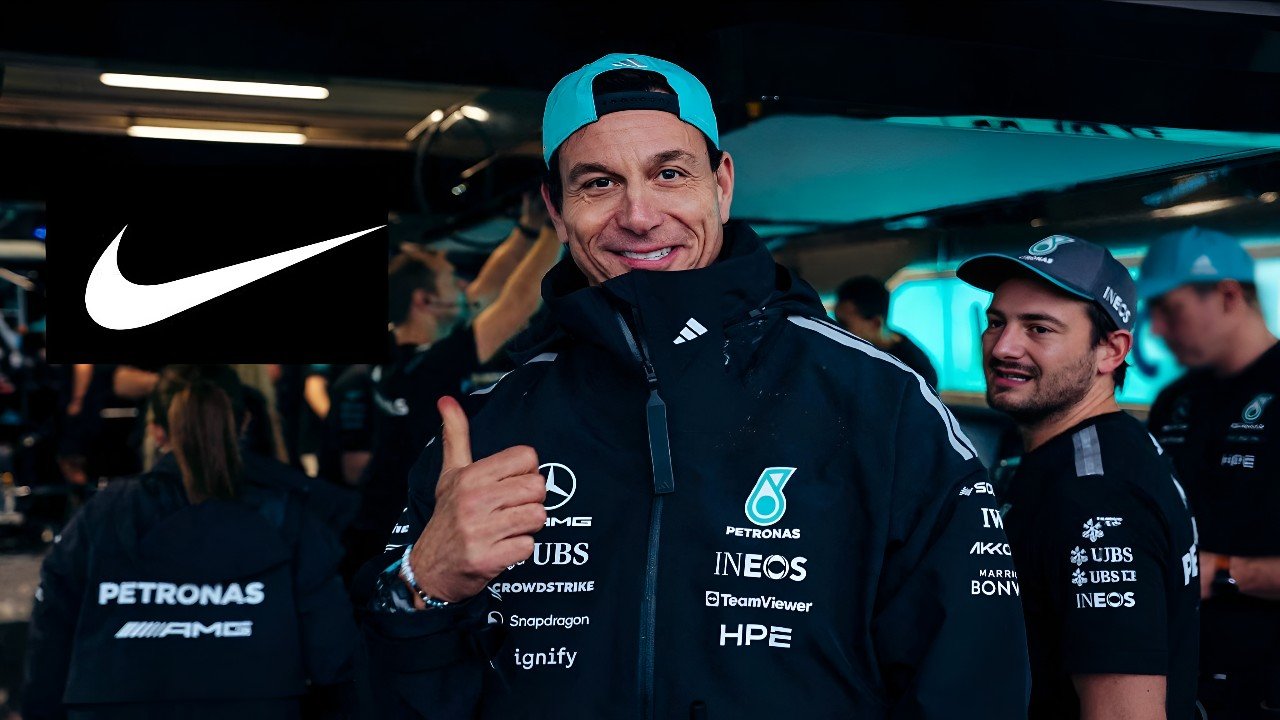
Toto Wolff has suggested that several sponsors chose not to partner with Mercedes after Lewis Hamilton’s departure and the arrival of Kimi Antonelli in 2025. The Mercedes team principal made the remarks in Las Vegas, speaking with evident amusement about a period of commercial doubt. Nike has been drawn into the conversation by later reporting, although Wolff himself did not name the company.
What Toto Wolff Said About Mercedes Sponsors in Las Vegas
Wolff explained that he had already raised the subject in Mexico, but he returned to it with evident humour. In his words:
“I already said this in Mexico, but I remember very clearly the moment when sponsors asked us who Kimi Antonelli was and told us they didn’t want to be part of this adventure because Lewis Hamilton had left. I have a bit of a laugh about that, because they clearly made the wrong decision. Now they’re with other teams… and have to settle for the results those teams are getting.”
The comments are notable for their directness. Wolff describes sponsors who questioned the identity of a young driver and who linked their commercial decisions to the exit of a seven-time world champion.
Nike, Mercedes and the Hamilton Effect on Sponsorship
Wolff did not name Nike directly. However, German reporting indicated that Nike had previously considered a deal with Mercedes largely because of Hamilton’s global appeal, and that interest faded once the driver moved to Ferrari.
Nike has since signed an official Formula 1 partnership that begins in 2027, and it has also been linked with Cadillac. The sequence illustrates how closely a driver’s profile can shape sponsorship strategy, and how quickly a brand’s priorities can change when a marquee name changes teams.
It is important to separate what is confirmed from what is implied. Wolff spoke in general terms about sponsors, while the link to Nike comes from reporting rather than from his own statement. Readers should treat the Nike connection as context, not as an admission from the team.
Earlier Revelations: Two Sponsors Left Over Antonelli’s Promotion
The Las Vegas remarks build on earlier comments. After Antonelli secured the 2026 title in Mexico, Wolff had already revealed that two sponsors left Mercedes over the decision to promote the young Italian, asking who this kid was supposed to be.
The known major departures from that period were Tommy Hilfiger and Puma. Adidas later joined as the team’s apparel partner.
Taken together, the two sets of comments present a consistent account. Sponsors hesitated when the team changed its driver line-up, and the team later moved on with new partners. The account is Wolff’s own, so it reflects his view of events and should be read with that in mind.
Antonelli’s Title Win Gives Wolff’s Words Added Weight
Antonelli is now the 2026 world champion and the youngest in the history of the sport, a fact that gives Wolff’s comments extra weight. The driver whom some sponsors questioned in 2025 has reached the summit of Formula 1, and the team that promoted him can point to that outcome as evidence for its decision.
That context explains the tone of the Las Vegas remarks. Wolff was not simply recalling a commercial disappointment. He was commenting on a decision that, in his telling, looked cautious at the time and now looks mistaken. Sponsors who stepped away, he said, are now with other teams and must accept the results those teams deliver.
The story also shows how a single transition can reshape a team’s commercial landscape. Hamilton’s move to Ferrari ended one of the most visible partnerships in the sport. Antonelli’s promotion began another, and the reaction from the market was far from uniform. Some partners hesitated, while others, including Adidas, chose to join.
ALSO READ: Wolff Sees Big Cinema in Verstappen v Russell Duel
What This Means for Formula 1 Sponsorship Strategy
For brands, the episode offers a practical lesson. Sponsorship decisions tied heavily to one driver carry risk, because a departure can alter the value of a deal overnight. Teams, for their part, must reassure partners that their commercial proposition rests on more than a single personality.
Mercedes appears to have absorbed that pressure successfully. The team promoted a young driver, accepted the loss of some partners, welcomed Adidas, and then watched Antonelli claim the championship. Whether the sponsors who departed will regret their choice is a matter of opinion, but Wolff has made his own view clear.
Nike’s position is the clearest example here. According to the reporting referenced above, the company’s interest in Mercedes was tied to Hamilton, and its later Formula 1 partnership and Cadillac link show that its attention to the sport did not disappear. It simply moved elsewhere.
Readers following the Mercedes story should note the distinction between the facts on the record and the interpretation around them. On the record are Wolff’s own words, the departures of Tommy Hilfiger and Puma, the arrival of Adidas, and Antonelli’s championship. The reported Nike interest is context supplied by reporting.
The Mercedes case also highlights how quickly the narrative around a young driver can change in Formula 1. A driver questioned by potential partners in one season can be celebrated as a champion in the next, and the commercial conversation follows the results on track.
As the 2026 season closes, Wolff’s comments will likely be remembered as a pointed reminder to the paddock that sponsorship caution can carry a cost. Whether other partners now seek to join Mercedes is a question for the coming months. For now, the Mercedes sponsorship story is inseparable from the success of the driver whom some partners once doubted.