

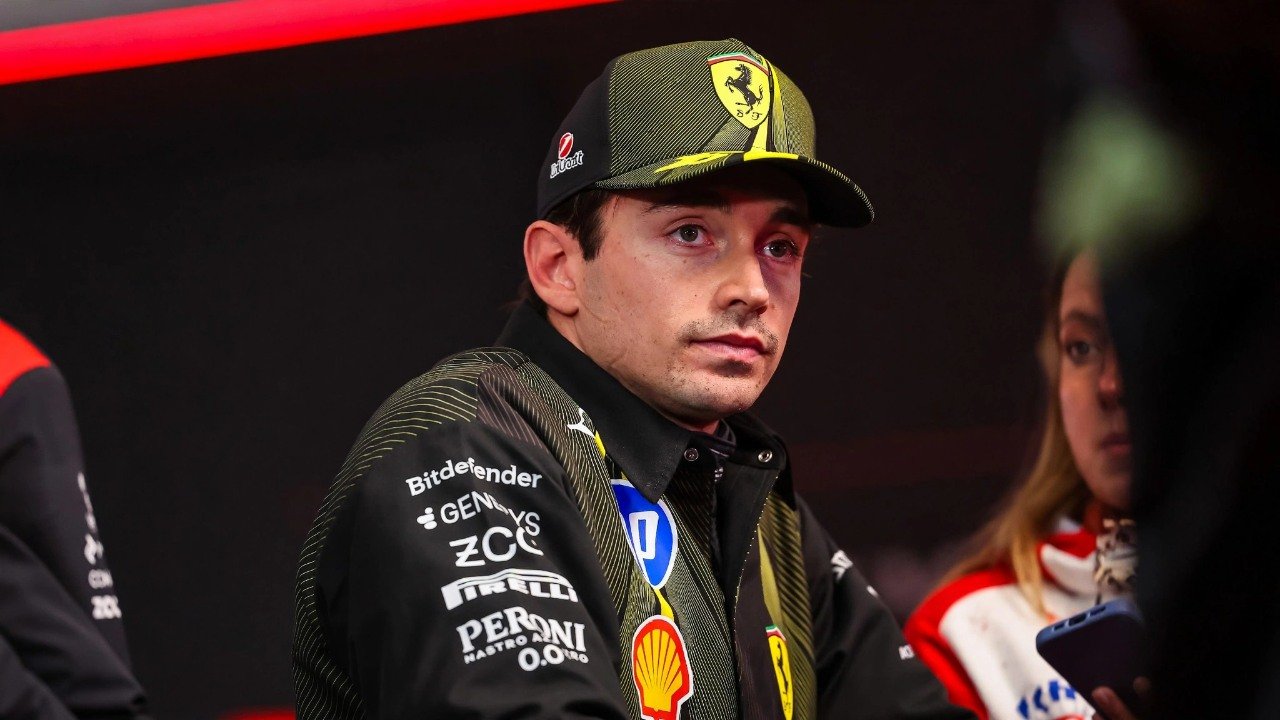
Ferrari Assesses Las Vegas Clash After the 10-Second Penalty
Charles Leclerc has accepted full responsibility for his collision with Ferrari teammate Lewis Hamilton during the 2026 Las Vegas Grand Prix, describing himself as “embarrassed for the team” after a 10-second time penalty dropped him to tenth place. The incident adds another uncomfortable chapter to a season in which Ferrari has now had to address contact between its two drivers more than once.
What Happened on Lap 38 at Turn 7
The collision occurred on lap 38 at Turn 7. Leclerc attempted an inside overtake on Hamilton, who was busy fighting a McLaren ahead of him at the time. Contact between the two Ferrari drivers spun Hamilton around, and after reviewing the move, the stewards judged Leclerc wholly at fault.
Why the Stewards Penalised Leclerc
The stewards’ reasoning rested on the FIA Driving Standards Guidelines. Leclerc started his move from a considerable distance behind Hamilton, and at the apex his front axle was not alongside Hamilton’s mirror. Under those guidelines, that meant he had not earned the right to the corner. In practical terms, a driver attempting an inside overtake must be sufficiently alongside before the apex to claim that space; without that overlap, the driver attacking from behind carries the responsibility for avoiding contact.
This explanation matters because the margin between a bold overtake and an avoidable collision is often a matter of a few metres. Leclerc believed the space was there, yet the stewards’ conclusion was that his position on the track did not support his claim to the corner. The distinction between feeling there is room and having earned it under the guidelines sits at the heart of the penalty.
Race Result and Penalty Impact
On the road, Leclerc finished the race in a stronger position. However, the 10-second penalty was added to his final time, and that adjustment left him classified tenth. For a team of Ferrari’s ambitions, losing places through an avoidable incident between teammates carries a cost that goes beyond a single driver’s result.
A time penalty works by being added to a driver’s race time after the chequered flag, which is why Leclerc’s position on the road did not match his final classification. In Las Vegas, that adjustment moved him down to tenth and reduced what Ferrari took from the weekend.
Hamilton, for his part, recovered to finish seventh. He had earlier served a 10-second penalty of his own for leaving the track and gaining an advantage while overtaking Lando Norris, so his race was already under pressure before the contact with his teammate came along.
Leclerc’s Response and Ferrari’s Reaction
Speaking to the media after the race, Leclerc made clear that he would not contest the stewards’ decision. He acknowledged that the penalty reflected the view that the mistake was his, and added simply, “I’ll accept that.”
Leclerc explained that he believed there was room on the inside because Hamilton was occupied with the car ahead. He suggested, however, that Hamilton may not have seen him because of the angle of his car. He was careful not to shift responsibility, saying he did not want to blame his teammate and instead felt very bad for the team once again. He described himself as “quite embarrassed for the team in general” and confirmed that Ferrari would review the incident.
Team principal Fred Vasseur did not soften his assessment, calling the clash “completely unacceptable.” He stressed that the message following the earlier incident in Mexico, and the team discussion that took place afterwards in Brazil, had been clear: when racing each other, the drivers must put the team first.
Vasseur said Leclerc’s mistake heavily penalised Ferrari, adding that the team was “more than upset.” The repeated nature of the contact, which Leclerc himself acknowledged by saying he felt bad for the team again, explains why the reaction from the pit wall was so firm.
ALSO READ: Wolff Mocks Sponsors Who Walked Away From Mercedes
Verstappen Wins as Ferrari Looks Ahead
Away from the Ferrari drama, Max Verstappen won a chaotic race for Red Bull. McLaren’s Lando Norris and Oscar Piastri completed the podium, giving the team two of the three top places, while Ferrari left with a disappointing outcome.
The episode highlights a challenge that every top team must manage: giving two elite drivers the freedom to race while protecting the collective result. Ferrari’s message was plainly that the second part of that balance had not been respected. Leclerc’s own admission that he felt bad for the team again indicates he understands the weight of the situation.
For Hamilton, it was a demanding race. He had already served a penalty of his own before being spun around by his teammate, and seventh place therefore reflects a recovery drive rather than a clean run.
Ferrari’s internal review will now be closely watched. Leclerc confirmed the team would go through the incident, and Vasseur’s comments suggest the conversation will centre on how the two drivers approach wheel-to-wheel situations against each other. Any further contact would only deepen scrutiny of how Ferrari manages its drivers in direct battles.
In summary, the key facts are clear. The collision happened on lap 38 at Turn 7. The stewards judged Leclerc wholly at fault under the FIA Driving Standards Guidelines. Leclerc received a 10-second penalty and finished tenth, Hamilton finished seventh, Vasseur called the clash “completely unacceptable,” and Verstappen won the race with Norris and Piastri completing the podium.
For Ferrari, the priority now is clear: turn Leclerc’s public accountability and Vasseur’s firm message into a more disciplined approach the next time the two drivers meet on track. Words must now be matched by clear action on track.