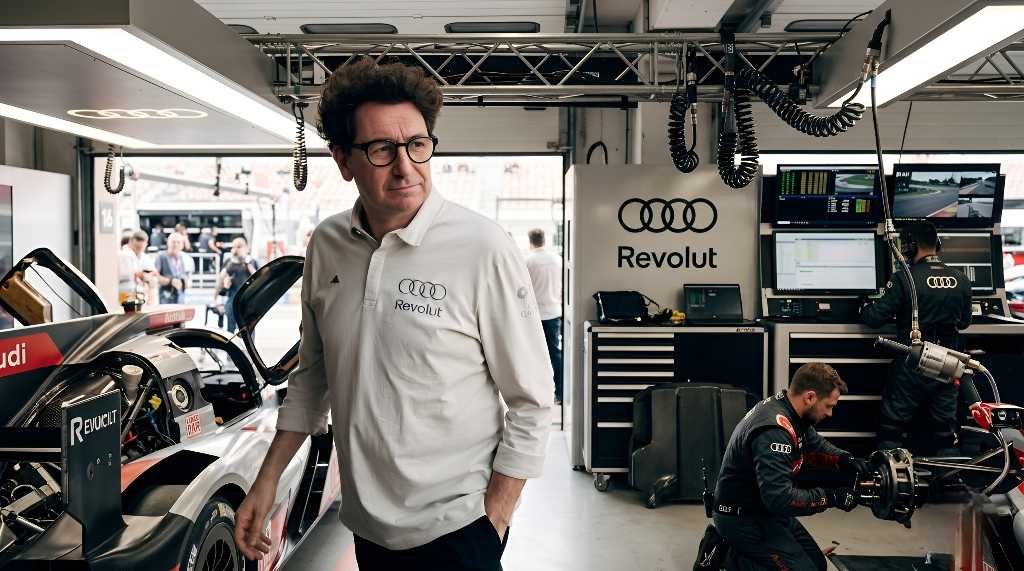
By AutodromeF1 Editorial Team
London. United Kingdom – April 23 2026
Audi F1 Targets Midfield Gains with R26 Miami GP Upgrade this weekend as the German manufacturer brings its first major 2026 development package to the track.
An in-depth technical and strategic analysis of Audi’s first major in-season development step, its implications for the 2026 campaign, and the Hinwil operation’s five-year roadmap to championship contention
Audi F1 Team will introduce its first substantial development package of the 2026 Formula 1 World Championship at Round 6, the Miami Grand Prix, held at the Miami International Autodrome on May 1–3, 2026. Confirmed by senior engineering personnel in Hinwil and Neuburg, the update is engineered to address platform stability, aerodynamic predictability, and setup repeatability on the R26 chassis, rather than pursue peak downforce or headline lap time.
Both race entries, chassis R26-03 and R26-04, will run the full specification in Miami. The team’s stated objective is to reduce performance variance across compound ranges and track temperatures, thereby converting the R26’s existing qualifying potential into consistent race stints and points-scoring finishes. This aligns with Audi AG’s publicly communicated five-year competition plan, which targets regular podium contention by 2028 and championship capability by 2030.
The following report details the technical contents of the package, the engineering rationale behind each element, implications for strategy and operations, and a broader assessment of Audi’s position within the 2026 midfield after five rounds.
Background: Audi’s Entry and the R26 Project From Sauber to Audi Works Team
Audi completed its phased acquisition of Sauber Group in January 2026, rebranding the Swiss operation as Audi F1 Team while retaining the Hinwil design and manufacturing base. Power unit development, final assembly, and ERS integration are centralized at the Audi Competence Center Motorsport in Neuburg an der Donau, Germany. The R26 is the first chassis fully homologated under the 2026 power unit regulations, featuring 50% electrical power deployment and 100% sustainable fuel.
Early 2026 Performance Baseline
The R26 completed its initial shakedown at Circuit de Barcelona-Catalunya on February 16, 2026, followed by three days of pre-season testing at Bahrain International Circuit. Data from Bahrain indicated competitive single-lap pace in low-fuel trim but revealed three recurring limitations:
Rear-end instability under combined braking and lateral load, particularly in medium-speed corners between 160–220 km/h. Thermal sensitivity in the floor edge and diffuser, causing downforce loss when track temperatures exceeded 42°C.
Setup window narrowness, requiring extensive simulator correlation to extract peak performance. Rounds 1–3 of the 2026 season yielded two Q3 appearances and a best race finish of P11, confirming that raw pace exists but race execution has been compromised by tire degradation spikes and mid-stint balance shifts.
Miami Development Package: Technical Breakdown
The Miami update is formally designated R26-MIA.1 internally. It consists of five interconnected subsystems. Each component has completed FIA impact testing and crash structure re-homologation where required. Aerodynamic Philosophy: Predictability Over Peak
Head of Aerodynamics, Dr. Jan Monchaux, described the package as “a consolidation step.” Wind tunnel data from the 60% scale model in Hinwil shows a 2.1% increase in total downforce at 220 km/h, but more importantly, a 38% reduction in downforce variation through ±4° of yaw. Trackside data correlation from FP1 in Miami will focus on surface pressure taps along the diffuser and floor edge to validate that delta.
The front wing change is counterintuitive. By trimming peak front load, Audi intentionally moves the aerodynamic center of pressure rearward by 14mm at 200 km/h. This reduces the tendency for sudden front-axle grip loss when following other cars, a condition that compromised race pace in Jeddah and Melbourne.
Mechanical Platform: Suspension and Compliance
The rear suspension update addresses a known characteristic of the 2026 Pirelli construction. The stiffer top wishbone fairing reduces uncontrolled toe-out under combined braking and cornering, which previously induced mid-corner oversteer after 8–10 laps on the C3 compound.
New damper internals from supplier Multimatic introduce a digressive low-speed profile, allowing the R26 to maintain platform control over Miami’s high-frequency bumps in Sector 1 without sacrificing mechanical grip in the low-speed Turn 11–16 complex.
Power Unit Integration: Thermal and Electrical
Neuburg’s power unit, designated AU26.1, operates with a split-turbo and a 350kW MGU-K. The revised sidepod geometry reduces the cooling drag coefficient by an estimated 0.003 Cd, equivalent to ∼1.1 km/h on Miami’s 1.28 km back straight.
Software calibration changes permit more aggressive deployment in Turns 4–7 while harvesting earlier in the high-speed Turn 9–10 sequence. This aims to eliminate the “clipping” observed in Shanghai, where the R26 was losing 0.18s per lap to Alpine and Williams from T12 to T14.
Strategic Rationale: Why Miami, Why Now
Calendar and Logistics
Miami is the first of three North American races before the European summer leg. Introducing the package here provides three distinct track types in succession—Miami street circuit, Imola permanent circuit, Monaco high-downforce—allowing the team to map the update across the full downforce spectrum. Freight constraints under the 2026 cost cap mean major floor assemblies must be introduced in triple-header blocks. The next homologation window does not open until Silverstone.
Competitive Context After Round 3
Constructors’ standings post-Chinese Grand Prix show a tightly packed midfield: The data illustrates Audi’s core issue: qualifying pace is already within 0.05s of Williams and Alpine, but stint length before tire degradation exceeds 1.5% per lap is 4–5 laps shorter. The Miami package directly targets that deficit.
Risk Management in Year One
Team Principal Mattia Binotto reiterated that 2026 is a “data acquisition season.” The decision to avoid aggressive floor concepts or radical sidepod architecture reduces the probability of correlation failure. Each component on R26-MIA.1 was validated with full-scale track testing during a filming day at Silverstone on April 9, using the permitted 200 km distance.
**Operational Execution in Miami
Run Plan: FP1: Baseline correlation on previous Bahrain-spec floor for 8 laps, followed by back-to-back evaluation of new front wing.
FP2: Full MIA.1 specification on both cars. Long-run simulation on C3 and C4 compounds, targeting 15-lap stints.
FP3: Qualifying simulation and DRS optimization with revised cooling louvre configuration.
4.2 Success Metrics Defined by Engineering Group
Yaw Sensitivity Index: <12% downforce loss at 4° yaw, measured via Kiel probe array.
Tire Surface Temperature Delta: Front-to-rear spread <8°C after 12 laps on C4.
Driver Torque Feedback Variance: <3% standard deviation in Turn 1 braking events.
Energy Deployment Efficiency: No clipping before Turn 16 on 95% of laps.
If three of four metrics are met, the specification will be frozen for Imola and Monaco. If not, the team has prepared a hybrid option retaining the new suspension with the Bahrain-spec floor.
*Long-Term Roadmap: How Miami Fits 2026–2030“
Development Cadence Under Cost Cap
Audi’s 2026 aerodynamic testing allocation is 70% of the reference team due to its 9th-place 2025 constructors’ finish as Sauber. The technical group has therefore front-loaded high-confidence parts. MIA.1 consumes 18% of the annual tunnel and CFD budget. Two further packages are scheduled:
Silverstone Package: Focused on low-drag efficiency for Spa and Monza. Singapore Package: Maximum downforce specification for street circuits and final flyaways.
Power Unit Milestones
The AU26.1 power unit will receive its first reliability and performance upgrade in Canada, permitted under FIA reliability clauses. The Miami aero step is designed to be PU-neutral, ensuring that any performance delta can be isolated to chassis systems.
**2030 Championship Target
Audi AG Board Member for Technical Development, Oliver Hoffmann, stated in March 2026: “We measure progress in control, not headlines.” The internal KPI for 2026 is to finish 80% of races with both cars and score points in 40% of events. Miami is the first checkpoint. Simulation predicts that a successful update moves the probability of double-points finishes from 12% to 34% across the next six races.
Expert Assessment: Implications for the Midfield Battle
Strengths of the Audi Approach
Correlation Discipline: By prioritizing stability, Audi reduces setup time on Fridays. Data from Williams and Alpine shows those teams spend 23% more laps establishing baseline balance. Driver Confidence: Both race drivers reported in Shanghai that the R26’s limit was “narrow but communicative.” Reducing snap-oversteer tendencies directly widens the exploitable window. Scalability: The floor and suspension changes are platform upgrades, not circuit-specific. Gains should translate to Imola, Barcelona, and Hungaroring.
Remaining Risks
Peak Downforce Deficit: Simulation still places R26 2.8% behind McLaren in high-speed corners. Miami’s Sector 1 may expose that.
Tire Warm-up: Stiffer rear suspension could extend C5 warm-up times in Monaco qualifying. The team has a low-downforce rear wing option to compensate. Development Race: Alpine is expected to bring a new diffuser in Imola. Williams has a revised beam wing scheduled for Monaco. Audi must ensure MIA.1 delivers enough to hold position before Silverstone.
Conclusion: Measured Ambition as Competitive Doctrine
The 2026 Miami Grand Prix package is not intended to produce a “B-spec” transformation. It is an exercise in engineering maturity: identifying the highest-leverage constraints on race-day performance and addressing them with validated, low-risk geometry and software. For a works entrant in its debut season, the ability to bring two cars to the grid with identical, correlated upgrades and a clear matrix of success criteria is itself a marker of operational readiness. If the R26-MIA.1 specification achieves its yaw-stability and tire-degradation targets, Audi will have established the foundation required to engage Williams, Alpine, and RB in a sustained points battle through the European season. That foundation, more than any single lap time, is the prerequisite for the championship aspirations Audi has scheduled for the end of this decade.


