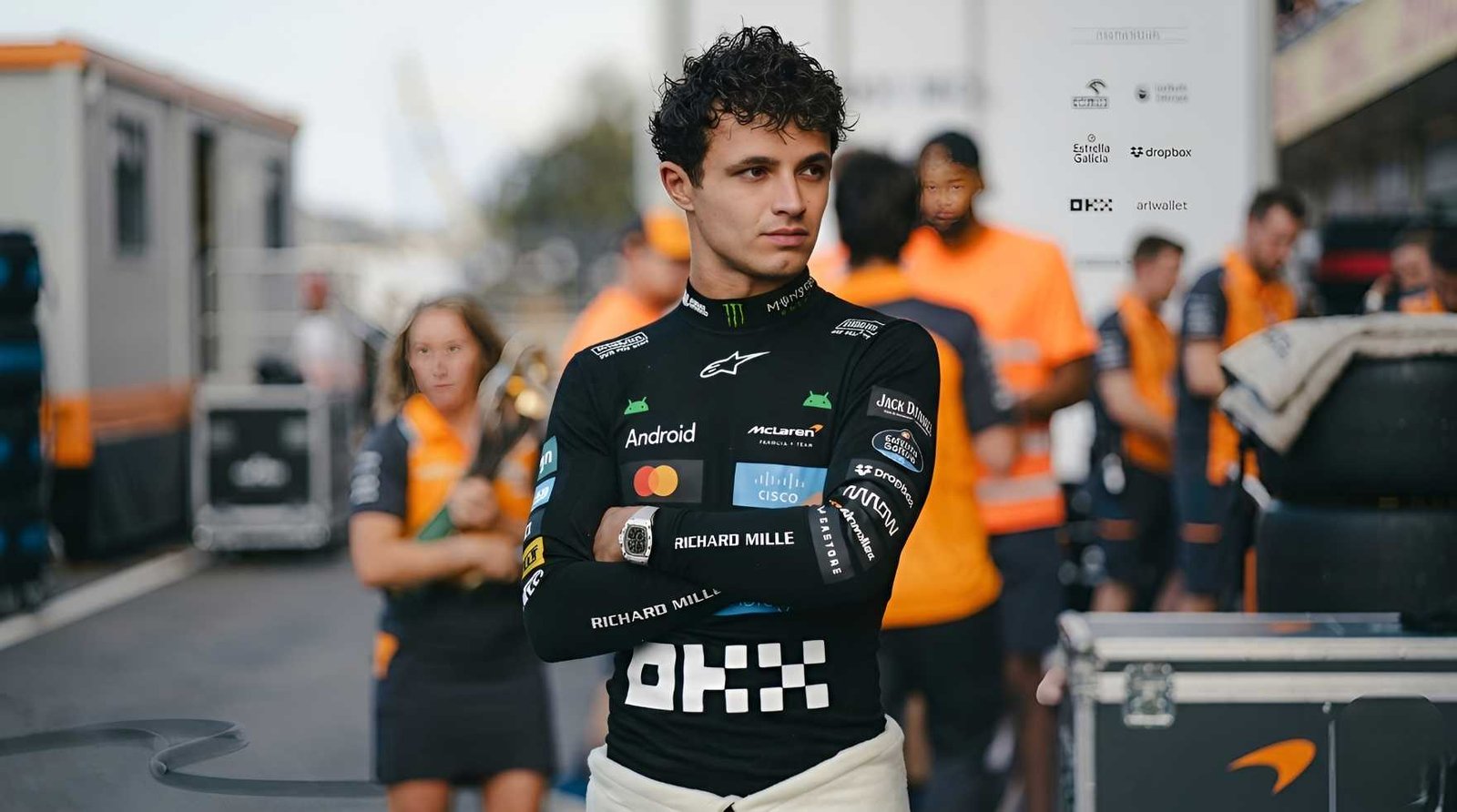
London, United Kingdom — April 15, 2026
Published by: AutodromeF1 Editorial Team
DECK: Amid a subdued opening to Formula 1’s new regulatory era, reigning World Champion Lando Norris has delivered McLaren’s most emphatic statement of intent yet, reaffirming that the Woking-based squad remains “fully committed to fighting for the 2026 Formula 1 championship” despite ceding early ground to Mercedes and Ferrari. The declaration comes as the team navigates power unit teething issues and a revised aerodynamic philosophy, but leverages a battle-tested development pipeline that reversed deficits exceeding 150 points in prior seasons.
The State of Play: New Rules, Familiar Resolve
The 2026 Formula 1 season arrived with the most comprehensive technical reset since 2014. A 50/50 split between internal combustion and electrical deployment, active aerodynamics, sustainable fuels, and reduced drag targets have reshuffled the competitive order. For McLaren, the transition has been anything but smooth.
Through the first four rounds in Bahrain, Saudi Arabia, Australia, and Japan, McLaren sits fourth in the Constructors’ Championship, 73 points adrift of leaders Mercedes AMG Petronas and 41 behind Scuderia Ferrari. On paper, the MCL40 has qualified no higher than the third row and has yet to lead a lap in Sunday competition. The primary deficit traces to energy deployment calibration and high-speed cornering stability, two areas where the new Mercedes HPP and Ferrari power units have demonstrated early maturity.
Yet if history is any indicator, writing off McLaren in April has become a precarious proposition.
Lando Norris, speaking exclusively after post-race debriefs in Suzuka, was unequivocal:
“The team remains fully committed to fighting for the 2026 Formula 1 championship. We know where we are right now, and we know why. That’s not the same as accepting it. The plan is podiums, then wins, and that comes through upgrades. We’ve done this before. We’re not shifting people or wind tunnel time to 2027. The title is this year.”
The statement lands with weight because Norris is not merely the team’s lead driver. He is the reigning Drivers’ World Champion, having secured McLaren’s first drivers’ crown since 2008 by overturning a 117-point mid-season deficit to Max Verstappen in 2025. His authority on turnarounds is earned, not theoretical.
Slow Start Context: Deconstructing the Deficit
To understand McLaren’s position, it is necessary to separate symptoms from structure.
Power Unit Integration
The 2026 regulations mandate a near-even split in propulsion between the 1.6-liter V6 turbo and the MGU-K, with total system output capped at approximately 1,000 horsepower. McLaren continues its customer partnership with Mercedes-AMG High Performance Powertrains. While the ICE element is spec-identical to the works team, integration, cooling, and software mapping are chassis-specific.
Sources within the paddock indicate McLaren’s initial packaging prioritized aerodynamic efficiency, resulting in compromises to battery cooling. The consequence has been intermittent clipping at the end of straights in Jeddah and Melbourne, costing an estimated 0.15–0.20 seconds per lap. Team Principal Andrea Stella addressed this in a technical briefing: “We are deployment-limited in specific race scenarios. It is a solvable problem, and the fix is in the pipeline for Miami.”
Aerodynamic Platform
The return of active aerodynamics has reintroduced movable front and rear wing elements to reduce drag on straights and increase downforce in corners. McLaren’s concept launched with a conservative front-wing authority range to ensure drivability. Data from Bahrain and Suzuka shows the MCL40 generates peak downforce comparable to Ferrari, but bleeds performance in the 180–250 km/h window where the active elements transition.
Operational Execution
Unlike 2023, reliability has not been the headline issue. Both Norris and teammate Oscar Piastri have finished every Grand Prix. The deficit is performance-based, not points left on the table. This distinction matters. As Stella noted, “You can develop speed. You cannot develop reliability on the same curve.”
Norris emphasized patience during the same media session: “People see P5 and P6 and think the season is done. That’s not how it works anymore. With the cost cap and ATR sliding scale, the team that learns fastest wins. We were fifth-fastest in Bahrain 2023. We were winning by Silverstone 2024. The gap today is smaller than it was then.”
Past Turnarounds: The McLaren Case Study
Norris’s confidence is anchored in precedent. McLaren’s trajectory since 2023 represents one of Formula 1’s most documented in-season recoveries.
2023 Baseline:
After the first eight races, McLaren had scored 17 points and sat sixth in the Constructors’ standings, 154 points behind Red Bull. The MCL60 was plagued by drag and low-speed traction issues.
2024 Transformation:
A comprehensive upgrade introduced at the Austrian Grand Prix, followed by iterative packages at Silverstone and Zandvoort, repositioned McLaren as the benchmark. From Austria onwards, Norris and Piastri combined for 12 wins, 9 pole positions, and 24 podiums. McLaren overhauled a 115-point deficit to Red Bull to win the Constructors’ Championship by 42 points. Norris clinched the Drivers’ title in Las Vegas, having been 117 points behind Verstappen after Miami.
2025 Consolidation:
Under stable regulations, McLaren started strongly and defended both titles. The MCL39 proved to be the most aerodynamically efficient car in dirty air, allowing Norris to win 10 Grands Prix.
The through-line across these seasons is infrastructure. McLaren’s new wind tunnel, commissioned in mid-2023, and its state-of-the-art simulator came online in late 2023. The 2026 car is the first designed entirely with those tools. Technical Director Rob Marshall, who joined from Red Bull in 2024, leads a structure that Stella describes as “decentralized but aligned.” The result is a development hit-rate that, per independent analysis by Race Tech Journal, delivered an average of 0.12 seconds per upgrade package in 2024 versus a paddock average of 0.07 seconds.
This is why Norris’s refusal to pivot resources to 2027 is strategically significant. Under F1’s Aerodynamic Testing Restrictions, the 10th-place team receives 115% of the baseline wind tunnel and CFD allowance, while the 1st-place team receives 70%. As defending champions, McLaren has the lowest ATR allocation. Diverting to 2027 would concede 2026 while failing to gain a substantial development advantage for the future.
Technical Roadmap: What Changes and When
McLaren’s recovery plan is phased, with major floor and sidepod geometry scheduled for the Miami Grand Prix, followed by a revised rear suspension in Imola and a power unit software step in Barcelona.
Table: McLaren’s Announced 2026 Development Timeline
The Miami package is critical. Internal simulations suggest it will place the MCL40 within 0.1 seconds of Mercedes in qualifying trim. Stella cautioned that correlation must be proven on track: “The wind tunnel says one thing. The stopwatch says another. Miami will tell us if we’ve understood the new aero structures.”
Piastri, who finished P4 in Suzuka after a late safety car, corroborated the timeline: “The numbers look good. We’ve been here before where the factory delivers. My job is to keep scoring so that when the car steps, we’re in range.”
The Championship Calculus: Why 2026 Is Still Alive
Formula 1’s 24-race calendar and the 2026 points structure mean deficits are less terminal than they appear in April.
Points Available
With 20 races remaining, 500 points are available for a driver in Grands Prix alone, plus 160 from Sprint events and 20 from fastest laps. McLaren is 73 points behind Mercedes in the Constructors’ standings. In 2024, they closed 115 points in 14 races.
Development Ceiling
The new regulations are immature. The rate of gain across the grid is steep. A team that finds 0.5 seconds in three races can vault from P7 to P1. Mercedes Technical Director James Allison admitted in Japan, “No one has this right yet. The car that wins in Abu Dhabi will look nothing like the car in Bahrain.”
Cost Cap and ATR
Because McLaren won in 2025, its ATR is restricted. However, the cost cap prevents rivals from outspending their way out of trouble. Development becomes an efficiency contest, and McLaren’s 2024 hit-rate suggests it is among the paddock’s most efficient operators.
Driver Execution
Norris leads all drivers in points scored from P6 or lower on the grid since 2024. His 2025 title was built on minimizing losses during uncompetitive weekends. With Piastri now a proven race winner, McLaren has two drivers capable of converting upgrades into 40+ point weekends.
*Rival Response and Paddock Sentiment
Mercedes Team Principal Toto Wolff was asked about Norris’s comments in Suzuka. His reply was measured: “You never discount McLaren. We saw what they did in ’24. The regulations are new for everyone. If they fix deployment, they’re in the fight. Our job is to make sure we keep developing too.”
Ferrari’s Fred Vasseur echoed the sentiment: “The championship is 24 races. We are four in. Anyone who thinks it is over does not understand modern F1.”
Red Bull, currently third, faces its own integration challenges with the Ford-backed Red Bull Powertrains unit. Christian Horner noted, “McLaren’s strength is that they know how to lose time and find it again. That’s a skill.”
The Norris Factor: Leadership Beyond Lap Time
Since assuming de facto team leader status in 2024, Norris has reshaped his public and internal role. Gone is the self-deprecating tone of 2021–2022. In its place is a driver who sets technical direction in debriefs and demands accountability.
McLaren Racing CEO Zak Brown summarized it: “Lando is not just driving the car. He’s driving the program. When your World Champion says we’re all-in on 2026, the factory runs through walls.”
Norris himself framed it in terms of legacy: “We didn’t work for 10 years to get back to the top just to take a year off because the first four races were hard. That’s not how McLaren does it. That’s not how I do it.”
Outlook: From Suzuka to Abu Dhabi
The next sequence of races favors McLaren’s planned upgrades. Miami’s mix of long straights and medium-speed corners will test the deployment fix. Imola and Barcelona are aerodynamic benchmarks. If the MCL40 is within 0.2 seconds by Spain, the title narrative changes entirely.
The team’s messaging is deliberate. By refusing to discuss 2027, McLaren is signaling to sponsors, staff, and rivals that the project has no off-ramp. It is also a message to its drivers. Piastri is out of contract at the end of 2026. Norris is signed through 2028. Demonstrating commitment now is retention strategy as much as performance strategy.
Conclusion: Commitment as Strategy
Formula 1 championships are not won in April, but they can be lost by the decisions made in April. McLaren’s decision is to fight.
The data supports the ambition. The history validates the method. The driver delivering the message has the credibility of having done it before.
As Norris concluded in Suzuka, “We’re not here to make up the numbers. We’re here to win. The upgrades are coming. The plan is working. See you on the podium.”
For a team that turned a 154-point deficit into a championship within 15 months, a 73-point gap with 20 races left is not a crisis. It is a problem. And McLaren, by its own admission, is a team that solves problems.


